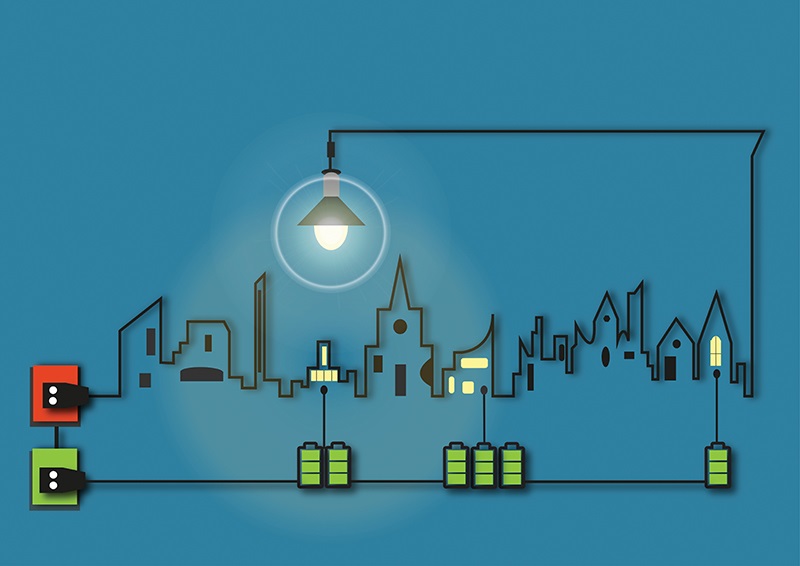
Not so long ago, the idea of a self-powered campus or data center that could provide self-sustaining electricity during a blackout, without missing a beat, was futuristic. Today, that expectation is the standard. As campuses, healthcare networks and data centers seek to find more resilient, efficient and sustainable energy models, solar-powered and natural gas microgrids are stepping up to lead the charge (pun intended).
Resilient energy for campuses
These systems don’t run on batteries and solar panels by themselves. Behind every load shift and power transfer is a layer of integrated systems, redundant conduit runs and control panels installed by electrical contractors. Electricians are enabling smart, responsive energy by bringing insight directly into the infrastructure. At a high level, a microgrid is fairly simple: generate power locally, store it and use it when the power goes down. But when you start managing multiple buildings, dozens of loads and shifting grid conditions, the complexity increases.
Microgrids rely on an advanced control system and integrated sensors to function in real time—balancing loads, isolating the buildings from the utility grid and prioritizing systems to an individual building’s specific needs. These smart systems depend on real-time data input such as current transformers (CTs) to measure load conditions, voltage taps to monitor utility versus local power generation, temperature sensors to protect and monitor batteries and gear, occupancy sensors to reduce nonessential demand, and breaker level monitors that detect faults or trip history. If those data points aren’t available, the system can’t make timely, informed decisions. As one project engineer told me, “You can’t build intelligence after the fact. If you don’t wire for data early, you’re flying blind.”
For example, a recent 500,000-square-foot healthcare campus project with multiple wings and critical processes such as labs and imaging suites has a microgrid design that includes a solar array on the main roof charging a 1.2-megawatt-hour (MWh) battery system, a generator backup with smart transfer switches and priority-based load shedding. None of this would matter without the infrastructure to measure and control it.
There are CTs on all distribution panels, modbus cabling from load centers to controllers, voltage sensing on the utility and solar main, zone-based occupancy and lighting control sensors as well as prefabricated sensor junction boxes labeled and kitted per floor. Instead of only running EMT and pulling wire, crews integrated automation and telemetry into the backbone of the system. It’s wiring that talks back.
Preconstruction opportunities
Microgrid-ready system installs succeed or fail during the preconstruction process. Without early coordination, identifying critical pathways for signal cable, sensor junctions and already crowded panel space gets missed. The VDC team models every sensor, data route and junction box, a coordination process that enables clash detection and supports clean commissioning. That process alone can make all the difference.
When the control teams arrive for commissioning, they will not need to ask where their CTs were or how trace signal lines cross the building. It has all been modeled, labeled and tested. A VDC coordinator put it this way: “Sensors are no longer accessories. They’re essential components. If you treat them like extras, you’re setting up the project to fail.”
Once installed and commissioned, these systems generate a steady stream of data. Users are able to monitor smart dashboards that show real-time solar production versus building demand, the state of the battery bank for charge and discharge rate, load priorities during peak shaving, outage detection and automatic load shedding as well as HVAC and lighting reduction based on zone occupancy.
When implemented at a university campus, such a project means lecture halls, corridors and dorms will have power while admin offices and decorative lighting go offline. In a medical center, the imaging suites will continue to have power while EV chargers go offline. This isn’t theoretical. These dashboards are live tools to enable facilities teams to make decisions proactively or set the system to make them automatically based on predetermined thresholds.
Data centers and microgrids
In your typical data center construction project, microgrids are designed as a backup system to provide power during a utility outage. However, there are instances where “typical” is just not an option. Particularly in fast-paced markets such as data centers and critical infrastructure, conditions on the ground can force project teams to quickly change strategy. Especially when utility infrastructure doesn’t align with construction timelines, we’re seeing microgrids pivot from their previous role as a standby backup system to serving as the primary source of power on a project.
This is not a plug-and-play solution. It means redesigning underground infrastructure mid-project, rerouting and rebuilding conduit banks, and identifying entirely new tie-in points. These changes often involve environmental reviews, revised trench routing and jurisdictional permitting, sometimes across multiple municipal districts.
The complexity grows in an urban setting with congested zones. Private and public easements can slow progress and introduce negotiation challenges. Meanwhile, the generation vendor is often operating in a silo from the project team, which creates a disconnect in timelines and expectations. Aligning the multiple teams and coordinating schedules becomes a full-time task.
For an electrical contractor, that change in scope can have significant implications. Instead of tying into a stable utility grid, the EC has to treat the self-generation plant as if it were the utility, which has the potential to be far less predictable. This means building in more contingencies, designing for a less consistent load profile and scheduling around system commissioning that may be weeks behind other project milestones.
Load testing, medium-voltage distribution and even equipment startup sequences are affected. In many cases, ECs are asked to commission core systems while the generation plant is still undergoing its own testing. That overlap introduces new layers of risk. Sudden power drops or unstable frequency output can compromise sensitive systems or damage equipment during functional testing. Without full alignment across trades, these issues can snowball quickly.
Prefab can help mitigate some of these risks. By building medium-voltage transition gear, control panel enclosures and sensor junctions off-site, ECs reduce the number of variables that can go wrong on-site. Prefabrication brings consistency, predictability and quality assurance, which are especially critical when field conditions are in flux. This means having the ability to perform testing on any devices in a controlled environment and then testing critical systems on-site once schedules have aligned.
Despite the complications, the opportunity for electrical contractors remains strong. Building trust with the owner, especially when stepping in to solve difficult coordination challenges, often leads to repeat work, future facility expansions or ongoing maintenance contracts. When handled correctly, they’re entry points into long-term service relationships.
By positioning themselves as installers and technical partners who understand the dynamics and complexities of microgrid systems, ECs can grow their presence in the market and support clients through construction and operational phases.
Avoiding common pitfalls
While microgrids are fertile ground for contractors, we’ve seen plenty of systems delayed or downgraded because of basic misses: data and power sharing rack space without proper separation, panelboards missing space for sensor terminations, signal cable runs uncoordinated and untagged, and no prefunctional sensor testing before the controls arrive. How can you prevent this before the install? Review everything during coordination and confirm what the sensor is actually measuring, where it is terminating, its location, and if it is properly labeled. It can be a minor investment with a big return: easier and more efficient commissioning, fewer RFIs that in turn create fewer change orders, and all-around lessened frustration for the control install team.
Keep in mind quality over quantity, focus on a partnership mentality and work together to find solutions that benefit both companies. These pitfalls happen, and they can be compounded on projects with microgrid systems, but solutions are within reach.
Build a smarter contracting model
The contractors really standing out in this new facet of the electrical industry are those who are already shifting their approach. That includes the following:
- Bundling monitoring as a service. Offer clients 12-month load visibility packages post-install.
- Providing prefabrication opportunities, such as sensor-labeled panels, factoryterminated CTs and tested signal lines.
- Partnering with engineers earlier. Help define the sensor package during schematic design.
- Training field teams and service crews. Equip electricians to troubleshoot sensor arrays, not just breakers.
- Thinking outside the box and providing solution that benefit the project as a whole.
Wiring for decisions, not distribution
In the past, we wired to deliver power. Today, we’re wiring to optimize it. That shift changes how we design, install and support systems.
Microgrids are only as smart as the infrastructure beneath them. If we want buildings that adapt to outages, control energy costs and meet sustainability targets, we need to wire for insight—from the first rough-in to the final dashboard login.
stock.adobe.com / reichdernatur
About The Author

CHRISTMAN specializes in innovation and construction technology from an electrical contractors point of view. He is passionate about elevating the industry. He can be reached at [email protected].