This article continues reviewing fiber optic technology. In this article, I will discuss the development of the optical fiber, one of the major developments that created the application in communications and fueled the rapid growth of fiber optics.
The origins of optical fiber
Optical fiber has been around almost a century, used in bundles for lighting and transmitting images. Fibers improved in the mid-1950s when it was shown that cladding the fiber in a lower index material would improve transmission by causing total internal reflection.
For the short lengths of fiber used in inspection, the attenuation of the fiber was not an issue. But when communications researchers began to consider it as an alternative to copper wire or radio waves, the big problem was getting attenuation low enough— under 20 dB/km—to make it practical.
In 1966, Charles Kao, a scientist at Standard Telephone and Cables in the United Kingdom, published a paper showing that pure glass where the loss is primarily limited by light scattering in the glass could achieve a loss of less than 20 dB/km. Kao essentially created fiber optic communications and won a Nobel Prize in 2009 for this work.
It was not easy achieving glass as pure as Kao hypothesized was needed. Fiber was produced by melting glass and extruding fibers or heating glass rods and pulling fibers, but the glass they started with was not pure enough.
The invention of chemical vapor deposition for optical fiber
Corning Glass Works provided the solution. Three scientists at Corning, Donald Keck, Peter Schultz and Robert Maurer, developed a process capable of making glass pure enough to reduce the attenuation of fiber to levels that made fiber optics practical for communications.
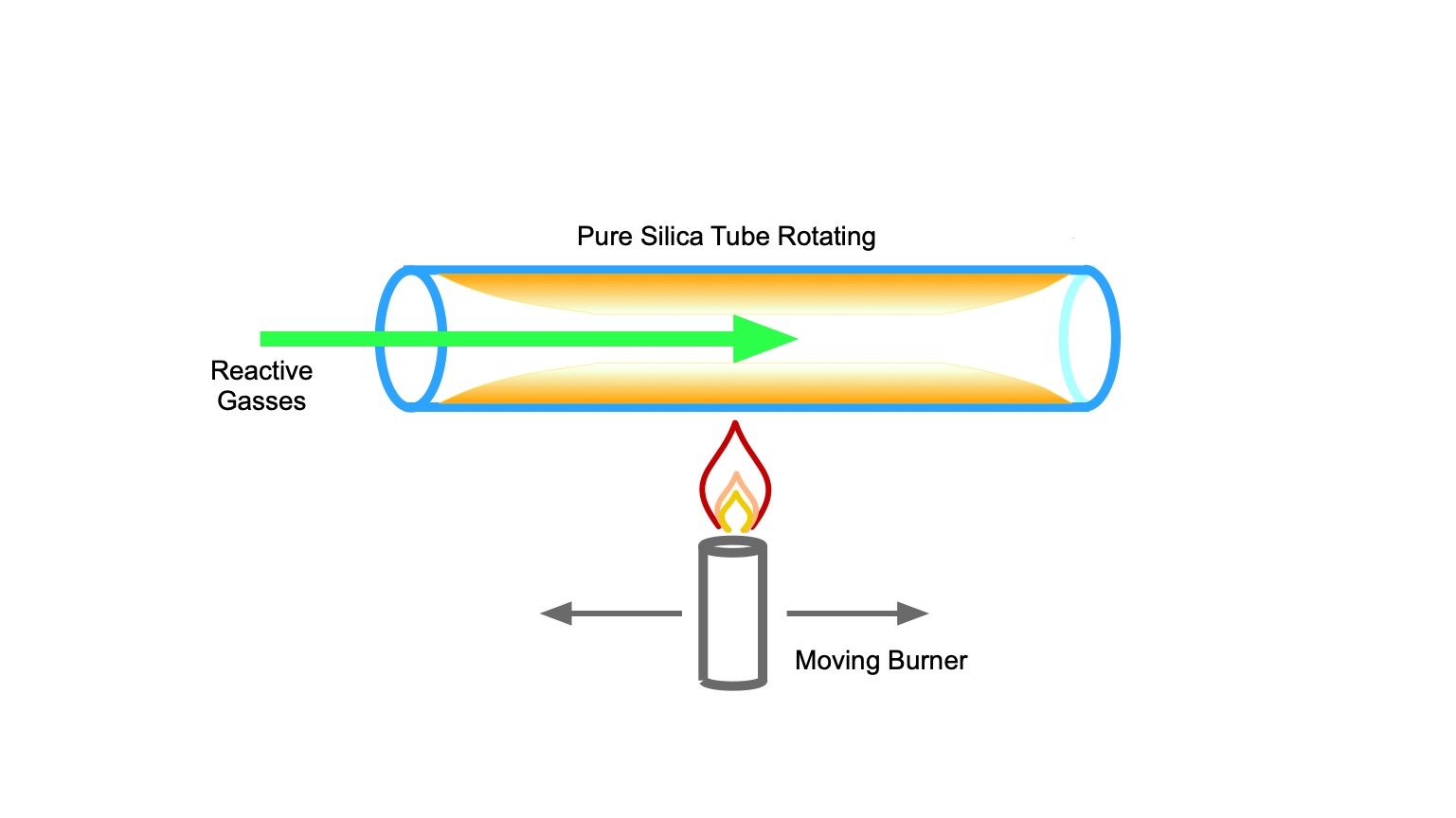
Chemical vapor deposition process
The Corning process, called chemical vapor deposition, starts with a pure silica tube held in a device like a lathe that allows the tube to rotate. A high-temperature burner moves back and forth to heat the tube evenly. A special gas mixture is passed through the tube, reacting in the heat to produce a deposit like soot. The heat from the burner melts the soot into layers of pure glass.
By varying the composition of the gasses, the type of glass deposited can be varied, changing the nature of the glass. That’s how the refractive index profile of the fiber is created. Once sufficient deposits have been made, the heat is turned up and the glass fuses into a large rod called a preform.
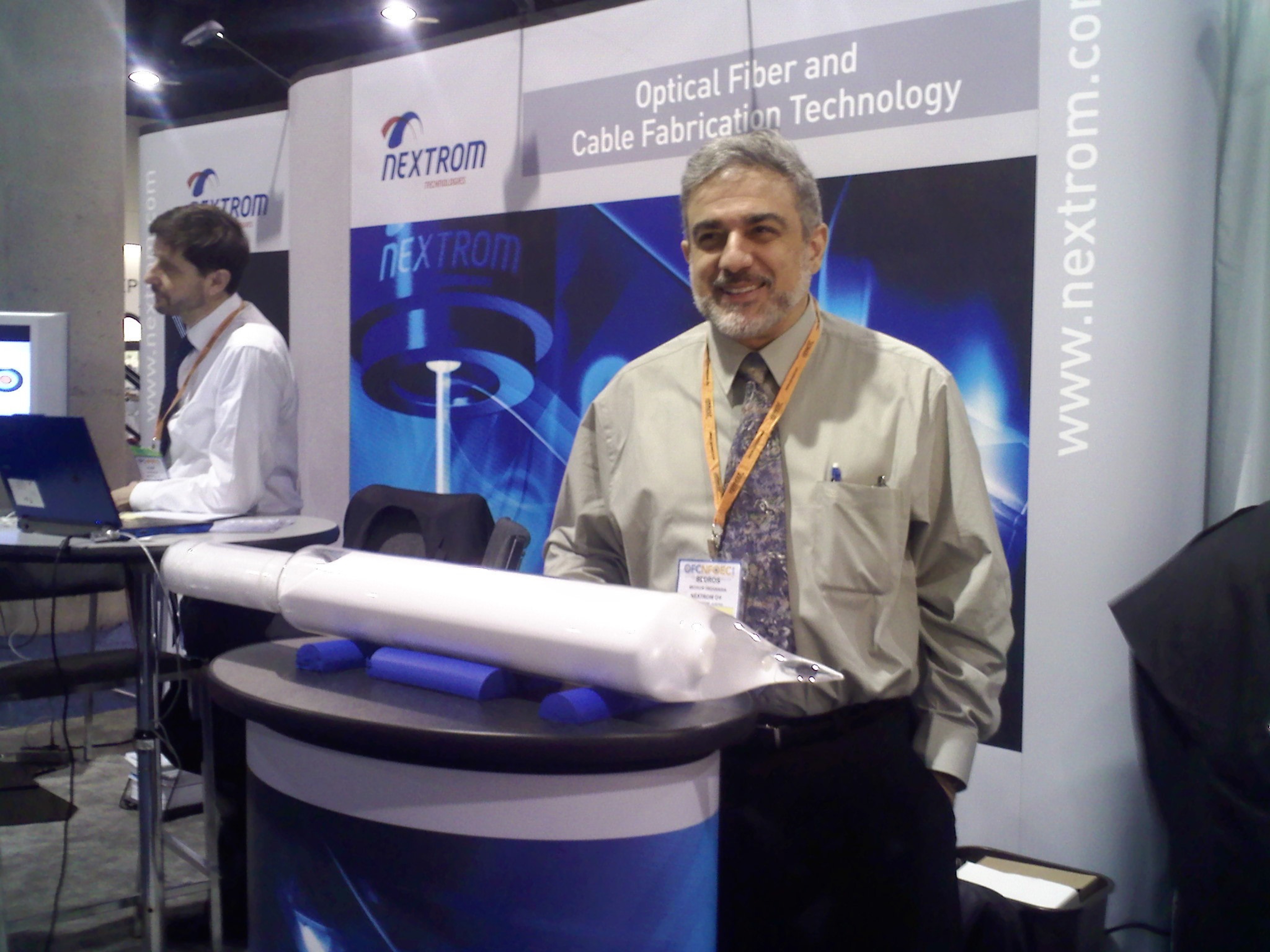
Fiber optic preform on display at a trade show
When fiber production began, preforms were only about an inch in diameter and produced a few kilometers of fiber. Today, preforms are much larger and produce up to 50 kilometers of fiber.
How preforms are used to create optical fiber
Once a preform is made, it is pulled into fiber in a giant device called a drawing tower.
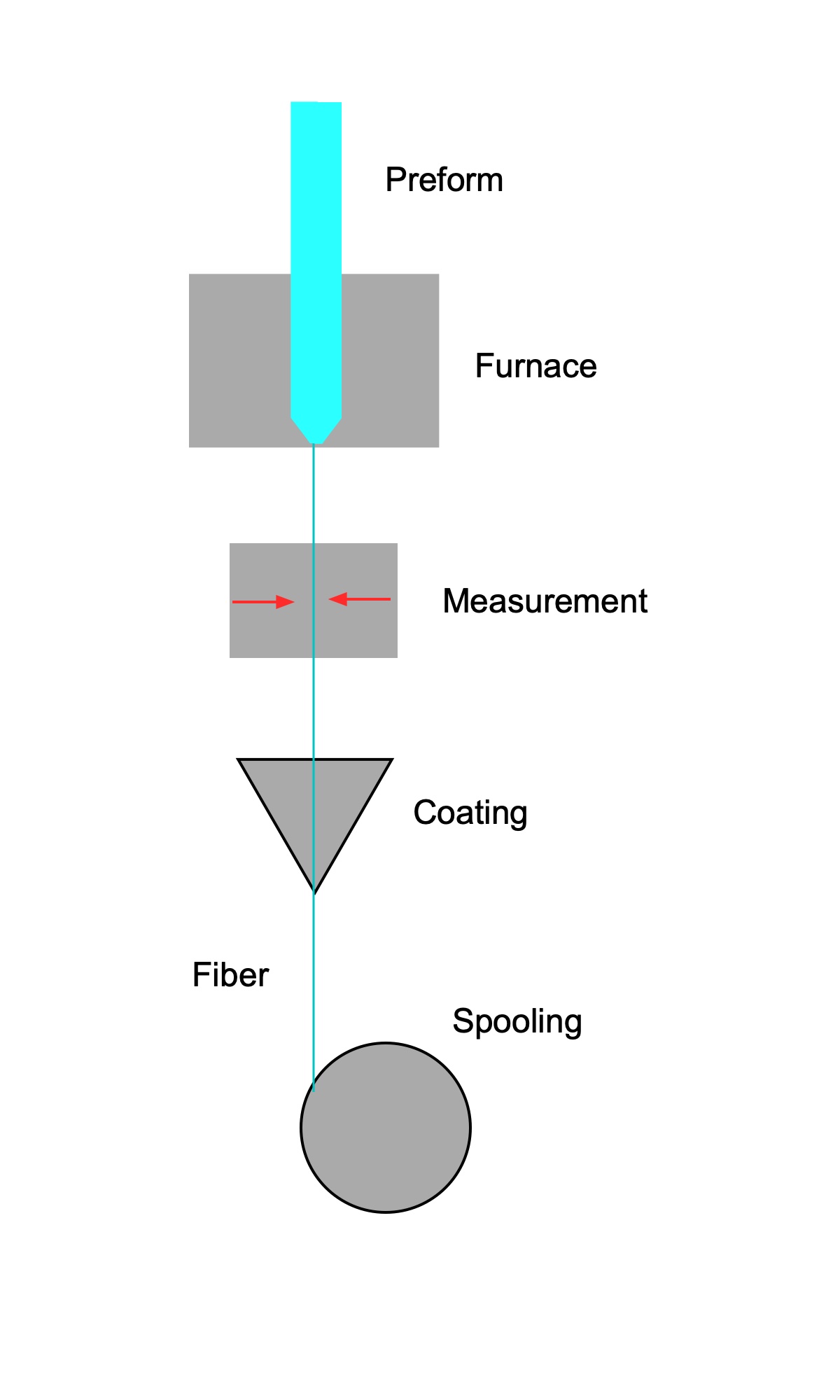
Production of fiber in a drawing tower
The preform is inserted into a furnace that evenly heats the end to a temperature high enough to melt glass. As it heats up, a large drop of glass (called a “glob”) falls out of the furnace trailed by the fiber. The fiber is threaded through several processing stations before being wound onto a spool.
The first stage is measurement of the fiber diameter, which is done with highly accurate lasers. The diameter is determined by the pulling speed, and the measurement provides feedback to the tower to adjust the pulling speed. Next the fiber is coated with the primary buffer coating that protects the fiber from the environment and handling. Finally, the fiber is wound onto a spool. When the spool is full, it is taken to labs for measurement of attenuation and dispersion before being labeled with manufacturing and test data and put on the shelf to await being made into a cable.
While the general process is well known, the details are considered proprietary by manufacturers. Although I’ve asked, pleaded and begged, I have not been in a fiber manufacturing facility in more than 30 years. I’ve been through several cabling factories, but never where the fiber is made.
About The Author

HAYES is a VDV writer and educator and the president of the Fiber Optic Association. Find him at www.JimHayes.com.