Job site productivity and efficiency are crucial. Nothing has increased our ability to do more than cordless tools. The tools have evolved over time, and so have the batteries that drive them. What originally started as a convenience has become a performance revolution driven by battery chemistry, smarter electronics and rapid-charging systems. Today’s battery packs deliver corded-class power with fewer compromises, while new chargers minimize downtime and extend battery life. This article walks through where we have been, where we are and two standout platforms—Milwaukee Tool’s Redlithium Forge and DeWalt’s Flexvolt.
Evolution of cordless tool batteries
Early cordless tools used nickel-cadmium battery packs. While these were functional, they were fairly heavy, suffered from memory effects and offered only modest energy density (the amount of energy stored versus the battery’s weight and size). Nickel-metal hydride batteries arrived in the 1990s and offered a higher energy density, didn’t suffer from memory effects and were better for the environment as they didn’t contain cadmium. However, in the early 2000s, lithium-ion (Li-ion) batteries were commercially introduced and are now considered the standard. Li-ion delivered higher energy density and lower self-discharge, enabling smaller, lighter packs that hit harder and run longer.
Even after more than 20 years, there have been Li-ion developments. Larger individual cells have pushed capacity and thermal headroom further for high-draw tools, thanks to greater volume per cell and improved heat handling. Those changes (backed by improvements in internal resistance and pack management) translate into more torque, longer runtime and faster charging.
Battery-management systems, pack construction and cooling strategies have also evolved. Electronic components within modern battery packs monitor temperature, current and cell balance, and can be paired with new battery chargers that cool and optimize charging profiles. This results in better performance and longer usable life over thousands of charging and use cycles.
Milwaukee Tool’s Redlithium
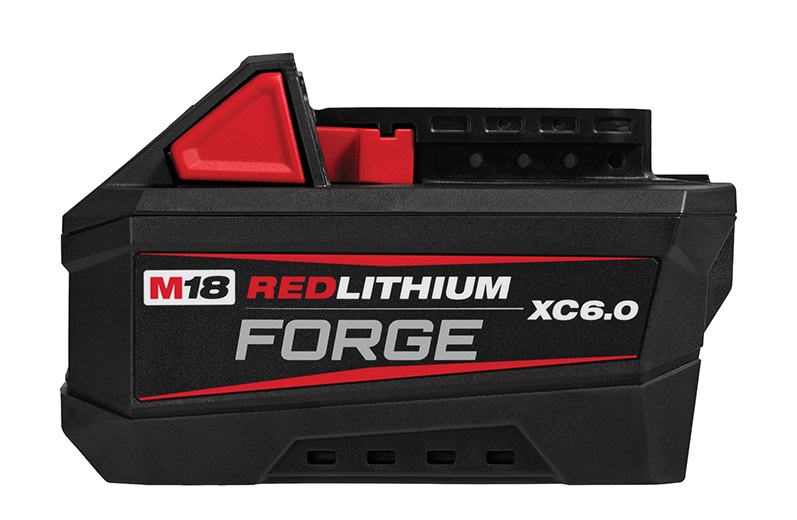
Milwaukee Tool, Brookfield, Wis., was the first to use Li-ion in cordless tool batteries in 2005. While most of the tools come with the standard Redlithium XC5.0 batteries when you buy them, Milwaukee has improved on battery design with its newer Forge line of 18V batteries. This line focuses on three main principles—more power, quicker charging times and longer lifespan. These battery packs are engineered to deliver the punch of the larger high-output batteries but in a smaller and lighter footprint. They are also designed to charge quickly when paired with the correct charger. The M18 Redlithium Forge XC6.0 pack is marketed to match the power of the M18 High Output HD12.0 in a much more compact package. This means we can get the 12.0 amp-hour (Ah) performance but with less tool weight.
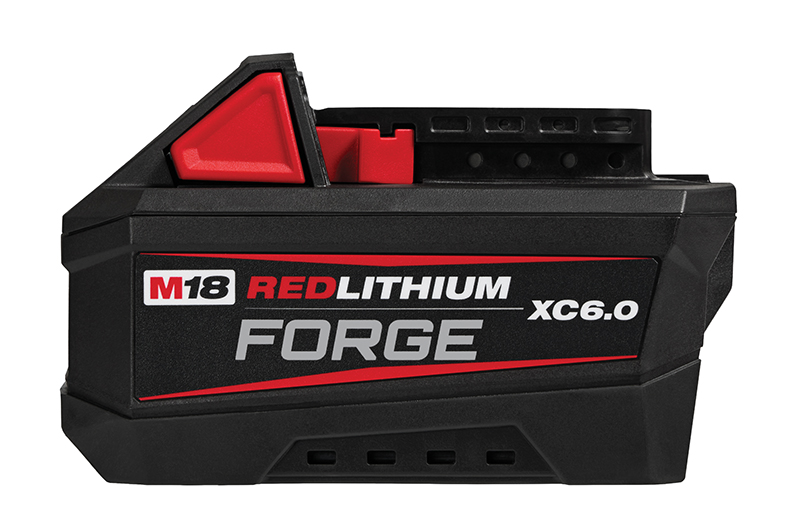
Milwaukee Tool's M18 Redlithium Forge XC6.0 battery pack
The ability to provide the same power as larger battery packs lies in the individual cells and the electronics in the packs. The cells are now tabless—meaning they use the entire tail of the current collector as a tab, increasing the conduction area while shortening the conduction distance. This design significantly reduces internal resistance, which leads to higher current output and improved performance overall. The onboard electronics also monitor the system, providing optimum performance and preventing overheating.
The Forge system also has an active cooling cycle—a technology designed to enhance battery performance and efficiency. It works by forcing air through vents in the battery packs and cooling them, allowing the packs to begin the charging process much faster than just letting them cool down on their own. Milwaukee’s M18 dual bay simultaneous super charger boasts that it will charge an XC6.0 battery to 80% capacity within 15 minutes. This allows electricians to get back to work with much less downtime.
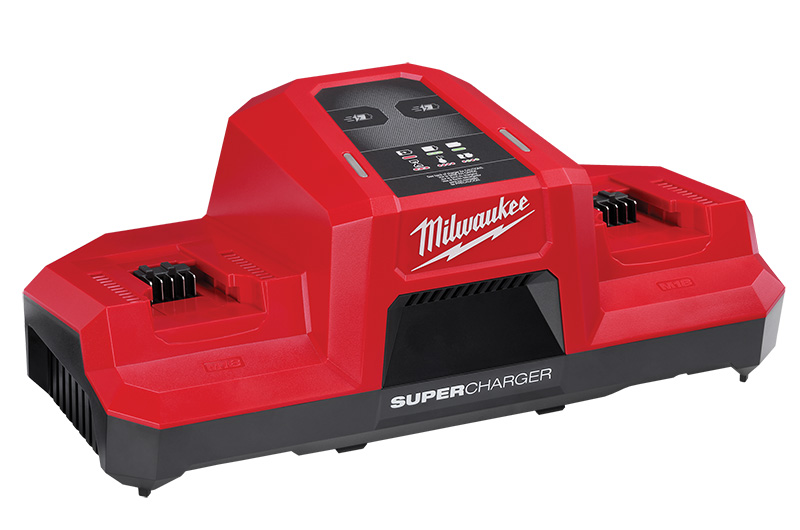
Milwaukee Tool's M18 dual bay simultaneous super charger
For those who don’t need 18V power in their arsenal, Milwaukee Tool has an extensive 12V power tool lineup. While 12V doesn’t provide quite the punch that 18V does, the tools are smaller and lighter, enabling users to work nimbly and in tighter spaces. Although the 12V line up is not currently offered with Forge technology, it may be an option in the future.
For larger tools (trench compactors, core drilling machines, demo hammers, pipe threaders, etc.), Milwaukee’s MX Fuel batteries operate at 72V—perfect for those demanding tasks where we can benefit from not having to rely on corded power. The MX Fuel lineup is available with Forge technology.
DeWalt Tools’ Flexvolt
DeWalt, Towson, Md., has a bit of a different approach to cordless tool batteries with its Flexvolt line. While most manufacturers rely on 18V, DeWalt has chosen to forgo that in favor of 20V and 60V options instead—in one battery pack! The electronics within a Flexvolt battery pack automatically change its configuration to deliver the correct voltage for the tool: 20V Max for 20V tools, or 60V Max for the 60V Max line. Pop the same battery into the right tool and it “just works,” eliminating guesswork while unlocking higher voltage for big-draw applications.
On 20V Max tools, the Flexvolt battery boosts runtime versus standard 20V packs. On 60V Max tools, it unlocks the extra power those machines are designed to use by changing to a series connection. There are even specialized 120V Max tools run by two Flexvolt packs in series to reach their operating voltage for corded-class performance without the cord. This single-battery approach to several different tool voltages is convenient in that it cuts down on the different types of batteries needed on the job.
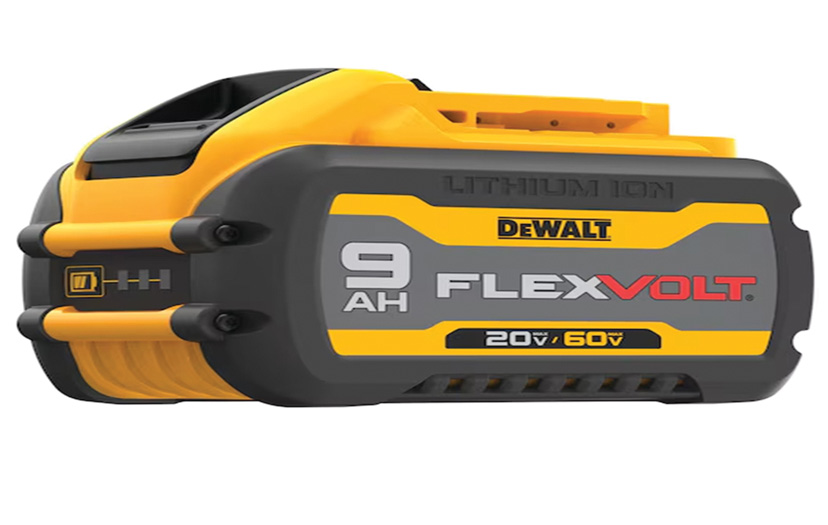 DeWalt's 20V/60V Max Flexvolt 9-Ah battery
Additional considerations
A few additional things to keep in mind when considering which battery types to use:
- Standardize when possible. If your tool inventory leans heavily toward one color (red or yellow, for example), then the ecosystem effect will pay dividends by not having to invest in an entirely new system. The Flexvolt battery platform spans the 20V and 60V range with a single battery pack. However, Milwaukee’s M18 platform is massive, and adding the Forge packs to your existing lineup of tools can really lift their performance.
- Match the platform to the task. If you are working in the light- to medium-duty most days (think service, trim-outs or punch list type work), then a 12V platform or compact 18V platform would be the best option. These smaller, more compact and lighter versions enable you to be more agile and nimble. Keep in mind you may have to keep additional batteries charging, as these tend not to have longevity. If you are frequently running high-draw tools (such as grinders, SDS Max hammer drills or full-size band saws), then the larger-volt platforms will pay off here. Tools powered by 18V to 20V or even 60V will provide the power punch needed for these larger tasks, and the higher amp-hour batteries will last much longer.
- Watch heat. Heat is the biggest enemy of cycling life for a battery. High-draw work on hot days accelerates aging, as does charging a hot pack immediately after a hard run. Active-cooling chargers, shaded storage and rotation habits (run one, cool one, charge one) will all help to preserve performance. Milwaukee’s Forge cool-cycle approach and DeWalt’s fan-cooled chargers can help address this by cooling during charging to maintain the speed of charge without abusive temperatures.
- Be mindful of compatibility notes. DeWalt’s 20V tools accept either 20V Max or Flexvolt packs but its 60V/120V tools require Flexvolt. Milwaukee’s M18 Forge batteries are backward-compatible across M18 tools but offer the largest benefits on high-demand models and with cool-cycle-capable chargers.
- Future proof your tool platform. The Flexvolt’s cross-voltage offers some leeway to add 60V tools at a later date (thus saving money up front). Forge brings faster charging and more power to the current tools within our stable.
Conclusion
Modern Li-ion composition, larger capacities and smarter battery management systems provide corded-tool performance without being tethered to an extension cord. When you pair these newer battery lines with today’s fan-cooled rapid chargers, you will spend more time working and less time waiting for batteries to charge—a blessing in this day and age where time is money.
Milwaukee Tool | DeWalt