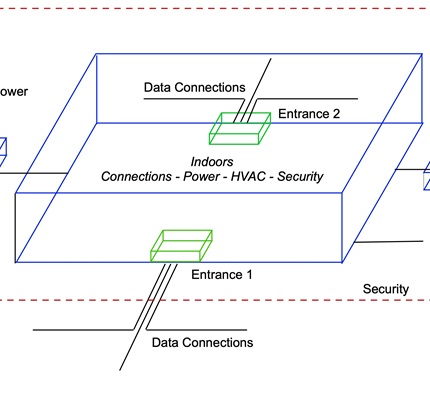
Naysayers take note. Copper cabling isn’t dying, but rather evolving into a site-specific connectivity pathway that bridges physical security, lighting, environmental technologies, sensors and automation. It’s migrating to a hybrid transmission topology mixing copper, fiber, wireless, structured cabling and other components, depending on the needs of the connected building.
Upward outlook for copper
“The global copper wire and cable market is expected to continue to grow, thanks to rising infrastructure, urbanization, renewable energy needs and the advanced telecommunication industry,” according to the Copper Wire and Cable Market report by research firm UnivDatos, India. “As the world evolves to adopt modern technologies that are energy-saving, copper wire and cable play a central role in electrical distribution networks.”
The Copper Development Association Inc., McLean, Va., is also keen on the renaissance of copper, citing the development of new buildings and rapid expansion of communication lines as playing a role in increasing demand for copper wires and cables.
Essential to building intelligence
For smart cities, copper is central to the internet of things and edge computing. In Inside Networks, Mike Boisseau, director of product management for smart buildings at The Siemon Co., Watertown, Conn., discussed how copper cabling is an essential backbone, enabling edge devices that make spaces smarter and more efficient.
“The real intelligence of a building resides at its edge—in the connected devices that enable spaces to sense, respond and adapt in real-time. And at that edge, copper remains the indispensable foundation,” he said.
Copper “shines” in modern smart buildings, “and every new application at the edge represents another potential copper connection,” Boisseau said.
Sensors, cameras, access control points, lighting fixtures, wireless hubs and environmental systems that require both power and data are some of the solutions being deployed.
Smart cities rely on different transmission methods: fiber optics, power over ethernet (PoE), 5G cellular and buried and overhead cabling for safety and security, building automation, intelligent traffic management and utility and grid monitoring. Copper cabling continues to handle retrofit and new construction with superior electrical and thermal conductivity and energy efficiency. Copper is also highly recyclable, making it a sustainable product that can be reprocessed without disruption to its physical or chemical properties.
Structured cabling and local networks also continue to improve and expand to handle new connections with speed and the ability to deliver power according to the latest PoE++ standards. For long-haul telecommunications, fiber still stands as a preferred option, but copper is still critical in the “last mile” and for LANs.
Copper is also evolving
The advantage of copper cables, according to QSFPTEK Technology Co., City of Industry, Calif., lies in their ability to transmit data and provide power simultaneously, making them particularly useful in PoE applications, such as powering and networking wireless access points, voice terminals, building-internal devices and even cameras.
“Copper cable technology itself is also advancing. With the release of the 25G/40GBASE-T standard, Cat8 (data-center-specific) copper cables can achieve bandwidths of up to 2GHz, remaining competitive in short-distance high-speed transmission links,” according to the company’s report, “Exploring the Data Center’s Copper Cabling Development in 2025.”
Copper cabling still reigns supreme in many use-cases and will continue to evolve as it piggybacks its proficiencies with the latest technologies.