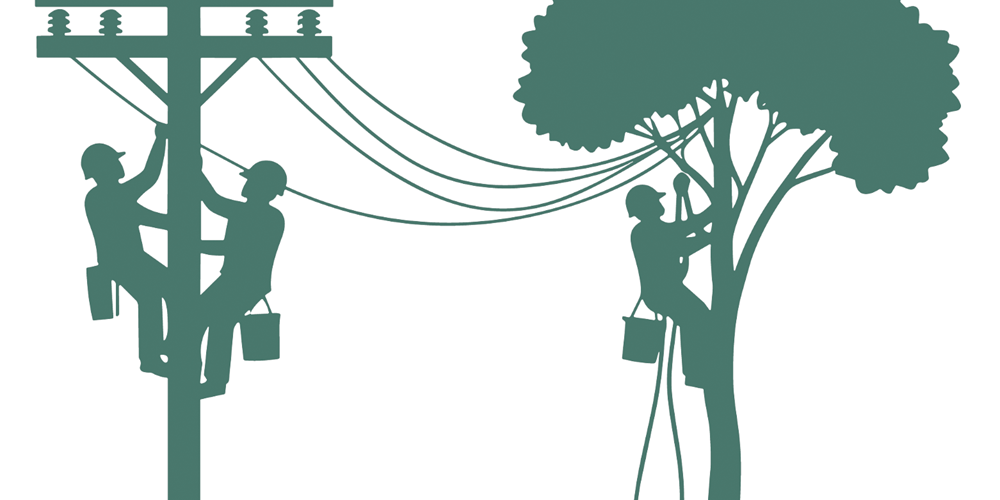
Lineworkers, tree trimmers and ET&D professionals are familiar with the dangers associated with their jobs, and most are rigorously trained on the hazards they face. Unfortunately, there are some who are not, and according to an estimate from the aggregate BLS fatality statistics, these workers are nearly four times more likely to be killed on the job.
Accident review
Below is a recent real-world example of a tree trimmer who encountered a live line, which resulted in a fatality. Hopefully this case study will serve as a refresher and motivate others to prevent similar incidents in the future.
A 29-year-old tree trimmer was electrocuted while trimming palm trees near a utility power pole and high-voltage lines. The victim was working alone when the incident occurred. A trimmed portion of the tree contacted the high-voltage line and conducted electricity to and through the victim.
The victim’s employer was a family-owned and operated business specializing in tree trimming and removal. The employer had a business license, but no one was a certified tree trimmer. The company had six employees.
It did not have a written safety or injury and illness prevention program. None of the employees had ever received formal training in tree trimming or were certified tree trimmers; they all learned their trade through observation and on-the-job training (OJT). None were trained in first aid, CPR or electrical hazard identification.
The tree exceeded 50 feet in height and its fronds extended outward within 10 feet from high-voltage lines. On the day of the accident, the victim was assigned to a crew of four, including three tree trimmers and a foreman/supervisor. When a crew member asked about the utility lines, the supervisor stated that he thought they were a safe distance from the trees and wouldn’t be a problem.
The supervisor and one of the other workers then left the site. The victim donned his climbing spurs and safety belt, attached a chainsaw to his work belt and climbed the tallest palm tree.
The other worker on-site heard a chainsaw idling and went to the other part of the job to check on the victim. He saw the victim arched backwards in his safety belt and noticed he was not moving or responding. He then called 911. First responders arrived within five minutes and observed the victim hanging from a palm tree about 40 feet up.
First responders then contacted the electrical company to have them turn off all the power to the area to ensure the safe retrieval of the victim. Once the power lines were rendered safe, the victim was lowered to the ground and placed on his back. There paramedics pronounced the victim dead, and the cause of death was electrocution.
What can we do?
To prevent similar future incidents, investigators determined tree trimming companies and tree trimmers should:
λ
Ensure a written safety program and adequate job and hazard awareness training programs are in place.
λ
Perform a proper job hazard assessment and briefing prior to starting work by a qualified tree worker who can assess the hazards, including electrical hazards. A qualified tree worker is a person who, through related training and OJT, has demonstrated familiarity with the techniques and hazards of tree maintenance, removal and the equipment used in the specific operations involved.
λ
Use a qualified line clearance tree worker when tree trimming is within 10 feet of energized high-voltage power lines. A qualified line clearance tree worker has knowledge about hazard recognition. They also are aware that electrical shock will occur when a person, by either direct or indirect contact with an energized electrical conductor, energized tree limb, tool, equipment or other object, provides a path for the flow of electricity to a grounded object or to the ground itself and will result in serious or fatal injury.
Safe procedures when working near energized lines include:
λ
Use insulated gloves and tools to prevent the flow of electricity if accidental contact is made.
λ
Use an insulated bucket truck to gain access to the work area, preventing the direct path for electricity to the ground if accidental contact is made.
λ
Call the utility company to have the line covered with insulated tubes or blankets or have the line de-energized for the duration of the job.
λ
Only hire tree workers trained or certified by organizations such as the Tree Care Industry Association or International Society of Arboriculture.
Source: National Institute of Safety and Health Fatality Assessment and Control Evaluation Program Report: 18CA001.
STOCK.ADOBE.COM/MstShefaly
About The Author

O’CONNOR is safety and regulatory affairs manager for Intec, a safety consulting, training and publishing firm. Reach him at [email protected].