You're reading an older article from ELECTRICAL CONTRACTOR. Some content, such as code-related information, may be outdated. Visit our homepage to view the most up-to-date articles.
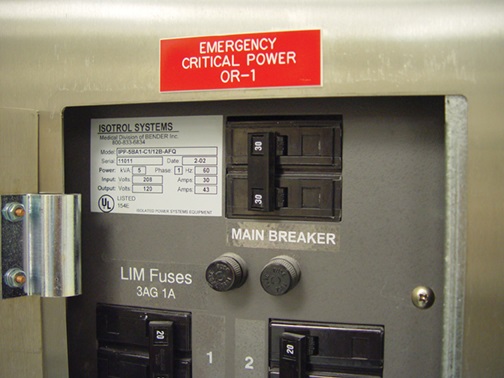
The National Electrical Code (NEC) requires all boxes and enclosures—including transfer switches, generators and power panels that are part of an emergency system—to be marked so they are readily identifiable as a component of the emergency system. Recently, during an inspection of a large healthcare facility emergency system, an inspector turned down the project because of the way the contractor had identified the components of the emergency system. To resolve the inspector’s rejection of the project, the emergency system components had to be labeled using the term “emergency system” in felt-tip marker on boxes or on labels adhered to the equipment, such as transfer switches and panelboards. Ultimately, the contractor was able to attain compliance on that project, but a couple of questions resulted.
First, does the designation “EM” on a 4-inch-square box cover marked with a felt-tip marker meet this NEC requirement? Does the designation “EM” on a transfer switch, switchboard or panelboard meet this requirement? This is a very common practice in the field, and the company that asked had never been cited for this violation before.
The answer is no. Although it is a common field practice, the designation “EM” marked on a 4-inch-square box cover would not meet the requirements in 700.10(A). This rule indicates that the permanent marking must “readily identify” the wiring as part of an emergency system. While “EM” could stand for “emergency,” it could also stand for “energy management” or something else. So it is best not to abbreviate the marking, because it does not meet the general requirement of being readily identified.
The specific marking is critical to maintaining continued required separation between conductors and components of emergency circuits and systems from those that are not. Marking with “Emergency” or “Emergency System” complies with the NEC. The simple objective behind the “readily identified” marking rule is that, when seen, there is no question that the wiring is part of an emergency system. Whether it is a label, sign, placard or handwritten marking, the words “emergency system” should be used.
Here is the second line of questioning, which I believe is a bit more complicated:
“Since revised Section 517.26 in the 2014 NEC no longer includes the critical branch as having to meet the requirements in Article 700, does that mean I no longer have to readily identify the boxes and enclosures for the critical branch as part of the emergency system? Seems as though this identification is still necessary, based on its relationship to the normal branch power in the facility. The inspector required us to mark the enclosures with the words ‘emergency system,’ but even the inspector was a bit concerned about how to apply the marking requirements that only appear in 700.10(A). I do see separation requirements in 517.30(C)(1), but the marking requirements are not there. Some guidance in meeting the NEC requirements for this and future projects would be helpful.”
Section 517.26 was revised in the 2014 edition of the Code to remove the critical branch from having to meet the requirements for emergency systems as covered in Article 700. In my opinion, this created a gap in the rules for several requirements that should still apply to the essential electrical system in a healthcare facility. I believe this was an inadvertent oversight and the inspector is using his discretion under 90.4 to attain compliance and achieve the objectives of the required marking. The critical branch is a part of the essential electrical system in a healthcare facility. The identification requirements in 700.10(A) are no longer applicable to enclosures and boxes of the critical branch in a healthcare facility essential electrical system. This means that the “emergency system” marking is not required on the enclosures containing circuits for the critical branch, but it is required for the life safety branch.
It is also important to refer to the project specifications that may require specific identification methods for electrical systems to distinguish one branch from another. Section 517.30(C)(1) still generally requires the life safety branch and critical branch of the essential electrical system be kept entirely independent of other wiring and equipment and not enter the same raceways, boxes or cabinets with each other or other wiring. It is a good idea to verify with the authority having jurisdiction that the method used for identification of an emergency system or essential electrical system is Code-compliant and one he or she can approve.
This is also a good opportunity for the Code-making panels to revise the NEC to address this gap created by this apparent and inadvertent oversight. Public input can be submitted to revise the NEC. For more information on getting involved in the standards-development process, visit www.nfpa.org.