You're reading an older article from ELECTRICAL CONTRACTOR. Some content, such as code-related information, may be outdated. Visit our homepage to view the most up-to-date articles.
Jim Dollard has an extensive background in codes and standards. If you have a query about the National Electrical Code (NEC), Jim will help you solve it. Questions can be sent to [email protected]. Answers are based on the 2014 NEC.
Type NM cable in raceways in wet locations
On a recent townhome project, we had to rewire 12 heating, ventilating and air conditioning (HVAC) units because we had run nonmetallic (Type NM) cable in conduit listed for use outdoors. This is a common practice in our area, and we have done this on many residential projects. The 12 units were on two floors with a basement. To get to the outdoor HVAC unit, we simply installed a junction box in the basement near the condensing unit location and took the Type NM right into the conduit without splicing or removing the jacket to supply the outdoor disconnect. When the electrical inspector saw the Type NM jacket in the disconnect, he made us rewire all 12 outdoor units. Section 334.10(1) permits type NM to supply detached garages and buildings, and the conduit was not buried. The Type NM cable is protected from weather. If we put the Type NM cable into flexible nonmetallic conduit, where is the problem? Is Type NM cable permitted to be installed in a flexible nonmetallic conduit that is listed for outdoor use?
The NEC recognizes the cable assembly you are referring to as Type NM cable, which is not permitted to be installed in raceways that are above grade in wet locations.
There are multiple NEC references necessary to explain why this is not permitted. First, we must look in Article 300, which contains general requirements for wiring methods and materials. Where raceways are installed in wet locations above grade level, Section 300.9 requires the interior of these raceways to be a wet location. Conductors installed in these raceways must comply with 310.10(C), which requires the conductors installed to be listed for wet locations, and Type NM is not listed for wet locations. In addition, Section 334.12(B)(4) prohibits Type NM cable from being installed in wet or damp locations. In this installation, the cable must end at the junction box and conductors that are listed for wet locations, such as THHW, must be installed in the raceway to supply the outdoor disconnect.
Using ceiling wires for support
For several years, I have argued about the intention of the Code-making panels (CMPs) in regard to the exception to Section 300.11(A)(2), which permits supporting branch-circuit wiring and associated equipment where installed in accordance with the ceiling-system manufacturer’s instructions. We are all aware that ceiling manufacturers do not perform these tests. Therefore, it is my argument that the CMPs intended for this to mean that “the ceiling, where installed in accordance with manufacturer instructions, may be permitted as a branch-circuit support system,” if there is documentation to prove it. This exception merely states, if the ceiling is installed in accordance with manufacturers instructions, it may be used for support. I see other contractors tying to the ceiling support based on the exception, but I have liability concerns using the ceiling and have won this argument with some inspectors.
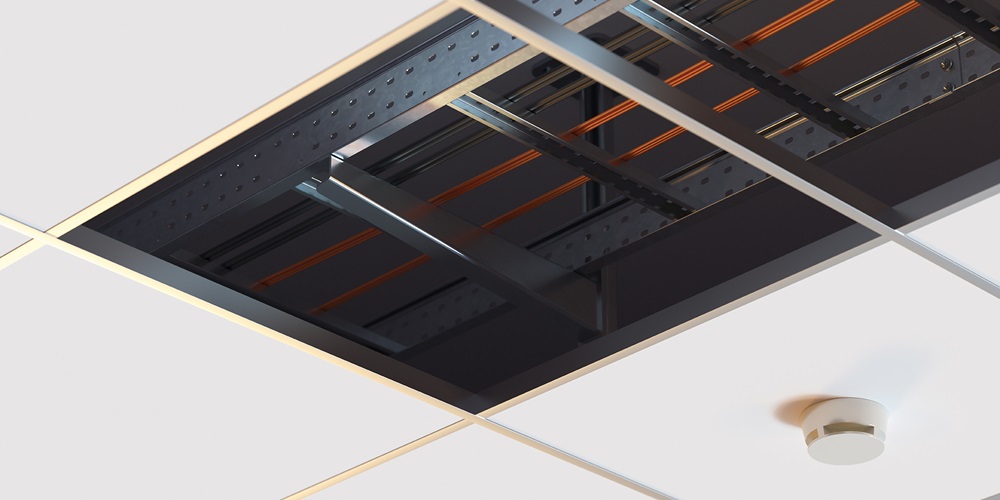
Section 300.11 contains requirements for securing and supporting raceways, cable assemblies, boxes, cabinets and fittings above ceilings. Section 300.11(A) provides general requirements that the equipment is to be securely fastened in place. In addition to the ceiling-grid- support wires, along with many products available to connect to the wires, support wires are permitted as the support method. Installing these additional support wires, along with products to support and secure cable assemblies, boxes, etc., is very common.
You are correct that the exception is permissive in nature and may require the contractor to document the ceiling manufacturer’s instructions that permit connection to the product’s support wires, if that method is used. While I am not aware of a ceiling manufacturer that permits connection to its support wires, if one were to test the ceiling for this purpose and provide such documentation, the contractor could use those wires for support. It is important to note that, in no case, are cables, raceways or boxes, etc., permitted to be supported by the ceiling grid itself.
Concrete-encased electrodes
While installing temporary power on a new construction project, the general contractor asked us to bond 3/0 copper to the rebar for the grounding electrodes so the GC could pour concrete. There were four separate grade beams, and we provided a 3/0 copper tail at each to bond to building steel. When working with rebar in concrete as a grounding electrode, how often do I need to bond the rebar to the building steel? Do we need to hit every grade beam?
No, second-level subdivision 250.52(A)(3) contains the requirements for concrete-encased electrodes, and 250.52(A)(3)(2) clarifies that, where more than one concrete-encased electrode is present, it is permissible to bond only one. In your situation, the NEC requires a minimum of one connection to a concrete-encased electrode. It should be noted that this requirement states that “it shall be permissible to bond only one,” recognizing that, where there is more than one concrete-encased electrode and all are bonded, the net result is a better grounding electrode system.
Rigid conduit threadless coupling for grounding
In an indoor installation of rigid metal conduit (RMC), multiple points in conduit runs made it infeasible to use threaded couplings, so we used listed threadless couplings. The plant engineer took exception with the installation and claimed that, since these were 480-volt (V) feeders, we could not use the RMC as an equipment grounding conductor (EGC) because the conductors contained in the conduit were more than 250V. An EGC was installed with the feeder. However, I have searched the NEC and not found anything other than Section 344.60 that permits RMC as an EGC. Can you help?
The scope of Article 344 covers RMC and all associated fittings. Section 344.6 requires all associated fittings, which would include couplings, to be listed. Section 344.42(A) specifically permits threadless couplings. In addition, 250.118(2) recognizes RMC as an EGC. Nothing in the NEC would prohibit the use of RMC as an EGC where listed threadless couplings are used.
In the 2015 UL White Book, threadless couplings fall under the product category “Conduit Fittings DWTT.” This category specifically permits listed threadless couplings on RMC for grounding purposes. It permits threadless fittings for use with EMT, RMC and intermediate metal conduit for grounding purposes without voltage limitations where they are installed in accordance with the NEC.
Why aren’t all definitions in Article 100?
The NEC has Article 100 for definitions, but other articles contain definitions as well. This can get confusing when trying to apply a given Code rule. If there are terms that I am not sure of, I find myself looking in Article 100 and then in the pertinent article. I think all definitions should be placed in Article 100. Why are they in different articles?
In the introduction to the NEC, Section 90.1(A) clarifies that the NEC is not a design specification or an instruction manual for untrained people. NEC users must understand Code arrangement. The NEC style manual, which is available on www.nfpa.org, governs the Code format. The style manual requires definitions to be in alphabetical order and prohibits definitions from containing requirements or recommendations. In general, Article 100 contains definitions of terms that appear in two or more other articles of the NEC, but individual articles may contain definitions in the second section of the article. The definitions in Article 100 apply globally throughout the NEC, and the definitions in the second section of an article apply only in that article.
It is extremely important that the NEC user understands this format. It is essential to keep that separation. Adding all definitions to Article 100 may sound like a great idea, but that would actually create confusion and misapplication. Definitions necessary for application in an individual article would be in Article 100 instead of being logically located and easy to find in the second section of an article.
For example, Article 517 contains 39 definitions necessary for the application of NEC requirements for healthcare facilities. They are located up front in that article for clarity and usability. Code users who are not familiar with the requirements in Article 517 should familiarize themselves with those definitions before attempting to apply requirements within. Other issues would occur where a defined term works in a given article but not in other areas of the NEC.
About The Author

DOLLARD is retired safety coordinator for IBEW Local 98 in Philadelphia. He is a past member of the UL Electrical Council, NEC Correlating Committee, NEC CMP-10, CMP-13, CMP-15, NFPA 90A/B and NFPA 855. Jim continues to serve on NFPA 70E as a Special Expert. Reach him at [email protected].