The National Electrical Code (NEC) has contained multiwire branch-circuit color coding since the early 1950s. However, it wasn’t until the 2005 NEC that it required the voltage system to identify ungrounded conductors where a building had more than one voltage system. Each system is identified by separate insulation color coding, marking tape, tagging or other approved means. In addition, the Code required identification to be posted at the branch-circuit origin in the panelboard or similar branch-circuit distribution equipment.
Color coding and identification address safety issues where more than one voltage system exists within a building, and they ensure circuit connections are not inadvertently mixed together, especially where different voltage systems were installed within the same raceways.
A change in the 2008 NEC permitted “the method utilized for conductors originating within each branch-circuit panelboard or similar branch-circuit distribution equipment to be documented in a manner that is readily available or shall be permanently posted at each branch-circuit panelboard or similar branch-circuit distribution equipment.”
Similar text was also added to Section 215.12 for feeder identification where more than one voltage system was in a building or structure.
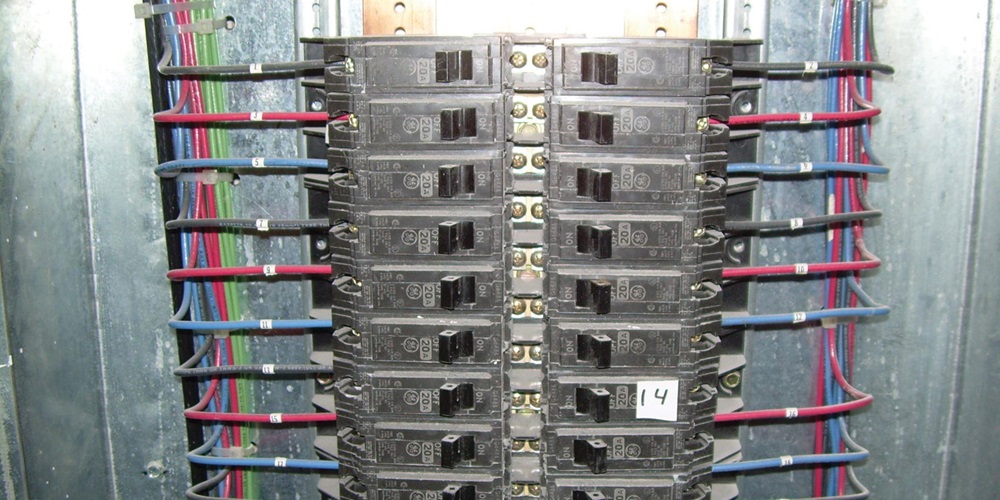
Permitting the identification to be documented in a readily available location, rather than requiring the identification to be posted at the feeder or branch-circuit panelboard or distribution board, was a major change because outside electrical contractors or maintenance personnel may not have ready access to the identification. Where industry-standard color coding of either branch-circuit or feeder conductors are used—such as black, red, blue and white for 208/120-volt (V), three-phase systems and brown, orange, yellow and gray for 480/277V, three-phase systems—readily available documentation is usually not an issue. However, if the voltage color coding was reversed for some reason, it might be a safety issue.
Determining color coding for different voltages would be the responsibility of the facility and the visiting contractor or maintenance personnel. Whatever identification is used should be consistent throughout the facility. For both branch-circuits and feeders, the 2008 NEC also added the requirement that “phase or line conductors must be identified at all termination, connection and splice points.”
In the 2011 NEC, 210.5(C) was subdivided into three subsections. New subsection 210.5(C)(1), Application, deals with applications covering the text and requires identification of all phase or line and system conductors at all termination, connection and splice points where there are more than one voltage system for the premises.
New subsection 210.5(C)(2), Means of Identification, deals with the means of identification by separate color coding, marking tape, tagging or other approved means.
New subsection 210.5(C)(3), Posting of Identification Means, includes requirements for either permanently posting the identification means at the panelboard or distribution panel or documenting in a manner that is readily available.
In the 2014 NEC, both 210.5(C) for branch-circuits and 215.12(C) for feeders had identification requirements added for direct current (DC) systems. The requirements were added for color coding or marking of positive and negative polarity.
For the 2017 NEC, permission was added to 210.5(C) and 215.12(C) to use conductor sleeves or shrink-tubing for positive and negative DC conductor marking identification. In addition, an exception was added to 210.5(C)(1), stating that, for existing installations where voltage system(s) already exist and where a different voltage system is being added, only the new system voltage needs to be marked.
In addition, “existing unidentified systems are not required to be identified at each termination, connection and splice point,” especially if the existing system was installed before this requirement occurred in the 2008 NEC. “Labeling shall be required at (each) voltage system distribution equipment to identify that only one voltage system has been marked for a new system(s).” The new system label(s) shall include the words “other identified systems exist on the premises.”
Compliance with the new exception and these other requirements hinges upon understanding the 2017 NEC, along with the requirements of older editions.
About The Author

ODE is a retired lead engineering instructor at Underwriters Laboratories and is owner of Southwest Electrical Training and Consulting. Contact him at 919.949.2576 and [email protected].