You're reading an older article from ELECTRICAL CONTRACTOR. Some content, such as code-related information, may be outdated. Visit our homepage to view the most up-to-date articles.
Jim Dollard has an extensive background in codes and standards. If you have a query about the National Electrical Code (NEC), Jim will help you solve it. Questions can be sent to [email protected]. Answers are based on the 2014 NEC.
Slash-rated breakers on 480V ungrounded delta?
I am constantly battling with fellow contractors and engineers at some of the industrial facilities I handle, which have 480-volt (V), three-phase, 3-wire delta systems that feed bus duct around the plant. It is my understanding that, since these systems float, you must install all breakers, etc., that have a 600V rating as the individual legs can go above 300V. The problem I am encountering is contractors and engineers who say it is permissible to install 480Y/277 breaker systems on these 480V delta systems, which are only rated for 300V to ground, and for systems that have neutrals. But they argue, since they are not powering 277 circuits and only using them for 480V, they are OK to use. I have seen entire new additions to plants done with 480Y/277 set ups. Is there a specific Code section I can cite? Even the distribution houses are telling electricians the panels are safe to use because of the 480-marking.
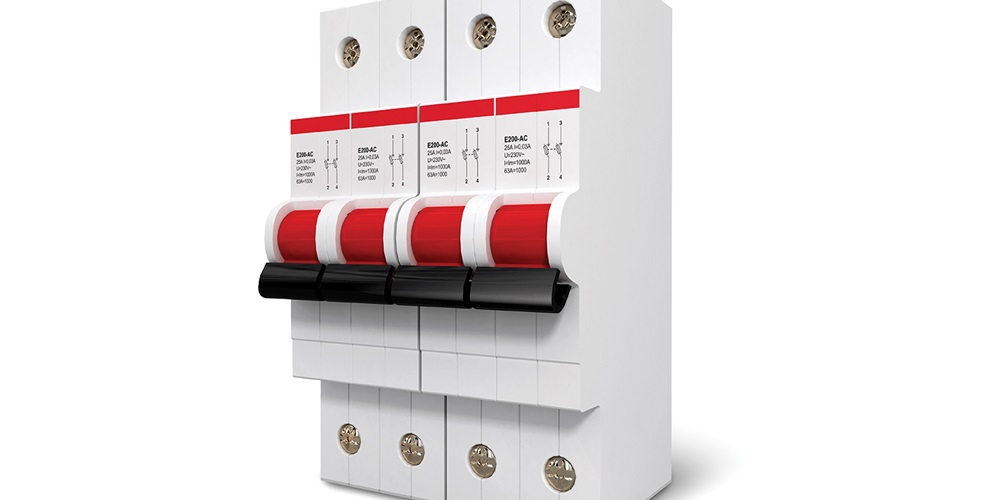
The NEC prohibits a slash-rated, 480Y/277 type circuit breaker from being installed in a 480V, three-phase, 3-wire delta system. Slash-rated circuit breakers are only permitted on solidly grounded systems in which the voltage to ground does not exceed the lower voltage rating value and the phase-to-phase voltage does not exceed the larger voltage rating value.
Article 100 defines “voltage to ground” as follows: “For grounded circuits, the voltage between the given conductor and that point or conductor of the circuit that is grounded; for ungrounded circuits, the greatest voltage between the given conductor and any other conductor of the circuit.” In a 480V, three-phase, 3-wire delta system, the voltage-to-ground is always 480V whether it is ungrounded or corner-grounded. Applying a slash-rated breaker in such a system may result in complete device failure when a full voltage fault exceeds the circuit breaker rating. This is a violation of Section 240.85, which requires a circuit breaker with a “straight rating” of at least 480V in this application.
This section also clarifies that slash-rated breakers may only be applied in solidly grounded circuits where the voltage-to-ground does not exceed the lower voltage rating. The installation you described is also a violation of 110.3(B) because the circuit breakers are clearly being installed in direct conflict with the product labeling on the device.
GFCI requirement locations
Can you explain why the basic rules for ground-fault circuit interrupter (GFCI) protection are located in 210.8? I am struggling to understand this because Article 210 is for branch circuits and the rules in 210.8(A) and (B) apply only to receptacles. The rules in 210.8(C) and (D) for boat hoists and dishwashers apply to outlets and may be properly located in 210.8 because they likely are hard-wired and the entire branch circuit may be GFCI-protected. However, a GFCI-type receptacle could be used or located just ahead of the hard-wired connection. This issue gets even more muddied when I consult Article 422 and find rules that require GFCI protection for vacuums, water coolers, spray-wash machines, tire inflators and vending machines. This is how I got started on this path. Why are these requirements spread all over the NEC? It is confusing and difficult to ensure something does not get missed.
Article 210 contains branch-circuit requirements separated into three parts to address general provisions, branch-circuit ratings and required outlets. The rules for GFCI protection of personnel are located in 210.8 (Part I General Provisions) for multiple reasons. The requirements are focused primarily on locations, such as dwelling unit bathrooms and equipment/appliances that put people in situations where a greater likelihood of shock exists. The requirements to protect specific outlets or equipment can be met by protecting the entire branch circuit with a GFCI-type circuit breaker or at the outlet(s) with a GFCI-type receptacle. The requirements in 210.8(A) and (B) address only receptacle outlets in specified locations and not the entire branch circuit. It is well understood that the majority of 210.8(A) and (B) installations are protected by GFCI-type receptacles.
Specific equipment/appliances to be GFCI-protected are addressed in 210.8(C) and (D). The issue here is that similar GFCI requirements exist in Article 422. The GFCI requirements for equipment and appliances in 210.8(C) and (D) must be correlated with GFCI requirements for equipment/appliances in Article 422. As this issue unfolds in the NEC revision process, it is imperative that GFCI protection be considered at the time of branch-circuit installation. Requirements for equipment and appliances that need to be GFCI-protected should be located together for clarity and usability. This issue was heavily debated in the 2017 revision cycle and will most likely see some action again in the 2020 NEC. The intent of 210.8 is to protect people from shock.
Welding cable for trade-show floor feeders?
Can we use welding cable for feeders on a trade-show floor? The cables are being run in areas not subject to foot traffic and are terminated in camlock-type connectors. The reason for choosing welding cable is because it is extremely flexible and easy to get.
No, welding cable is not permitted. Article 518, Assembly Occupancies, addresses requirements for the type of cable permitted for use on a trade-show floor. Power distribution on a trade-show floor is considered as temporary wiring, and this section requires the wiring to be installed in accordance with Article 590. All flexible cords and cables must be approved for hard or extra-hard usage and must be laid only on floors where protected from contact by the general public. Section 590.4(B) requires flexible cords or cables used for temporary feeders to be of a type identified in Table 400.4, which does not list welding cable.
There are many cable types that are both portable and hard or extra hard usage. It is typical to see Type SC, flexible stage and lighting-power cable used for this purpose.
Definitions of low, medium and high voltage in the NEC
Where are the definitions in the NEC for low, medium and high voltage? These terms are used throughout the Code, but they are not defined, leading to confusion. These terms are used differently from article to article, making things worse. We have definitions for nominal voltage and voltage-to-ground, but it ends there. Section 110.4 tells us that the voltage considered is that at which the circuit operates, but there are requirements for low, medium and high voltage. Definitions would be helpful and are sorely needed.
I understand your frustration, but adding definitions to the NEC for low, medium and high voltage is not as easy as it sounds and is not possible at this time due to wide ranging use of these terms in different areas of the NEC. This would be a substantial effort to correlate.
Many issues affect the way these terms are used. For example, a telecommunications technician may consider 120V as high voltage and a high-voltage power crew may consider 4,160V as low voltage. I agree with you that some type of correlation or clarity is needed. However, we must look at each use of these terms in the context of a given requirement to apply the NEC. I encourage you to submit public inputs for the 2020 revision cycle. The following includes just some of the uses of these terms to illustrate the inconsistencies you have pointed out:
The term “low voltage”—
- 517.64: 10V or less
- 680.2 Low Voltage Contact Limit definition: not exceeding (1) 15V (RMS) for sinusoidal alternating current (AC), (2) 21.2V peak for nonsinusoidal AC, (3) 30V for continuous direct current (DC), (4) 12.4V peak for DC that is interrupted at a rate of 10 to 200 hertz
- 551.2 Low Voltage definition: 24V, nominal, or less
- 110.26(A)(1)(b), 393.6(A), 620.5(D): 30V AC or 60V DC
- 411.3: 30V or less
- 110.34(B): 600V or less
- Informational note: defined term “switchgear” in Article 100 as below 1,000V
The term “medium voltage”—
- 328.2 Medium Voltage Cable Type MV definition: 2,001V or higher
- 328.10: up to and including 35,000V, nominal
The term “high voltage”—
- 110.34(B) and (C): at over 600V
- 392.18(H): over 600V
- Part II of Article 300, 300.45: over 1,000V, nominal
- Part IV of Article 314, 314.72(E): over 1,000V, nominal
- 490.2 High Voltage definition: more than 1,000V, nominal
While the Code is inconsistent in the way the terms are used, each requirement using the terms “low,” “medium” or “high voltage” is clear and unambiguous in their respective sections and the context in which they are used.
About The Author

DOLLARD is retired safety coordinator for IBEW Local 98 in Philadelphia. He is a past member of the UL Electrical Council, NEC Correlating Committee, NEC CMP-10, CMP-13, CMP-15, NFPA 90A/B and NFPA 855. Jim continues to serve on NFPA 70E as a Special Expert. Reach him at [email protected].