You're reading an older article from ELECTRICAL CONTRACTOR. Some content, such as code-related information, may be outdated. Visit our homepage to view the most up-to-date articles.
Service equipment must have an interrupting rating or short-circuit current (SCC) rating equal to or greater than the amount of available fault current supplied. Any equipment with ratings less than the maximum available fault current supplied by the system is in violation of the National Electrical Code (NEC). A rule was added in the 2011 Code requiring the amount of fault current to be marked on the service equipment for other than dwelling units. Yes, it’s another marking requirement for installers and owners, but with significant relevance and at very little added expense to the project. Section 110.24(A) requires the amount of available fault current at the service to be legibly marked and dated at the time of the initial installation. There are two parts to this new requirement. The first addresses new installations, and the second addresses modifications. Let’s look at each of these in sequence.
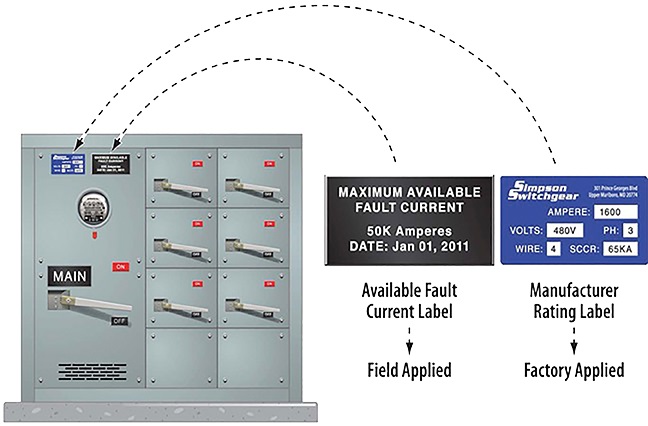
The new requirement in 110.24(A) calls for a field-applied and legible marking that indicates the maximum available fault current being supplied at the service equipment’s line terminals. This rule does not require anything new from designers or engineers, since this information must be known to specify and install service equipment within its ratings. The only new requirement is the marking, which typically is accomplished by use of a label or sign in a readily visible location on the equipment, usually near the main service disconnect.
Utility companies typically publish maximum available fault current values in their service requirement regulations and guidelines. These can be obtained by contacting the utility company, and the published values can often be downloaded from the Internet. The other important information required on this marking is the installation date, which is a time stamp to indicate that, at this point in time, the service equipment had the minimum required SCC ratings necessary for a Code-compliant installation.
There is nothing new here relative to properly rated equipment being connected to a source. To properly design an electrical service or system with adequate SCC ratings on equipment, the starting maximum value of fault current must be known. The maximum value should be included in the markings now required for service equipment. As an example, if the maximum available fault current delivered to a service is 50,000 amperes, the equipment must have a SCC rating for at least that much.
The requirements in 110.24(A) are related to equipment ratings only and should not be used for arc flash hazard analysis, as indicated in the informational note following 110.24(A). Even though the amount of available fault current is typically used in the arc flash incident energy studies, this NEC rule requires a maximum value rather than the actual value. NFPA 70E, Standard for Electrical Safety in the Workplace, provides the information to assist in determining the severity of potential exposure and selecting appropriate personal protective equipment.
Section 110.10 provides general requirements for equipment to have appropriate SCC ratings. Note that this section does not have a time limit and does not address legacy equipment or grandfathering of installations. This rule simply requires that the equipment be properly rated. Any service equipment with a SCC rating less than the maximum available fault current is in violation of the NEC and is potentially unsafe. It’s as simple as that.
Let’s look at the part of this rule that deals with system modifications. Subdivision (B) in 110.24 introduces a more progressive approach to dealing with existing installations and raises the awareness level that an older service or equipment may no longer be adequately rated for the maximum available fault current. In complying with the marking requirement in (A), it can easily be determined that the existing service equipment continues to comply with, or is in violation of, the minimum rating requirements. This new marking requirement raises the awareness level for owners, installers, contractors and others that there is or could be a problem with the existing equipment’s SCC ratings.
The modifications addressed in subdivision (B) typically relate to installations that have been in use for some time. Often, the supply network or power infrastructure can experience capacity needs that change, requiring larger capacity transformers that replace smaller ones. The result is service equipment with inadequate SCC ratings. Sometimes, an owner does not even know this condition exists.
There is an exception, which relaxes the labeling requirement for industrial establishments and is only applicable under the controlled conditions described in the exception. It does not relieve the requirement for compliance with the equipment rating. The equipment must always be suitable for the maximum available fault current at its line terminal, just as it always did. This new requirement will assist owners, engineers, designers, contractors, workers and inspectors in attaining compliance with 110.9 and 110.10, not only for new installations, but those remodels and retrofits that happen some time after the original equipment was first energized.
About The Author

Michael Johnston
NECA Executive Director of Codes and Standards (retired)JOHNSTON, who retired as NECA’s executive director of codes and standards in 2023, is a former member and chair of NEC CMP-5 and immediate past chair of the NEC Correlating Committee. Johnston continues to serve on the NFPA Standards Council and the UL Electrical Council. Reach him at [email protected].