You're reading an older article from ELECTRICAL CONTRACTOR. Some content, such as code-related information, may be outdated. Visit our homepage to view the most up-to-date articles.
All of the first eight chapters in the National Electrical Code (NEC) contain at least five articles except one. Chapter 1, General, contains only two articles. The first, Article 100, contains definitions essential to the proper application of the NEC. As stated in the scope of Article 100, it is not intended to include commonly defined general terms or commonly defined technical terms from related codes and standards. If a term is used in two or more articles, the term is defined in Article 100. If a term is only used in one article, the definition will be included in the article in which it is used, but the term still may be referenced in Article 100.
The second or last article in Chapter 1 is Article 110, Requirements for Electrical Installations. As stated in 110.1, it covers general requirements for the examination and approval, installation and use, access to and spaces about electrical conductors and equipment; enclosures intended for personnel entry; and tunnel installations. While this scope mentions quite a few things covered in Article 110, it does not come close to mentioning everything covered in the article.
Last month’s column covered the arc flash hazard warning requirements in 110.16. The next section also uses a term that was used in 110.16 but not in the same way. Section 110.16 covers arc flash hazard warnings, and 110.18 covers arcing parts. If parts of electrical equipment in ordinary operation produce arcs, sparks, flames or molten metal, they shall be enclosed or separated and isolated from all combustible material. An informational note under 110.18 instructs the Code user to see Articles 500 through 517 for hazardous (classified) locations and Section 430.14 for motors. In accordance with 430.14(B), open motors that have commutators or collector rings shall be located or protected so that sparks cannot reach adjacent combustible material.
Section 110.21 was revised in the 2014 edition. The section—“Marking”—is the same in the 2014 edition as it was in the 2011 edition. The three sentences that were in Section 110.21 are now in 110.21(A), and this subsection is now titled “Manufacturer’s Markings.” In accordance with 110.21(A), all electrical equipment shall have a marking or label that contains the manufacturer’s name, trademark or other descriptive marking by which the organization responsible for the product can be identified. As stated in the next sentence, other markings that indicate voltage, current, wattage or other ratings shall be provided as specified elsewhere in the Code. The marking or label shall be of sufficient durability to withstand the environment involved.
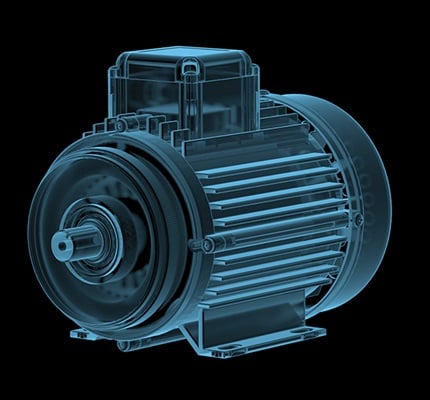
The only information required by this section is a marking or label that identifies which organization is responsible for the product. Other sections require additional information such as voltage, current and wattage to be marked on the electrical equipment. For example, in accordance with 430.7(A), the manufacturer’s name is just one of many items that must be marked on a motor. Some of the other items include rated volts and full-load current; rated frequency and number of phases (if an AC motor); rated full-load speed; rated temperature rise or the insulation system class and rated ambient temperature; time rating; rated horsepower (hp) if ⅛ hp or more; Code letter or locked-rotor amperes (if an AC motor rated ½ hp or more); and design letter for B, C or D motors.
While 430.7(A) lists 15 items, not all of them are required to be on every motor. For example, if a motor is provided with a thermal protector complying with 430.32(A)(2) or (B)(2), it shall be marked “Thermally Protected” [430.7(A)(13)]. This section has an alternative provision for motors rated 100 watts (W) or less. Thermally protected motors rated 100W or less and complying with 430.32(B)(2) shall be permitted to use the abbreviated marking “T.P.” See 430.7(A)(1) through (A)(15) for a complete list of information required to be marked on a motor (see Figure 1).
In the 2014 NEC, a new subsection was added to 110.21, which covers field-applied hazard markings. Required hazard signs and labels, such as the required arc flash hazard warning in 110.16, are in a number of places throughout the Code. In accordance with 110.21(B), where the NEC requires caution, warning or danger signs or labels, the labels shall meet all of the requirements in 110.21(B)(1) through (3). While there are a number of locations throughout the Code that require some type of field or factory marking, not every marking has to meet the requirements in 110.21(B).
For example, 110.24(A) pertains to field marking certain equipment with the maximum available fault current. It does state the field marking(s) shall be of sufficient durability to withstand the environment involved but does not specify the marking shall meet the requirements in 110.21(B). Section 110.21(B) only applies to caution, warning and danger signs. The first requirement for field-applied hazard markings is that the marking shall use effective words, colors or symbols to adequately warn people of the hazard.
An informational note under 110.21(B)(1) provides help in determining the physical appearance of the sign or label. As stated in the note, guidelines for suitable font sizes, words, colors, symbols and location requirements for labels are in ANSI Z535.4 2011, Product Safety Signs and Labels. A danger sign indicates a hazardous situation, which, if not avoided, will result in death or serious injury if an accident occurs. This signal word is to be limited to the most extreme situations. A warning sign indicates a hazardous situation, which, if not avoided, could result in death or serious injury if an accident occurs. A caution indicated a hazardous situation, which, if not avoided, could result in minor or moderate injury if an accident occurs (see Figure 2).
The second requirement for field-applied hazard markings states the label shall be permanently affixed to the equipment or wiring method and shall not be handwritten. Even if a permanent marker is used, hand writing the words “Danger,” “Warning” or “Caution” shall not be permitted. While this is not permitted, certain information can be written on the sign or label.
In accordance with the exception to 110.21(B)(2), portions of labels or markings that are variable, or that could be subject to changes, shall be permitted to be handwritten and shall be legible. In accordance with 110.21(B)(3), the label shall be of sufficient durability to withstand the environment involved. The informational note under this section references an ANSI standard that provides guidelines for the design and durability of safety signs and labels for application to electrical equipment. The document referenced in this informational note is the same document referenced in the informational note in 110.21(B)(1).
As previously mentioned, a number of sections throughout the Code require a caution, warning or danger sign (or label). Instead of each of those sections containing the requirements for field-applied hazard warnings, those sections say the marking shall meet the requirements in 110.21(B). For example, 110.16 requires an arc flash hazard warning. As stated in the second sentence, the marking shall meet the requirements in 110.21(B) and shall be located so as to be clearly visible to qualified people (see Figure 3).
Next month’s column continues the discussion of electrical installation requirements.
About The Author
Charles R. Miller, owner of Lighthouse Educational Services, teaches custom-tailored seminars on the National Electrical Code and NFPA 70E. He is the author of “Illustrated Guide to the National Electrical Code” and “Electrician's Exam Prep Manual.” He can be reached at 615.333.3336 and [email protected]. Connect with him on LinkedIn.