You're reading an older article from ELECTRICAL CONTRACTOR. Some content, such as code-related information, may be outdated. Visit our homepage to view the most up-to-date articles.
Article 110 in the National Electrical Code (NEC) covers general requirements for the examination and approval, installation and use, access to and spaces about electrical conductors and equipment; enclosures intended for personnel entry; and tunnel installations (110.1). It contains a number of rules and regulations.
For example, as 110.3(B) states, listed or labeled equipment shall be installed and used in accordance with any instructions included in the listing or labeling. This rule is easily overlooked. The requirement in 110.3(B) is a mandatory rule because it uses the term “shall.” As stated in 90.5(A), mandatory rules identify actions that are specifically required or prohibited and are characterized by the use of the terms “shall” or “shall not.”
Another type, permissive rules, are actions that are allowed but not required and are normally used to describe options or alternative methods. They are characterized by the use of the terms “shall be permitted” or “shall not be required.” For example, the last sentence of the first paragraph in 110.14(A) is a permissive rule. Connection by means of wire-binding screws or studs and nuts that have upturned lugs or the equivalent shall be permitted for 10 AWG or smaller conductors [110.14(A)]. While most sections in Article 110 contain mandatory rules and permissive rules, some sections contain general statements that are neither mandatory nor permissive. For example, 110.6 is just a general statement; it is not a rule. As stated in 110.6, conductor sizes are expressed in American wire gage (AWG) or in circular mils. This general statement is in Article 110 to explain how conductor sizes are stated in the Code book.
The requirement in 110.11 is similar to the requirement in 110.3(B). As stated in 110.3(B), listed or labeled equipment shall be installed and used in accordance with any instructions included in the listing or labeling. The requirement also pertains to equipment installation. Unless identified for use in the operating environment, no conductors or equipment shall be located in damp or wet locations; where exposed to gases, fumes, vapors, liquids or other agents that have a deteriorating effect on the conductors or equipment; or where exposed to excessive temperatures (110.11). Conductors and equipment must be selected in accordance with the type of environment in which they will be installed.
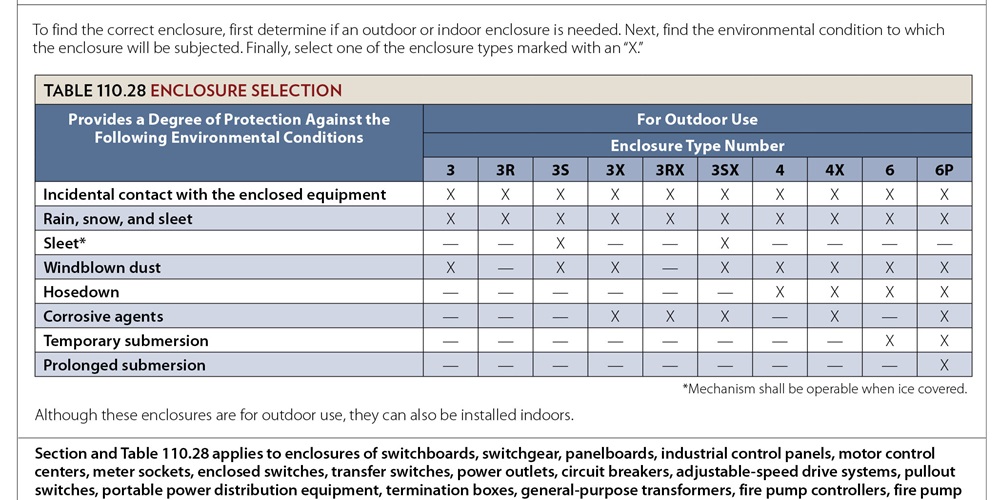
For example, a main-breaker panelboard will be installed as service equipment. The panelboard will be located outdoors in a wet location. Because of this, the panelboard cabinet must be listed for use in a wet location. The enclosure for this panelboard will be Type 3R, which is listed for outdoor use. Because conductors will be installed in the panelboard cabinet, the conductors must also be listed for use in a wet location. A common insulation for electrical conductors is Type THHN, but this is not permitted in a wet location. Many conductors are listed for more than one insulation type. A conductor with Type THHN insulation may actually have an insulation of THHN/THWN or even THHN/THWN-2/MTW. In accordance with Table 310.104, a conductor with the letter “W” in the insulation type can be installed in wet locations (see Figure 1).
The last paragraph in 110.11 pertains to protecting equipment exposed to weather during construction. As defined in Article 100, a dry location may be temporarily subject to dampness or wetness, such as in a building under construction. If dry-location or damp-location equipment will be temporarily exposed to weather, the equipment must be protected. Equipment not identified for outdoor use and equipment identified only for indoor use—such as “dry locations;” “indoor use only;” “damp locations;” or enclosure Types 1, 2, 5, 12, 12K or 13—shall be protected against damage from the weather during construction (110.11).
The next section in the article has remained unchanged for more than 50 years. In accordance with 110.12, electrical equipment shall be installed in a neat and workmanlike manner. The term “workmanlike” has been in the Code since 1947, though it is not common anymore. If this section were added to the Code today, it might say that electrical equipment shall be installed in a “neat and professional” manner.
Sometimes knockouts are removed from boxes and box connectors or fittings are not installed. The hole left by the removed knockout is an unused opening. In accordance with 110.12, unused openings shall be closed to afford protection substantially equivalent to the wall of the equipment.
For example, a 4-inch square metal box (sometimes referred to as a four-square box, a 1900 box or a 4S box) had three knockouts removed. An EMT connector has been installed in the opening at the bottom of the box but the other two openings will not be used and, therefore, must be closed. Installing duct tape over the opening closes it, but the duct tape does not provide protection that is significantly equivalent to the wall of the box. Installing knockout seals listed for the openings will close the openings and provide the proper protection (see Figure 2).
The requirement for unused openings applies to more than just boxes; the requirement applies to equipment. As defined in Article 100, equipment is a general term, including fittings, devices, appliances, luminaires, apparatus, machinery and the like used as a part of, or in connection with, an electrical installation. It is also important to make sure there are no unused openings in equipment such as switchboards, switchgear, panelboards and motor control centers.
For example, four too many circuit breaker knockouts were removed from the panelboard cover. Because circuit breakers will not be installed to fill the space, the opening must be closed to afford protection substantially equivalent to the wall of the equipment. Filler plates listed for use with the panelboard will be installed to close the opening (see Figure 3).
In the 2008 NEC, there was a change to 110.12(A). Before the change, this section specified that unused openings shall be closed to afford protection substantially equivalent to the wall of the equipment. A lot of equipment, such as boxes, panelboards, etc., are manufactured with some openings or holes already in the equipment. It is not required to close openings intended for the operation of equipment, openings intended for mounting purposes and openings permitted as part of the design for listed equipment.
For example, a 4-inch square metal box has been installed on a concrete block wall. Two EMT connectors have been installed where two knockouts were removed. Other than those two knockouts, no other knockouts were removed. Two anchors have been installed to secure the box to the wall. This box has additional mounting holes in the back and sides that will not be used. In the back of the box, there is a threaded hole for the attachment of an equipment grounding conductor. In this installation, the threaded hole will not be used. There is no need to close the additional holes intended for mounting purposes. There is also no need to close the threaded hole because it is part of the design for this box. In this box, there are openings, but none of them are required to be closed (see Figure 4).
The last section in 110.12 pertains to integrity of electrical equipment and connections. Internal parts of electrical equipment—including busbars, wiring terminals, insulators and other surfaces—shall not be damaged or contaminated by foreign materials such as paint, plaster, cleaners, abrasives or corrosive residues [110.12(B)]. It is important to ensure the electrical equipment is not damaged or contaminated before, during and after installation.
Before this section was added to the 1993 NEC, there were occasions when electrical equipment became damaged as a result of not being properly protected. Because of this, paint and debris comprised the electrical reliability of busbars in panelboards, switchboards, switchgear and motor control centers as well as meter sockets in meter bases. For example, there were times when the busbars or guts were left unprotected inside panelboard cabinets during construction. It was not uncommon to find the panelboard, including the busbars, spray painted the same color as the walls (see Figure 5).
Next month’s column continues the discussion of Article 110.
About The Author
Charles R. Miller, owner of Lighthouse Educational Services, teaches custom-tailored seminars on the National Electrical Code and NFPA 70E. He is the author of “Illustrated Guide to the National Electrical Code” and “Electrician's Exam Prep Manual.” He can be reached at 615.333.3336 and [email protected]. Connect with him on LinkedIn.