You're reading an older article from ELECTRICAL CONTRACTOR. Some content, such as code-related information, may be outdated. Visit our homepage to view the most up-to-date articles.
In a recent training presentation, a question came up about the new identification requirements for automatically controlled receptacles. Does the marking need to be on the receptacle face, or is a marking on the faceplate in compliance? Let’s look at these new requirements and the rules that apply.
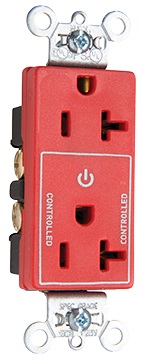
The 2014 edition of the National Electrical Code (NEC) includes new requirements for identifying receptacles that are controlled by energy management systems. Many jurisdictions that regularly adopt the NEC also adopt energy codes that require control of receptacles. The new requirements address specific markings for receptacles using a commonly recognized power symbol as shown in Figure 406.3(E). Because this new figure is not identified as an informational note figure, it is a mandatory marking symbol. The objective is to provide a readily identifiable means for occupants to easily distinguish receptacles that remain continuously energized from receptacles that are automatically controlled on and off. This issue can be a safety matter for building occupants in that the users are generally not aware of when the receptacles will be energized. It can also be an inconvenience if equipment, such as refrigerators and battery chargers, are inadvertently connected to automatically controlled receptacles. The need to identify them is justified.
The text of 406.3(E) makes it clear that identification is only required for automatically controlled receptacle outlets or if the receptacle incorporates control features that de-energize it for energy management or building automation. This means the receptacle outlet, and not the receptacle itself, requires the marking. As worded, this requirement is vague about location, and it’s because NEC Article 100 defines the terms “receptacle” and “outlet.”
These two terms are not synonymous, yet many think they are. A receptacle outlet is an outlet with an installed receptacle. The definitions in NEC Article 100 provide the clarification for properly applying the rule. One could interpret that rule to mean that the required power symbol in Figure 406.3(E) would be acceptable if located on the faceplate of the receptacle outlet. So far, that is a correct approach, and NEC compliance with this rule as written could be achieved by locating the power symbol marking on the face or faceplate.
The requirements for installing automatically controlled receptacles originate in Section 8.4.2 of ASHRAE 90.1 2013. This rule mandates automatic control of not less than 50 percent of 125-volt, 15- and 20-ampere receptacles in all private offices, conference rooms, copy or printer rooms, break rooms, and individual workstations. This performance requirement is more restrictive than the minimum NEC requirements and necessitates installing additional wiring and a means of automatic control.
Section 8.4.2 of ASHRAE 90.1 also requires the controlled receptacle(s) to be marked to differentiate them from the uncontrolled receptacles. This requirement differs from the NEC and is more restrictive in that the marking is for the receptacle only, not the receptacle outlet. Jurisdictions adopting ASHRAE 90.1 must meet marking requirements that differentiate an automatically controlled receptacle from other receptacle types. However, the rule in ASHRAE 90.1 does not require the symbol shown in Figure 406.3(E) as the NEC requires. An inconsistency exists. Another problem is that many building occupants will not know the meaning of the power symbol on a receptacle face, which may necessitate additional markings. This is a good opportunity for public input to change the NEC. Public input can be submitted to NFPA at www.nfpa.org.
Those involved in electrical system design, engineering and installation must be aware of the differing requirements. When two codes apply to the same aspect of an electrical system and they differ, jurisdictions typically render the more restrictive of two requirements as the one that must be complied with.
The requirements in ASHRAE 90.1 for receptacle marking should be consistent with the NEC, but they are not. It will lead to some confusion or inconsistencies in the field, especially in jurisdictions that adopt both the 2014 NEC and ASHRAE 90.1. There is a rapidly developing need for standards-development organizations (SDOs) to coordinate the electrical requirements of safety and performance codes so correlation exists rather than conflicts. This requires communication between the standards-developing organizations during the standards-development processes. While it is understood that energy codes are intended to address performance requirements that result in energy management and reduction, the performance requirements where adopted should drive the installation requirements that should reside in the NEC.
Effective collaboration and coordination of rules in different standards is necessary so that duplicate or conflicting requirements do not result. The meaning of marking requirements should also be clear to the public. The electrical industry and the public both deserve it.
About The Author

Michael Johnston
NECA Executive Director of Codes and Standards (retired)JOHNSTON, who retired as NECA’s executive director of codes and standards in 2023, is a former member and chair of NEC CMP-5 and immediate past chair of the NEC Correlating Committee. Johnston continues to serve on the NFPA Standards Council and the UL Electrical Council. Reach him at [email protected].