You're reading an older article from ELECTRICAL CONTRACTOR. Some content, such as code-related information, may be outdated. Visit our homepage to view the most up-to-date articles.
Jim Dollard has an extensive background in codes and standards. If you have a query about the National Electrical Code (NEC), Jim will help you solve it. Questions can be sent to [email protected]. Answers are based on the 2014 NEC.
Conductors installed on rooftops
The NEC requires the electrical contractor to reduce the allowable conductor ampacity for conductors installed in conduits on rooftops exposed to sunlight. As a result, we do all we can to keep from running conduit on rooftops, because of the significant increase in conductor size due to the required adjustments. An exception in the 2014 NEC permits conductor type XHHW-2 to be installed without the ampacity corrections. Why is this limited to only type XHHW-2 insulation types? Other 90°C-rated insulation types that are readily available.
The requirement you refer to applies to conduits and cables. Third-level subdivision 310.15(B)(3)(c) contains required temperature-adjustment factors for conductors installed in raceways and cables exposed to sunlight on rooftops. Where this occurs, the adjustments shown in Table 310.15(B)(3)(c) must be added to the outdoor temperature to determine the applicable ambient temperature for application of the correction factors in Table 310.15(B)(2)(a) or Table 310.15(B)(2)(b). There are two informational notes to assist the user in determining the appropriate ambient outdoor temperature based on the location of the individual installation.
The 2014 NEC introduced an exception to 310.15(B)(3)(c), exempting insulation type XHHW-2 from the rooftop adder requirements. Significant technical substantiation was provided to the technical committee to add this exception. A fact-finding study revealed that type XHHW-2 insulated conductors were subjected to tests that simulated the most extreme exposure to heat on a rooftop that could occur over a 30-year period. To simulate such severe exposure, the XHHW-2 conductors were subjected to 250°F for 60 days. The results proved that this insulation type performed extremely well and the technical committee agreed that the rooftop-adjustment factors were not necessary for XHHW-2 insulation types. While there are other 90°C-rated conductors, they were not all subjected to the same tests; therefore, the exception is limited to XHHW-2 insulation.
Controlled receptacle markings
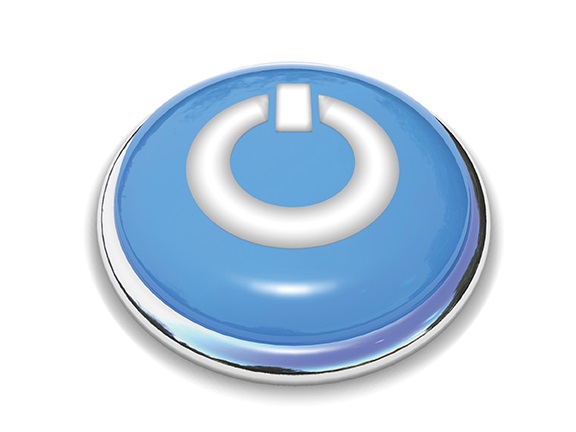
The new requirement for receptacles with a power button marking has me a bit confused. The required symbol is the universal symbol for a power switch or an on/off button. How will end-users know what this marking means? I think many end-users will attempt to turn on or off a device by pressing this marking. Why was this symbol used? Where do we place the marking? Can it be on the plate, or must the receptacle itself be marked? I understand that—if there is an automatic means of control—the marking must be applied, but the exception negates that requirement where a motion sensor, for example, is used in dwellings and guest rooms/suites. Shouldn’t they be marked as well?
The requirement you reference is new in the 2014 NEC. A new first-level subdivision 406.3(E) requires marking for receptacles that have a means of automatic control. This applies only to nonlocking type, 125-volt (V), 15- and 20-ampere (A) receptacles that are automatically controlled and is not limited to only lighting. Any new requirement in the NEC typically sees some modifications for clarity and usability in the subsequent revision cycle. A number of public inputs have been submitted to revise this requirement for the 2017 NEC, and a few address some of your questions.
As you say, the symbol chosen by the technical committee is universally understood as the power on/off symbol. There has been much discussion on the choice of that symbol instead of a marking that states “Receptacle Automatically Controlled.” I agree that the end-user may be confused, but installers and people that maintain electrical systems should stay current with changes in the NEC and should understand these markings. As written, the location of the required marking is confusing. The first sentence addresses both the receptacle itself and the controlled outlet and may be interpreted to mean the device or the cover plate. Clarity is needed here. The intent of this requirement is for receptacles that are controlled by an energy-management system or other building-automation system and is not limited to receptacles controlled by a wall switch that are permitted in lieu of a lighting outlet. This requirement will most certainly be revised in the 2017 NEC.
Maintaining power continuity
Most of the work my company performs is located primarily in a few coastal counties in Hurricane Alley. Over the last few years, we have done several upgrades for emergency and other systems that included relocating generators above the flood plain. This includes commercial companies, small industry and some healthcare. What else should we advise our clients to do to maintain continuity of service in weather-related outages?
Where there is a critical need for power continuity, Article 708, Critical Operations Power Systems (COPS), can be applied. Typically, this article only applies where mandated by municipal, state, federal or other codes by any governmental agency having jurisdiction or by facility engineering documentation establishing the necessity for such a system. The article typically applies to military, police, 911 call centers and other installations in which a power interruption could disrupt national security, the economy and public health or safety. Where it is not mandated by another entity, a designing engineer can also require compliance with all or part of Article 708.
COPS require a risk assessment to be performed to identify hazards, the likelihood of their occurrence and the vulnerability of electrical systems to those hazards. The assessment aids in determining the means and methods necessary to maintain power continuity in a site-specific manner. Application of Article 708’s requirements results in designs that are specific to an individual installation along with hardened installation methods to maintain power continuity. Chapter 5 of NFPA 1600 2013, Standard on Disaster/Emergency Management and Business Continuity Programs, provides additional guidance concerning risk assessment and hazard analysis.
Qualified person?
In discussions with an owner during a recent project, I found myself going in circles with their company safety department. The department wanted documentation that each employee had “demonstrated” their skills and knowledge on all of the electrical equipment involved in the project. After some discussion, I learned that NFPA 70E has a slightly different definition of “qualified person” than Article 100 of the NEC. The 70E definition requires that the “skills and knowledge” related to the construction of the operation of electrical equipment be “demonstrated.” This could be a significant burden on employers. There was no energized work being performed. How could one possibly document that an individual has “demonstrated” their skills and knowledge on every piece of electrical equipment?
The definitions of “qualified person” in the NEC and in NFPA 70E are similar, but there are significant differences. It should be noted for clarity that, while the NEC and NFPA 70E both address electrical safety, they are dynamically different. The NEC is an electrical installation code, and NFPA 70E deals primarily with electrically safe work practices. The NFPA 70E technical committee added the word “demonstrated” in the defined term to correlate with the Occupational Safety and Health Administration (OSHA) definition of “qualified person.” The OSHA definition mandates training in and demonstration of skills and knowledge in the construction and operation of electrical equipment and installations along with the hazards involved. An individual who completes required training in skills and knowledge of the construction/operation of electrical equipment and the hazards involved, through a program such as an apprenticeship and on-the-job training, can meet the OSHA definition.
The NEC definition goes a bit further by including that the individual receives safety training to recognize and avoid the hazards involved. It is imperative that employers ensure all employees are qualified for the equipment on which they will work and the tasks they will perform. An individual may be qualified on one piece of equipment, system or task but not qualified for another.
In this case, the training and experience of the employees involved on similar equipment and installations in the past should have been adequate for the owner. NFPA 70E covers how to determine “qualified person” status where exposure to energized conductors and circuit parts exists, and it requires substantially more documented training.
ELECTRICAL CONTRACTOR is saddened by the loss of Charlie Trout. The former NEC expert and contributor to this column passed away in late October. As a life-long Code expert, his contributions to the industry are invaluable. He will be missed. For more about Charlie’s life and career, visit www.ecmag.com/charlie-trout-in-memoriam.
About The Author

DOLLARD is retired safety coordinator for IBEW Local 98 in Philadelphia. He is a past member of the UL Electrical Council, NEC Correlating Committee, NEC CMP-10, CMP-13, CMP-15, NFPA 90A/B and NFPA 855. Jim continues to serve on NFPA 70E as a Special Expert. Reach him at [email protected].