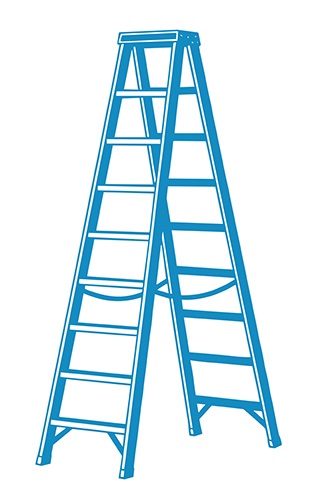
Electricians can spend a lot of time working at heights. Ladders are used for many types of work, from trimming out lighting and installing conduit to troubleshooting panels and running low-voltage cabling. Because ladder use is so routine, hazards are often underestimated, and statistics continue to show that ladder-related incidents remain a significant cause of injuries.
According to the U.S. Bureau of Labor Statistics, falls from ladders result in thousands of injuries each year. While these incidents can result in fractures, head trauma and even death, ladder risks often receive less attention and training than other hazards.
Electrical workers must also consider the electrical hazards associated with ladder use. A study conducted by the Centers for Disease Control and Prevention and the National Institutes of Health found that 91% of ladder-related electrocution deaths happened because portable metal ladders contacted overhead power lines.
Correct ladder selection
To mitigate the risk of falls and shock, correct ladder selection is critical. Fiberglass or nonconductive ladders are almost always required when there is risk of electrical exposure, since aluminum ladders can become a conductive hazard when working on or near energized components or overhead service conductors.
Additionally, extension, step, platform and articulated ladders all serve a specific purpose. Using the wrong ladder may cause overreaching, unstable positioning or climbing beyond the manufacturer’s recommended limits. For these reasons, OSHA requires ladders to be used only for their intended purpose.
Additionally, OSHA emphasizes that ladders must be able to support all intended loads, including the worker and their tools. Overloading is an extremely common factor in most ladder mishaps.
Safety tips
Tools and ladders take abuse on job sites and during transport. They get dragged across rough terrain and exposed to moisture, and they are often improperly used as scaffolding or planks. This all compromises their integrity.
As time progresses, rungs loosen, rails crack, feet wear down and locking mechanisms break down or deteriorate. Therefore, OSHA requires ladders to be inspected prior to each use. Any ladder with visible structural defects must be tagged and removed from service until it can be repaired or thrown away. This inspection should become routine and include a check of side rails for cracks or splits, rungs for bending or looseness, feet for wear or missing slip-resistant pads, and spreaders and locks for proper function.
An improperly set up ladder is one of the most common causes for falls. For every 4 feet of vertical rise, the base should be 1 foot away from the structure. This is known as the 4-to-1 rule, and it especially applies to extension ladders. Stepladders must be fully opened with spreaders in the locked position. Ladders should never be used when folded or leaned against surfaces unless specifically designed to do so.
Electrical work frequently presents unique positioning challenges. Workers often place ladders in front of panels, inside mechanical rooms or near energized equipment. Whenever possible, circuits should be de-energized prior to beginning work. Falls combined with electrical contact to energized components can be catastrophic.
The Electrical Safety Foundation International also acknowledges the reverse. Falls can be a common secondary outcome following electrical contact. A shock often leads to a loss of balance and a subsequent fall. As a result, stable footing is always critical. Ladders should never be placed on boxes, pallets or uneven surfaces to gain additional height. If the task requires extended reach, a lift or scaffold should be used instead.
Workers should always maintain three points of contact while on a ladder. This means that either two hands and one foot, or two feet and one hand, always remain in contact with the ladder. Electrical workers often carry tools, testers or materials while climbing. Tool belts, hoists or hand lines should be used to raise materials instead.
Workers should also avoid overreaching. If a worker’s center of gravity moves outside the ladder’s side rails, it can tip. Climbing down to reposition may seem inconvenient, but it would be a far greater inconvenience to fall and become injured or worse.
Ladder safety cannot be separated from electrical safety. Prior to any work being done, workers must consider if the equipment is de-energized, whether there are exposed energized conductors nearby, the potential for arc flash, and whether the ladder is positioned within a minimum approach distance to overhead lines. Lockout/tagout procedures should always be employed when possible.
Employers must provide adequate training on safe ladder use and job site hazards to keep everyone safe.
stock.adobe.com / AIGen Studio
About The Author

O’CONNOR is safety and regulatory affairs manager for Intec, a safety consulting, training and publishing firm. Reach him at [email protected].