When I travel, I am always observing electrical installations—or what we may want to call the good, the bad and the ugly. The bad and the ugly are most notable since dangerous and improperly installed electrical installations always grab my attention first.
When I see something extremely dangerous, I find it very difficult to just walk away without pointing it out to someone in charge. This brings me some relief, even if the situation may not be corrected. At least I tried—hopefully, someone will take care of the hazardous situation and no one will be hurt.
When I travel with my wife Vicki, a registered nurse, she constantly reminds me not to touch railings on the movable walkways and escalators, buttons on elevators, handles on gasoline pumps and other similar locations where bacteria, viruses and similar microbes lurk. I am certainly much less aware of the hazards that she is acutely cognizant of, such as the coronavirus and similar dangers, and much more aware of the electrical hazards.
Recently, we were on an escalator at Phoenix International Airport, and I noticed a sign explaining that the railings were disinfected using germicidal lamps. At long last, I could touch the railings without having to worry about carrying germs on my hands and infecting myself and everyone around me. No longer would I have to use hand sanitizer every time I touched anything and everything, as I am likely to do on a regular basis. I am not sure how it is possible that I have lived as long as I have with all of these small critters that we can’t see, lurking in the background, waiting to strike us down.
Added to the Code
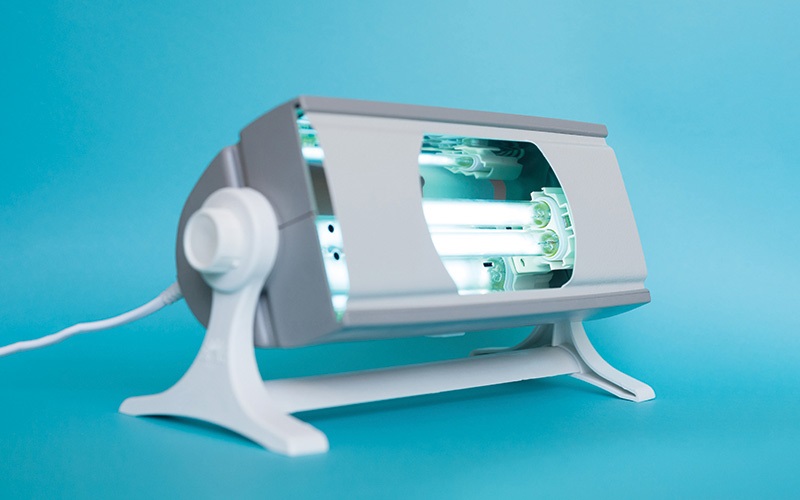
I was more than excited to see that a new Part XVII, labeled “Special Provisions for Germicidal Irradiation Luminaires,” has been added to Article 410 in the 2023 National Electrical Code. Section 410.191 in the 2023 NEC requires these special luminaires, which emit germicidal irradiation, to be listed and identified as germicidal equipment. They are required to be installed in accordance with the manufacturer’s instructions and equipment marking.
How do they work?
Inside these luminaires, which gained popularity during the pandemic, is a special lamp that is also called a disinfectant or sterilizer lamp that produces ultraviolet-C (UV-C) light. The short-wave UV-C light disrupts DNA base pairing in a way that blocks DNA/RNA replication and its transcription into proteins, causing bacteria, viruses and protozoans to become inactivated.
This concept is likely better understood by my wife, my daughter Danielle—also a registered nurse—and my other daughter Trina, a doctor in Colorado. I am surrounded by medical expertise in my family, which is a good thing. They are much smarter about the thought process leading to the inactivation of bacteria, viruses and protozoans than I am. I wouldn’t know what a protozoan was if I hooked one while fishing in a lake somewhere. All I know is I sure wouldn’t want to touch one if I could help it.
Further exploration of this technology in Wikipedia (a great source for this type of knowledge) provided the following information: “Recent developments in light-emitting diode (LED) technology have led to the commercial availability of UV-C LED sources. UV-C LEDs use semiconductor materials to produce light in a solid-state device. The wavelength of emission is tunable by adjusting the chemistry of the semiconductor material, giving a selectivity to the emission profile of the LED across, and beyond, the germicidal wavelength band. The reduced size of LEDs opens up options for small reactor systems, allowing for point-of-use applications and integration into medical devices.”
Installing germicidal luminaires
The thoroughness of the 2023 NEC provides location restrictions for germicidal irradiation luminaires. These luminaires cannot be installed as lighting for general illumination, unless specifically permitted and indicated in the manufacturer’s instructions. These luminaires cannot be installed where subject to physical damage. They cannot be installed in a dwelling, unless listed and identified for use there.
Where installed in a building space that will be occupied during luminaire operation, the luminaires must not be mounted below the minimum height specified by its listing and installation instructions.
Exposing people to germicidal light could be hazardous and cause sunburn and, with long exposure, cancer. It can also cause painful corneal inflammation. As electricians, care must be taken when working with these lights by wearing effective eye and skin
protection. It’s one more thing to worry about in the search for electrical safety.
Note: For more on germicidal UV-C lighting, visit ECmag.com.
stock.adobe.com / Irina
About The Author

ODE is a retired lead engineering instructor at Underwriters Laboratories and is owner of Southwest Electrical Training and Consulting. Contact him at 919.949.2576 and [email protected].