Working in a trench, an electrician must forge a crucial permanent bond between copper and steel cables to construct a substation grounding grid. Armed with advanced training and an exothermic welding toolkit, the journeyman completes the five-step exothermic welding process safely and in a matter of minutes.
First, they use a wire brush to clean away any contaminants on the two metal surfaces. Next, they use a blowtorch to dry the inside of a graphite mold where the bond will be made. They then place the mold around the junction of surfaces and load a copper-infused cartridge that looks almost like a Keurig coffee brewing cup into the top of the mold. Connecting the cartridge’s copper tongue to a cord leading to an ignition controller, they step out of harm’s way and push two buttons. The buttons activate a charge that heats the mold to 4,600°F.
After the process is complete, they open the mold to inspect and clean the new connection. The electrician then clears away any slag from the mold and prepares to perform the procedure again wherever needed on the job site.
Harger
The Harger, Grayslake, Ill., exothermic welding kit is used extensively in the power generation setting for connecting copper conductors to steel cable and steel grounding structures. It is just one of many essential tools of the electrical industry that, over time, has evolved to eliminate hazards and save time.
But like many tools that perform complex functions, Harger’s toolkit is of little use without related training and conscientious maintenance.
More than ever, tool manufacturers are devoting almost as much attention to training people to use their tools as they are to developing and manufacturing.
Those efforts include everything from training schools and campuses to online training and sales forces.
Harger’s sales team of 20 offers on-site classes and related three-year manufacturer certifications for electrical contractors and staff qualified to train others. The sales team also trains instructors to train apprentices in exothermic welding.
That effort is crucial, because exothermic welding is the only acceptable way, according to the National Electrical Code, to forge a connection between copper and galvanized cable that ensures fail-safe electrical conduction. The process supports grounding when copper conductors must connect to steel structures or ground rods. It’s also widely used in cathodic systems that inhibit corrosion of pipelines, bridges, railroads and more.
Adam Cash, Harger’s marketing manager, added that the popularity of Harger’s exothermic welding kit is fueled by two major factors. The first is efforts to harden infrastructure and improve grid reliability. The second is the rise of data centers.
“Exothermic is wildly popular these days with so much power generation work being done at data centers,” Cash said. “Data center owners are starting to put in their own substations outside of their data centers now.”
Besides substation grounding grids, exothermic welding is also used to install lightning protection systems. Harger University in Grayslake teaches hands-on lightning protection as well, though Cash said this is more about an installation process than tool instruction.
Fluke Corp.
Testing and measuring the function of electrical systems is a strength and area of expertise for Fluke Corp., Everett, Wash., maker of digital multimeters, clamp meters, power quality analyzers, portable oscilloscopes, thermal imagers and other specialized tools.
“For an apprentice, learning begins with the fundamentals,” said Ella Bowling, manager of education strategy and partnerships for Fluke. “That includes how to safely verify voltage, measure current, resistance and continuity, and understand what those measurements are saying.”
As the apprentice moves on in his or her career, those skills expand to assessing power quality, motor troubleshooting, thermal imaging, instrumentation and other advanced diagnostics.
“Most important to us is that making a measurement is only part of the skill,” Bowling said. “A good electrician also needs to understand what measurement to take, why they’re taking it, whether they can trust the result and what the result tells them about the system.”
Since 2011, Fluke has provided equipment, training support, curriculum resources and product endowments for training centers. Beginning in 1990, the annual National Training Institute (NTI), sponsored by the ETA, NECA and IBEW, has offered training for instructors, apprentices, journeymen, JATC committee members, training directors and local union and chapter officers. Fluke provided hands-on instruction at the 2026 NTI conference.
Beyond instrumentation process calibration, Fluke also has demonstrated electrical test tools for solar.
Fluke wants its products to be effective and for initial understanding of their use not to take place in high-stakes work settings.
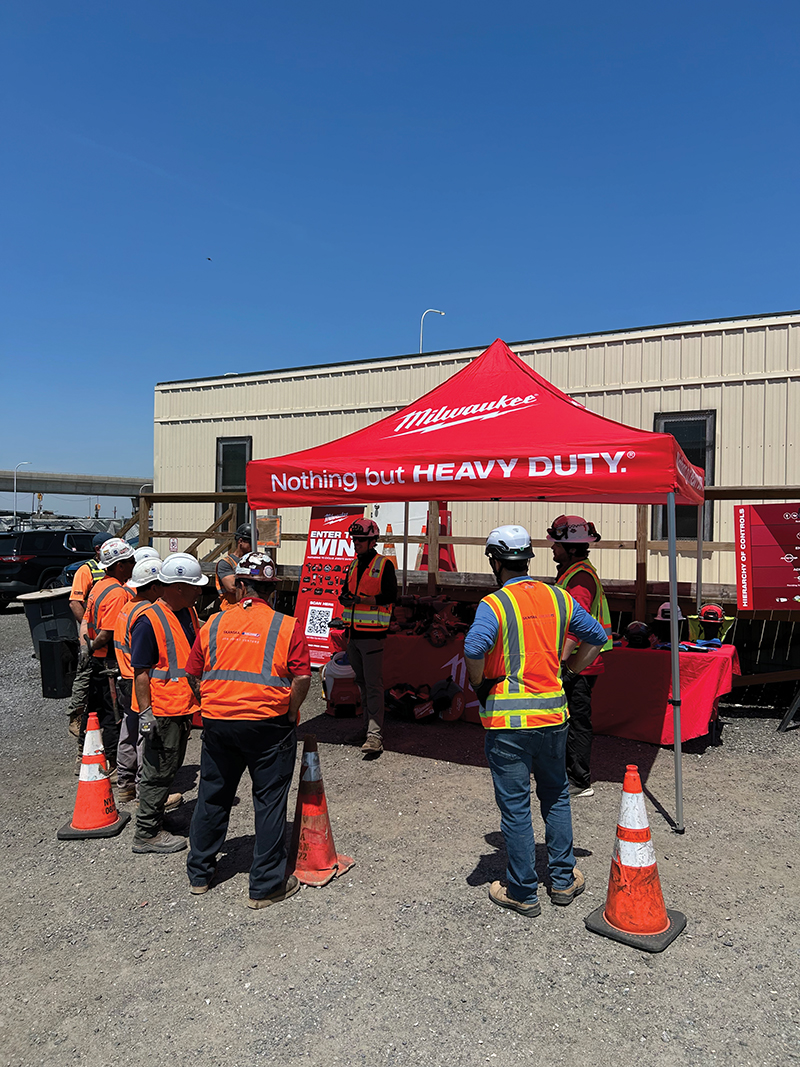 | 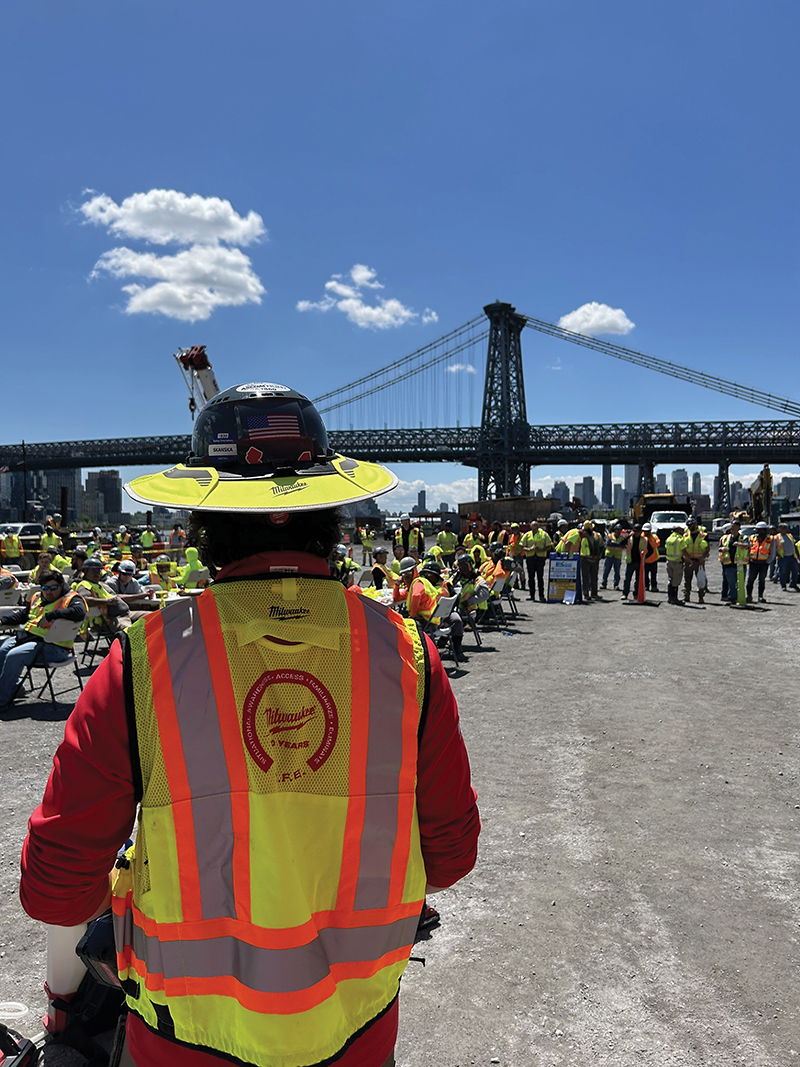 |
A Milwaukee Tool sales team member delivers a short presentation during National Safety Week
“We’re expecting the next generation of electricians to understand increasingly sophisticated electrical systems,” Bowling said. “We want that first instructional experience to happen in a training environment with a qualified instructor.”
The Fluke Education Partnership Program provides eligible education and apprentice organizations with access to discounted tools, grants and training resources. Fluke also makes thermography training and professional certification available through its partner, The Snell Group, based in Orono, Maine.
“So, we’re see training as a continuum—from an apprentice learning to use a multimeter correctly for the first time, all the way to an experienced professional developing expertise in power quality, thermography, calibration and advanced troubleshooting,” Bowling said.
Milwaukee Tool
Milwaukee Tool, Brookfield, Wis., also provides essential training on its tools on the spot. Sales teams are known for engaging one-on-one with work crews through presentations of 15 minutes or less.
“We could be doing this at 5:30 a.m., during lunch breaks or at the end of the day,” said Will Barone, Milwaukee Tool’s national account manager. “The idea is to convey what’s new in power tools and how to get the most out of them for taking on the tasks at hand.”
The presentations also enable Milwaukee Tool to stay close to the industry and gain important feedback, he said.
Besides covering tool tracking, Milwaukee now instructs on how to analyze tool use data and produce reports concerning proper crimps as well as bolt and screw tightness.
Power Tools 101, a first-year apprentice course, and other instruction supported by Milwaukee Tool cover safety for drilling, cutting, screw and bolt tightening, crimping, metal work and more.
“Our products and our instruction fall in line with what’s important to contractors and apprentices,” Barone said.
3M
Keeping the industry trained in tool use and functioning at optimum levels is a goal shared by 3M.
“It’s been an amazing opportunity to partner with the [Electrical Training Alliance],” said Patrick Lee, key account manager for 3M’s Electrical Markets Division. “This is a chance to help bridge the skills gap we’re seeing in the industry.”
During this year’s NTI conference, 3M trained 30 freshly minted journey-level electricians—all recognized as outstanding apprentices—with the goal of bringing them back as instructors someday, Lee said.
Medium-voltage cable prep taught by 3M is also an extremely important step for electrical installations and repairs.
“System failure is often the result of improper cable preparation or accessory installation, which is a craft,” Lee said. “We provide training to educate and help enable electricians to perform quality installations in medium-voltage systems. This requires knowledge, the right tools and materials, and best tips and practices.”
Factors making instruction more important than ever are the enormous scale of projects, manpower shortages and compressed timelines.
“We’re seeing more training requests than ever before,” he said.
To handle this, 3M trains electrical contractors in the field, apprentices through training centers and instructors who can teach both.
“We’re continually looking for ways to build support for training the next generation of electricians,” Lee said.
While many tool manufacturers offer online instruction, hands-on training reinforces what has been learned though classroom and computer-mediated learning and helps put those skills into practice.
Medium-voltage training is covered in years three and four of apprenticeships, and 3M’s training kits and train-the-trainer instruction align with training modules. The kits contain accessories both for classes/labs and hands-on demos in the field.
3M is known for additional specialties, including firestop, utility marking and locating, and worker safety.
Within the utility industry, locating, mapping and marking buried utility lines of all varieties is crucial for preventing formidable risks.
“Our team helps to prevent strikes [on utility lines] through technology and training aimed to mark, locate, map and help protect utility lines,” Lee said.
3M has worked directly with electrical contractors, co-presenting workshops on cable-marking technologies and mapping products. The company has also invited contractors, instructors, engineers and curriculum developers to its high-voltage lab in Austin, Texas.
stock.adobe.com/vostal, stock.adobe.com/Artstock / milwaukee tool
About The Author

DeGrane is a Chicago-based freelance writer. She has covered electrical contracting, renewable energy, senior living and other industries with articles published in the Chicago Tribune, New York Times and trade publications. Reach her at [email protected].