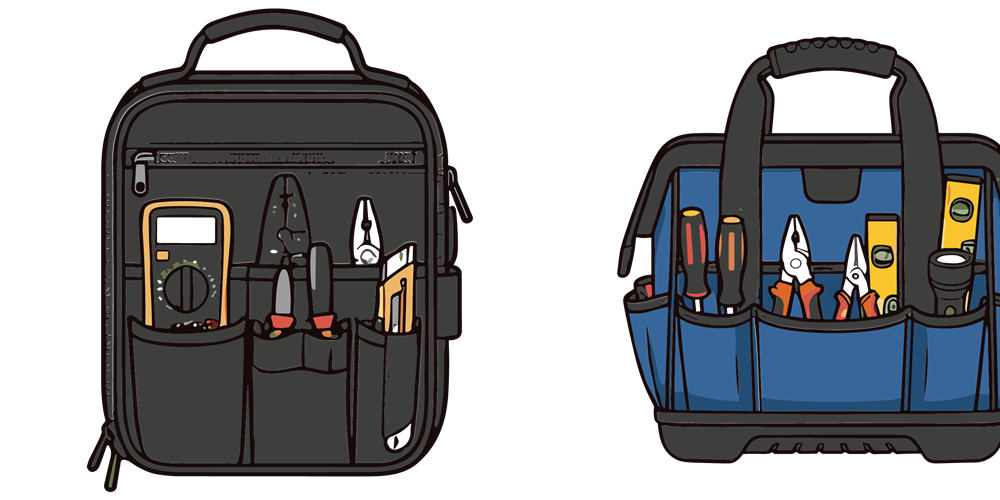
“The right tool for the job ” has always been the motto of the craftsman or technician who knows that having the proper tool makes the job easier, faster and better. As the job changes, the tools should change, too—especially when the job involves a high-tech, fast-moving technology like fiber optics.
In the earliest days of fiber optics, many installation tools were adapted from traditional wiring tools. Even today, the typical fiber stripper still looks a lot like a wire stripper. Since fiber is smaller than other wire and any roughness in the grooves can scratch the fiber and weaken it, fiber strippers have much smaller, more precise grooves than wire strippers. Even with that distinction, they look so much like wire strippers that inexperienced techs sometimes pick up the wrong tool.
Splicing and dicing
Splicing was the primary job of the outside plant (OSP) tech, so much so that most OSP fiber techs were called ”splicers.” Their methods have changed little in 50 years. Fusing the fibers in an electric arc works perfectly, so fiber cleavers and fusion splicers today work essentially the same way they always have. If it ain’t broke ...
What has changed in fusion splicers, however, is automating fiber alignment and controlling the fusion process. Splicing machines have also been modified for the different fiber coating sizes and flexible ribbons used in today’s microcables and high-fiber-count cables.
Even as fusion splicers have become higher-tech, the price has continued to fall, so every tech can now have a basic splicer in their toolkit. Next-generation fibers— hollow-core and multicore fibers—require more complex and expensive fusion splicers, but mainstream usage of those new fiber types still lies somewhere in the future.
The types of test equipment in the fiber tech’s toolkit have also changed a little. Visual fault locators (VFLs), connection inspection microscopes, light source and power meters, optical loss test sets and optical time domain reflectometers (OTDR) are still there, but they might not be recognizable to a tech of 20 years ago.
VFLs now use solid-state lasers, look like laser pointers and are about as inexpensive. Many microscopes use video cameras and can automatically analyze connector dirt and contamination problems. Sources and meters are smarter and store test data. OTDRs are also so much better, smarter and cheaper that techs even use them in premises installations.
Then and now
The big difference between OSP and premises fiber techs has traditionally been termination. Premises techs installing multimode fiber would attach connectors on each fiber using adhesives and polish the connector, a time-consuming process requiring considerable skill, patience and a lot of special tools.
As a result, premises techs’ toolkits looked very different than OSP techs’. While the premises tech’s kit lacked tools for preparing heavy-duty OSP cables, it had different fiber strippers for tight buffered fibers, scribes, crimpers, polishing pucks and pads, adhesives, syringes and polishing papers.
But that has changed. No installation process has evolved more than termination, which has caused the biggest changes in toolkits. Around 2000, factory-polished connectors with a mechanical splice in the back of the connector appeared. Termination no longer required adhesives and polishing. Many techs adopted these new connectors but quickly learned they were not yet perfected; many had high loss due to the mechanical splice and some did not hold on to the fiber well enough to be reliable. It took a while for these flaws to be addressed. Techs learned that cleaving fibers was critical for these connectors and began using the same type of cleaver used with fusion splicers.
Termination changed again when fusion splice-on connectors (now called SOCs) became available, along with lower-cost fusion splicers. Fusion SOCs were about half the price of mechanical SOCs and simple fusion splicers were comparable to some terminating kits for mechanical SOCs. The price and ease of use have made fusion SOCs the termination of choice for all fiber techs today.
While yesterday’s tech would be surprised at the changes in their toolkit, it would take no time at all to adjust to the easier installation processes available today.
STOCK.ADOBE.COM/JAMIL
About The Author

HAYES is a VDV writer and educator and the president of the Fiber Optic Association. Find him at www.JimHayes.com.