The suicide rate among U.S. construction workers is twice the national average, according to a study released last year by Purdue University. “It’s clear that this is a problem in the construction industry, above and beyond other industries,” said Sally Spencer-Thomas, a clinical psychologist, president of United Suicide Survivors International, lead author of the National Guidelines for Workplace Suicide Prevention and creator of VitalCog, a suicide prevention program with a specialized focus on the industry.
The construction industry’s risk factors
“There are unique factors within the industry that increase that risk,” said Alexandra Yannacone, director of education and community programs at the University of Colorado Anschutz’s Helen and Arthur E. Johnson Depression Center, which partners with Spencer-Thomas on VitalCog. The university partnership enables scalability by developing a pathway to become a master trainer.
“There’s a lot of elements,” Yannacone said. “Part of it is it’s a male-dominated industry, and men die by suicide at a much greater rate than women.”
Male-dominated industries—including construction—have higher rates of suicide, according to data from the Centers for Disease Control and Prevention (CDC).
The industry also sees high rates of injury. Construction workers account for more than one in six opioid overdose deaths, according to the Purdue study. Irregular access to health insurance and high costs of treatment also play a factor.
“This is an industry that has booms and busts, [and] that puts people out on the street because of injury,” Spencer-Thomas said.
Employees often face long periods of travel and time away from home for jobs, which causes them to feel disconnected from their family and communities. High stress and lack of sleep is also critical.
“With more sleep disruption, you’re more likely to have suicidal thoughts,” Spencer-Thomas said.
“It’s a recipe for disaster,” said Josh Rizzo, who leads workshops on mental health at schools, workplaces and events like the Construction Mental Health & Wellbeing Conference. “Long hours, hard work on their bodies, travel, being away from families, isolation.
“The sad thing I’ve personally seen, these young guys are working their butts off to try to make money to provide support for their family, and they lose their marriage and kids because they’re not at home cultivating those relationships,” he said. “It’s so heartbreaking.”
Beyond the demographics, Spencer-Thomas said that construction has historically had a toxic work culture and permissive culture of alcohol and drug use.
“ECs, especially on the line side, they’ve got this bravado, macho thing,” said Tom Murphy, the founder/CEO of Sweethearts & Heroes, Saint Albans, Vt., a program that has delivered presentations on empathy, hope and personal action to more than 2 million students and educators across the country. Murphy travels to deliver keynote speeches to safety professionals, lineworkers, journeymen and apprentices, the armed services, the Pentagon and others.
“After work, they’re sitting on a tailgate, drinking beer, not processing the challenges of life,” Murphy said. “Today, things like social media take us out of the 3D world. Every time they get a break, the guys are on their phones; that’s a problem. We used to build human skills just joking around with our buddies, hanging out, spending time with our peers processing life.”
“All these workers, every single one knows CPR, lockout/tagout, fall protection,” Rizzo said. “But they don’t know the signs of someone struggling or what to do if they notice. They’re paralyzed by fear [and] think they’ll be considered softies.”
“An electrical contractor will practice climbing poles, wiring, safety; but the things that insulate you against suicide take practice,” Murphy said. “Imagine if you just tested gloves after someone got hurt. No, you do that in preparation. You need to build skills in preparation of stressful events and negative emotion.”
Building trust
There are many avenues to address this mental health crisis. Washington state, for instance, recently passed House Bill 2492—the first of its kind in the country—mandating state-registered apprenticeship programs provide at least two hours of behavioral health and wellness training for building and construction trade apprentices starting in 2027.
Other methods focus on increasing awareness and creating support networks.
VitalCog raises awareness about suicidal warning signs and risk factors that contribute to mental health challenges, creates a dialogue about it in the workplace, offers resources specific to the industry and cultivates a construction community aspiring to eliminate the devastating impact of suicide.
Since its launch in August 2022, VitalCog has trained more than 20,000 people—10,000 in the last year alone.
“We’re really trying to build trust,” Spencer-Thomas said. “There are several ‘off the shelf’ trainings, but VitalCog was developed by, about and for the construction industry right out of the gate.”
“This makes it unique because we look through the lens of that population,” Yannacone said. “Our trainers work in construction; that makes a huge impact.”
VitalCog recently launched add-on trainings for substance abuse and firearm safety.
The program also holds monthly virtual and in-person train-the-trainer workshops and offers training for employees at all levels of construction organizations.
“There are lots of reasons why people don’t seek help,” Spencer-Thomas said. “They’re afraid of discrimination, or losing control, or that help will cost too much. We’ve got to lower those barriers. The way we do that is training up peers to run ahead, and they can say ‘this is a trusted path and here’s what you’ll find.’”
Murphy and Rizzo emphasized the importance of forming human connection for these programs to work.
“If we don’t personalize this, it’s just another training,” Rizzo said. “I often get called in after a suicide and hear the same thing every time: ‘Nobody saw it coming.’ Did anyone know Jimmy was dealing with a custody battle or having trouble paying his bills? We go to work and build barriers and know nothing about our coworkers.”
Workers often mock safety trainings. “They don’t have time [and] don’t want to talk about their feelings,” Murphy said.
That is why creating space for human connection, for employees and employers to see each other as people is critical.
“Providing space as much as we can is the greatest gift we can give,” Rizzo said. “To know the boss cares and is listening to you, to get feedback about how you’re doing so you’re not worried about getting fired. A lot of people don’t even have space to connect at home.”
Sweethearts & Heroes’ Circle sessions “cracked a code,” Murphy said. “We’ve tapped back into the way people for hundreds of thousands of years have connected.”
Circle is a face-to-face, communal sharing experience. They can be “flash” 20-minute check-ins or hours-long experiences.
“Our work is … reestablishing many of these human skills and creating networks of support that insulate employees against negative emotions,” Murphy said. “If a ‘flash’ Circle is all you can do, at the end of six months to a year, you’ll have a brand new group of people who understand the background of each person’s life.”
Peer-to-peer conversations are a really powerful way to keep people experiencing mental health challenges from taking an irreversible step.
“You don’t need any kind of background in mental health to know the value of having people who care about you,” Yannacone said. “Just showing somebody you care can go a long way.”
Frequency also matters. “You need to train everyone on mental health and well-being once a year, if not more, just like you do with CPR,” Rizzo said. “Get trained on what to look for [and] signs when someone’s going south. There are helpful trainings and acronyms that help you remember what to say, what to do. It takes away that fear of asking someone if they’re doing OK.”
This level of openness takes courage. “Have the courage to say we’re going to make this as important as physical safety, because if not, we’re going to lose people,” Murphy said. “We can’t stop this issue unless somebody’s got the courage to do it.”
That courage should be modeled at the top. “Leaders ask, ‘how do I get them to talk about that stuff?’ I say, ‘You’ve got to do it first. You signed up to be a leader, if you’re going to stand up in front of people you’re going to have to be vulnerable,” Rizzo said.
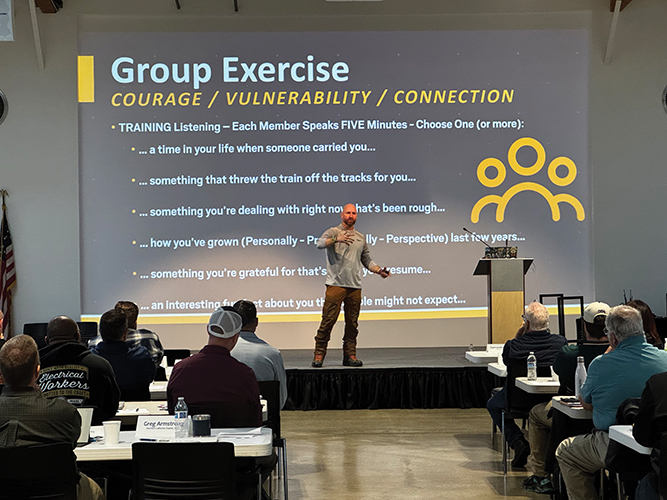 | 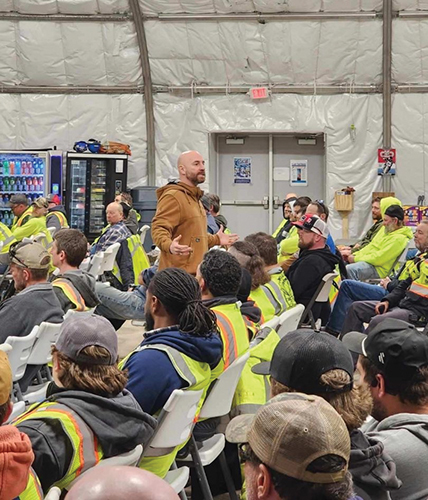 |
Josh Rizzo leads workshops on mental health at schools, workplaces and events.
Offering a ‘warm bridge’
Spencer-Thomas explained how important it is to provide people experiencing suicidal ideation with a “warm bridge.”
“It’s not enough to provide people in their darkest moment with a hot potato,” she said, meaning a confusing resource or one requiring a lot of legwork. “Just giving the 988 number without explaining what it is isn’t helpful.”
People in crisis need the least amount of work added to their plate. The legwork needs to be done, and resources need to be as simple as possible.
VitalCog complements NECA’s ongoing work with the Construction Industry Alliance for Suicide Prevention; 988, the free, 24/7 suicide and crisis lifeline; awareness chips and stickers; and mental health presentations across the country, said Wes Wheeler, NECA’s executive director of safety.
“We try to warm them up into the resources, rather than just a ‘see something, say something’ model,” Spencer-Thomas said. “We want to come alongside people in their darkest day to let them know they’re not alone. They’re championing this person into some kind of action, into support. Tell a coworker, ‘I called 988 and this is what I learned’ or ‘I’ll do it with you.’”
“988 is a resource that is leaning into the construction space,” Spencer-Thomas said. “They understand the risk. If anyone from the industry reaches out, their ears are perked.”
VitalCog workshops promote help-seeking and help-giving behavior and highlight employee assistance programs (EAP). EAPs are often offered through insurance, but employees are not always aware of them. The average national rate of EAPs use is only 4%–7%, according to Mental Health America.
“People don’t use EAPs because their leaders don’t use them,” Rizzo said. “How strong is it if the next time you’re on a job site and a foreman says he’s struggling, you suggest the EAP and say ‘I used it.’ Lead by example. Therapists are just emotional coaches; start demystifying it.”
Spencer-Thomas encourages following up with employees or co-workers after having a conversation about mental health or suggesting a resource to them.
“You’re not their therapist, but if you follow up, even a little bit, it communicates a lot to the person,” she said. “Something as simple as ‘how’s it going out there?’ or ‘how did those resources work out for you?’”
Postvention resources are also important. VitalCog covers how to address a suicide in the workplace initially afterward, in the months following and long-term.
“It’s a piece that gets missed,” Spencer-Thomas said. “What you do after suicide, how you respond in the aftermath matters greatly. It’s part of the suicide-prevention cycle. Making everybody go back to business as usual is a don’t. This is often where construction workplaces will start.”
“How a company handles a suicide speaks to the level of care and concern for not only an employee but a person,” Yannacone said. “It supports employees from that loss and grief that they’re experiencing as well. If you have policies and procedures in place, you’re able to better support your employees, create more trusting relationships and a healthier work environment.”
Does suicide prevention work?
A common mantra in the safety profession world is: “You will never really know the lives you may have saved,” Spencer-Thomas said.
The upstream work of building mental health and resilience is not as clear cut as “a firefighter pulling someone out of a burning building,” she said.
When she started Man Therapy in 2013, she knew she’d need to wait years to be able to tell if it worked.
“It took a decade to do a randomized control trial,” she said. “By the time that study was published, it had jumped to a whole other evolution. Research will never catch up with tech. Science is slow and methodical, tech is fast and innovative. And that was 15 years ago, before A.I. was really a thing.”
It is too early to tell if VitalCog definitely prevents suicide. “We have to train tens of thousands of people and track them for years. But we’re one of few suicide trainings measuring outcomes,” she said. “And the preliminary answer is yes; many people are using it within three months of getting trained. That’s encouraging.
“It’s like CPR. The more people are trained, the more likely someone is going to step into the arena and do their best to sustain a person’s life until they can get a higher level of care,” Spencer-Thomas said.
When someone learns suicide prevention skills and resources at work, that knowledge doesn’t remain in the workplace. They take this information with them everywhere they go.
“You can call them social and emotional core competencies, skills like empathy and compassion,” Murphy said. “All these skills, like anything else, have to be practiced.”
There is a real business return on investing in these skills, according to Murphy. Creating environments of belonging at work makes employees 3½ times more likely to be productive, contributes to a 56% increase in job performance, a 50% lower turnover rate and 75% fewer sick days, according to research from the Harvard Business Review.
Suicide prevention training is not a one-size-fits-all solution.
“There are many different layers to this,” Spencer-Thomas said. “There’s leadership’s role, management’s, the culture of the company, the resources they have. One training won’t fix everything, but training the trainers, building internal capacity can get traction and momentum.”
“You aren’t going to be able to change culture with a one- to two-hour training, but you can change individuals’ impact on each other,” Yannacone said. “What do you do to let people know you care or they can trust you, so they feel comfortable coming to you and talking when something is going on.”
Over time, this can create effects at a cultural level. “We can never [eliminate] suicide—but we want to provide alternative pathways so people can refind a passion for living,” Spencer-Thomas said. “Existential thoughts are part of the human condition—am I worthy or not, do I belong here, why am I here? These are not bad questions; these are important questions that we ask and give us meaning in our lives.”
Programs such as VitalCog and Sweethearts & Heroes come in when these questions become more targeted and intense.
“That’s when we want to pause people and tell them there are other pathways,” Spencer-Thomas said.
josh rizzo
About The Author

Chertock is a poet and renewable energy and science journalist in the Washington, D.C., area. Contact her at [email protected].