Walk onto any electrical job site today and you will immediately notice something: it doesn’t look or sound like the job sites many of us started on 30 years ago. Back then, extension cords stretched across the unfinished floors, powering nearly every major tool. Sure, cordless drills were around, but none of us trusted them to perform any challenging task. We carried around separate tools for nearly every task, and trips back to the gang box or truck were simply part of the routine. If you started your career in the 1990s (guilty as charged), you probably remember owning more batteries than cordless tools, and you just hoped your charger could get you through the workday.
However, today’s job sites tell a much different story. Cordless systems power everything from impact drivers and rotary hammers to hydraulic crimpers and knockout tools. Singular hand tools that perform multiple functions have reduced what we carry in our pouches. Modular storage systems have completely transformed tool organization, and new battery technology and onboard electronics have dramatically changed what we expect from our tools.
But the biggest trend over the past three decades is the steady removal of friction from our workdays.
Earlier this summer, I had a series of conversations with Matt Schneider, senior product manager at Milwaukee Tool, Brookfield, Wis., and Daniel Blythe, group product manager for Milwaukee Tool’s power tool division. During those conversations, one theme kept coming back up: today’s innovations are driven by the desire to improve the way we work. Schneider said many of the best ideas come from observing electricians work, identifying everyday frustrations and refining existing tools to eliminate those frictions.
That philosophy has guided the tool industry. Looking back, nearly every meaningful advancement of the past 30 years can be traced back to four common goals: improve efficiency, increase comfort, enhance safety and boost production.
The relentless pursuit of efficiency
As electricians, most of us have never been afraid of hard work. But we have always appreciated what can eliminate unnecessary work. Efficiency is about eliminating wasted motion so we can focus more time on installing systems and less time searching for tools, swapping batteries or repeating unnecessary steps.
Thirty years ago, carrying a tool belt often meant carrying a separate tool for every job. Screwdrivers, nut drivers, wire strippers, crimpers, utility knives and specialty pliers all competed for space. Every change in task meant a different tool, and every forgotten tool meant another trip across the job site.
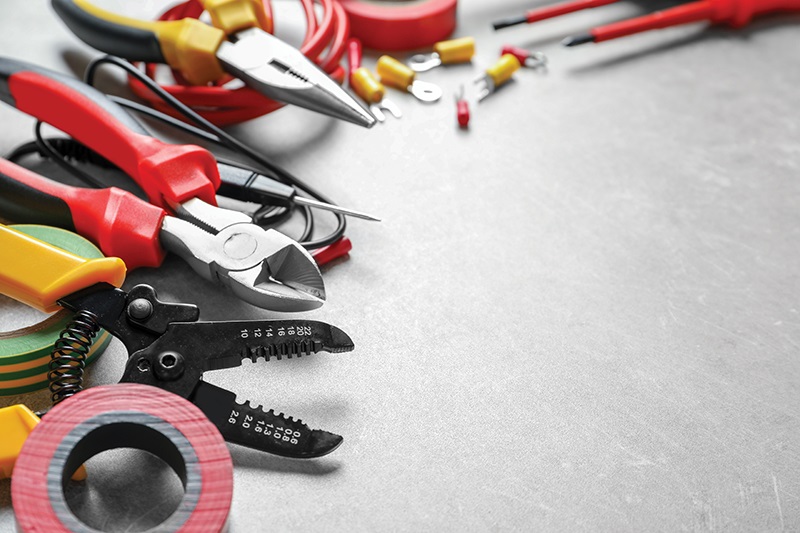
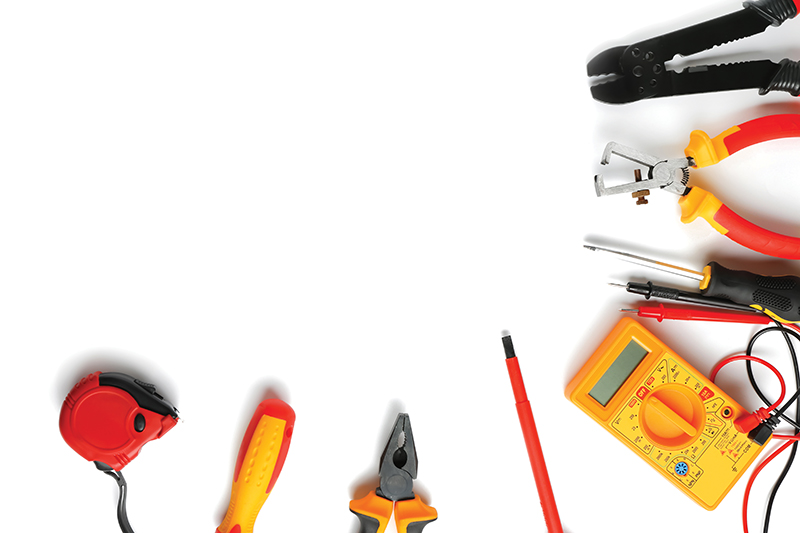
The hand tools at our disposal today have evolved considerably. Multifunction screwdrivers have become the norm, wire strippers are combined with crimpers and screw cutters, and lineman’s pliers have integrated fish tape pullers (among other features) that reduce the number of individual tools we need to carry.
Power tools have followed a similar trajectory. Gone are the days of heavy nickel-cadmium batteries with their limited run times. Lithium-ion batteries are lighter, give us longer run times and charge quicker, making cordless tools practical for all-day use. Brushless motors deliver more power, increase efficiency and reduce maintenance.
Even practical tool storage can add to efficiency. Modern modular storage systems allow us to customize how we carry our tools, which means less time spent searching for the right tool or repeatedly heading back to the truck.
Sometimes the best innovations are the ones that give us back a few minutes each day. Individually, these improvements may not seem like much. But when repeated hundreds of times each day, they become meaningful.
Comfort is productivity, not a luxury
Most of us don’t think about ergonomics at 7:00 in the morning. We tend to think about it at 3:30 in the afternoon. That’s when the drill feels heavier and just the thought of another 100 device screws makes our wrists ache. The lineman’s pliers we’ve had on us all day begin to feel twice as heavy. Most electricians just accept this as part of the job.
Thankfully, tool manufacturers see things differently. Instead of focusing solely on tool durability and performance, they are paying close attention to the long-term effects that repetitive work has on our bodies. They used to ask, “Will this tool last?” They are now also asking, “Will the electrician using it last?”
That train of thought has had massive effects on the power tools of today. Brushless motors allow for more compact housings, while improved battery technology reduces size and weight. Considerable time is spent balancing tools so they feel lighter when in use than the scale might suggest.
Vibration reduction has become another important area of development. Rotary hammers, reciprocating saws and demolition tools increasingly isolate vibration before it reaches hands and arms. Less vibration means less fatigue, particularly when performing demanding tasks day after day.
That same philosophy is evident in the hand tools used today. Grip materials provide better control. Handle shapes distribute pressure more evenly across hands. Improved steel reduces unnecessary weight while maintaining durability, and better cutting geometry requires less effort.
While none of these changes are overly dramatic by themselves, together they help to reduce the fatigue that builds over hundreds of repetitive motions. At the end of the day, comfort is an investment in productivity and career longevity.
Safety has become part of the design
For years, job site safety was largely about changing how we worked. Today, it’s also about changing the tools we work with. Safe work practices, proper training and personal protective equipment will always be the foundation of electrical safety. However, the tools we use today have become active partners in protecting users.
Some improvements are easy to spot. Insulated hand tools have become more common. Better grip materials improve control, while redesigned cutting edges require less force, reducing the chance of slipping and injury.
Other improvements happen behind the scenes. Electronic clutches help prevent violent twisting when a drill binds. Electric brakes stop rotating accessories more quickly after the trigger is released, while thermal monitoring and overload protection help prevent damage to batteries and tools. Cordless technology has even contributed to safer job sites, because fewer extension cords mean fewer trip hazards. Built-in LED lights improve visibility, while dust collection systems reduce airborne particles and help maintain cleaner job sites.
When it comes to advancements in tool technology, safety and production shouldn’t be viewed as separate goals. Anyone who has put in long days knows physical exhaustion affects concentration. When we are tired, we are more likely to overlook details or rush repetitive tasks. Reducing physical strain helps us stay focused, make better decisions and perform consistently throughout the day. Protecting the worker ultimately improves the work itself.
So, manufacturers have shifted to designing tools that actively support safer behavior every time they’re picked up. When efficiency, comfort and safety improve together, the result is exactly what we all hope to achieve: more production.
Production is the result of better tools
Every contractor wants greater production and efficiency. The challenge is how to increase that production without simply asking us to work harder. Higher production used to mean working longer hours, having larger work crews, or pushing harder to meet schedules. But today’s approach is different. Tool manufacturers have become focused on helping users accomplish more by removing unnecessary effort. The best tools amplify skills and experiences.
Take a look at cordless tools. Where electricians once owned a cordless drill and maybe an impact driver, today’s battery systems power everything from rotary hammers and bandsaws to task lighting and cable pullers. These tools have not changed the fundamentals of our work, but they have changed how efficiently repetitive tasks are completed. Like an airplane that changes its route by one degree, little changes can deliver significant gains over hundreds of repetitions. Individually, those time savings appear small, but together they add up to hours over the course of a project.
Blythe explained that these improvements don’t happen by accident. Product development begins by identifying pain points on the job site. Manufacturing engineers work alongside electricians, contractors and supervisors to understand where time is lost and where work can be improved. Ideas move through prototypes, field testing and refinement long before reaching the market, and the process continues long after a tool is released. As Blythe put it, “the process never stops.”
That approach is especially important as our industry continues to face a shortage of skilled labor. Contractors are expected to complete increasingly complex projects with fewer experienced electricians available. Manufacturers are making tools that help electricians work more efficiently while reducing the physical wear that comes with years in the trade.
The times are a-changin’
If you could walk an electrician from 1996 onto one of today’s job sites, they’d recognize the work immediately. They would still see conduit being bent, panels being installed, wire being pulled and circuits being tested. The trade itself hasn’t changed nearly as much as the tools we use to perform it.
However, what would surprise them is how much unnecessary work has disappeared. They would notice fewer extension cords stretched out across the floor, tool belts carrying fewer individual tools and cordless equipment replacing bulkier corded tools. Most of all, they would notice that today’s tools are designed with the electrician in mind, not just the task.
Greater efficiency reduces wasted motion, improved comfort reduces fatigue and better safety helps us stay healthy and productive. Together, they allow us to accomplish more without sacrificing quality.
Those conversations I had with Schneider and Blythe reinforced another important point: the future of tool development isn’t necessarily just about creating tools we have never imagined. It’s about refining the ones we already rely on by studying how we actually use them, identifying small frustrations and making smart improvements that save us time, reduce strain and improve safety.
If history is any indication, the next 30 years will be defined by thousands of meaningful improvements that continue to help us work smarter, safer and more efficiently, one innovation at a time.
stock.adobe.com/Africa Studio