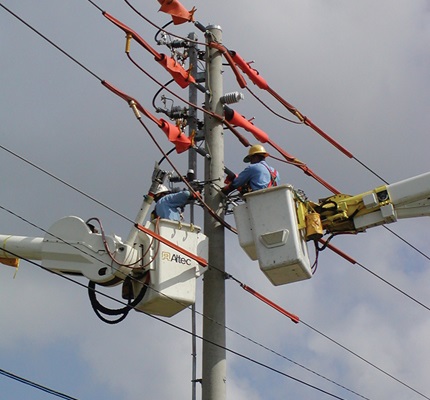
Some 72 hours before Hurricane Helene’s arrival, line contractors had answered mutual aid network calls and were sending personnel, trucks and equipment to staging areas in the region.
In Asheville, N.C., the worst destruction occurred in Biltmore Village, where rivers swollen with mud and flood debris destroyed substations and transformers. Temporary transformers and substations had to be trucked in.
Duke Energy’s nearby staging area accommodated 2,000 lineworkers and consisted of 142 trailers, each equipped with 18 beds and a shower.
First things first
The top priority was dismantling and replacing substations and transformers, then resetting poles and reconnecting transmission lines.
“Much of our success centered around first helping to clear roadways of debris and trees, and then, once access was gained, restoring power,” said Stephen Gaines, chapter executive of the NECA Southeastern Line Constructors Chapter (SLCC). “As with any disaster, first priority was re-energizing primary areas, first responder operations [and] hospitals.”
The terrain of western North Carolina consists of a thin layer of topsoil covering steep grades of granite and limestone bedrock. This requires special skills for pole setting. Even so, Duke Energy said 14,000 poles were reset in the region to carry millions of feet of new transmission line to serve Asheville’s 7,000 customers and others.
Throughout the Southeast, Duke repaired 60,000 locations.
While heat became less of a concern with fall closing in, lineworkers and apprentices had to deal with dangerous mud, debris and contaminated flood waters.
“I’m pleased we were able to minimize the risk related to illness and physical injury,” Gaines said. “Our workforce was equipped with the knowledge and skill and ability to move into a devastated environment and be a part of the effort.”
But as with any disaster, nothing can be taken for granted. “The question always arises for chapter members: ‘How can we mobilize in the safest way?’” Gaines said.
For future reference
Addressing that question is the goal of SLCC and its Safety Alliance Group, established in 2003 under the leadership of The L.E. Myers Co., headquartered in Thorton, Colo., with operations throughout the Midwest and Southeast. Safety professionals from OSHA, IBEW and line contractors are developing a guide based on shared best practices. The guide will include checklists and interactive software to answer specific questions related to disaster preparation and response.
“Most contractors do a great job bringing in crews,” Gaines said, adding that, “But this guide will envision a process that can vary significantly depending on where you are in the country.”
The guide will cover topics such as:
- Preparing for predicted weather and terrain
- Packing proper clothing and gear
- Ensuring trucks are well-maintained and equipped with proper tools and PPE
- Traffic safety considerations
- Stabilizing heavy equipment on uneven and compromised surfaces
“There are so many factors to consider with emergency response,” Gaines said. “Time spent driving even becomes an issue with mobilization. How far do you drive and stop before resting? Some customers want you there now, but as an employer, employee safety is our first concern. You can’t make people go without proper rest. Department of Transportation laws and OSHA say when it’s time to relax.”
Arranging for meals or lodging can also be challenging, especially when hotels fill up with people seeking shelter. Utility companies often set up camps that provide meals, beds and showers, but arrangements must be worked out in advance, Gaines said.
Members of the Safety Alliance Group are comparing strategies for handling those types of logistics.
“We’ve been putting together contractors’ proven checklists for all to share,” Gaines said.
SLCC’s Safety Alliance Group expects to publish the first iteration of the safety guide in about three months.
“The safety managers are all learning from each other during these meetings, swapping best practices and ideas,” Gaines said. “One thing we learned is once we mobilize, we don’t have to move in a large convoy. In fact, it’s probably safer if we don’t.”
One group member deploys trucks and equipment in increments of a half-hour to one hour, or even greater.
“That time spacing can make a big difference as far as mitigating road hazards and preventing any pileups,” Gaines said.
During its March meeting, the safety group discussed Hurricane Helene and what took place in the Asheville area.
“Our conversation centered around what worked,” Gaines said. “We had a very successful mobilization and have since maintained successful restoration and reconstruction efforts there. We haven’t run into any issues. We’ve been successful under those efforts.”
Additional restoration efforts are expected after local governing bodies develop reconstruction plans and receive FEMA funding.
STOCK.ADOBE.COM/ Jemastock
About The Author
.jpg?sfvrsn=a64b988b_1)
DeGrane is a Chicago-based freelance writer. She has covered electrical contracting, renewable energy, senior living and other industries with articles published in the Chicago Tribune, New York Times and trade publications. Reach her at [email protected].