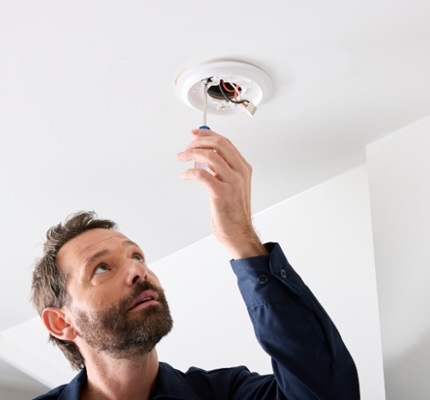
Driving from job to job on an average day, a contractor will see schools, hospitals, churches and community centers. These common structures may have one big, and relatively recent, addition.
Public and private institutions are increasingly adding sensory rooms for the use of neurodivergent people (i.e. those with ADHD, autism and intellectual disablities, etc.) and individuals with mental health challenges (i.e. anxiety, depression, OCD, PTSD, etc.). Working on rooms to serve people in these populations can be a major business opportunity for contractors.
These rooms use equipment that create a carefully curated and predictable environment for people, primarily through intentional lighting and sound choices. Sensory rooms can help people regulate when they are overstimulated by providing a modulated sensory environment. This is more than just a one-and-done opportunity: the rooms need to be built out and maintained at least yearly, if not every six months.
“The population of individuals [diagnosed] with autism has increased dramatically over the last 10 to 15 years,” said David Mays, owner of Chicago-based Amazing Sensory Designs. “The external stimuli that kids and adults that have sensory issues [face] has grown.”
The key for Mays when building out a sensory room is the electrician. He retains an electrician from a local contractor to complete all electrical work, such as adding dimmers and black lighting effects and installing multiple outlets on a wall. Sometimes that contractor will even fly to a job site if it is elsewhere in the country.
The benefits of sensory rooms
Sensory rooms can help neurodivergent people learn coping mechanisms and regain emotional control when overstimulated by providing a low-stress area where they can self-regulate.
According to National Autism Resources, which offers educational resources, visual aids and calming products for people with autism, the best sensory rooms are those that can easily control the amount and intensity of the sensory experience. The idea is to manage overstimulation because that can adversely affect people who are neurodivergent. But not enough stimulation makes a sensory room ineffective. Contractors in this field walk a fine line, but they can become trusted partners in providing value-added service and the right products.
A useful sensory room product is Coopersburg, Pa.-based Lutron’s Athena system, which features intelligent Ketra or Rania lighting and automated shading integration that makes it possible to program preset scenes with the touch of a control keypad.
“The most important aspect of sensory room lighting is adaptability—the ability to adjust lighting to individual preferences,” said Craig Casey, Lutron’s building science leader. “With presets as a starting point, room occupants can further customize the lighting environment with controls in the space.”
Casey said that lighting shapes how a space “feels.” Overly bright or harsh white lighting can affect one’s ability to focus and magnify feelings of stress.
“So it’s especially critical in a sensory room to help tone down the ‘noise’ and restore a sense of control and order,” he said. “Something as simple as dimmable lighting with a warm color temperature can help deliver a calming environment. Ideally, a sensory space will include controls that give people the ability to create their preferred environment.”
Sometimes those using the space may try to operate even the controls that aren’t adjustable. For example, someone may enjoy touching an occupational sensor, so it may be necessary to revert to an old-school rotary dial timer. If that doesn’t mitigate the issue, then single-pole keyed switches are another option.
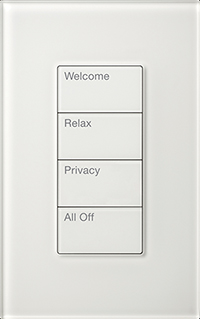
Intuitive wall controls or remotes offer easy access to preset
lighting scenes programmed for a calm, sensory experience.
When it comes to design, sensory rooms can often include bubble tubes or columns, or even a bubble wall, with fiber-optic lighting for further visual effects. Immersive reflections can be added by a product such as the TFH SNAP Projector, an LED device that caters to large rooms. It has a built-in wheel rotator for multiple images. Cloud lighting is also a viable option.
Many opportunities at one location
Virginia Commonwealth University in Richmond, Va., recently added a sensory room to its James Branch Cabell Library. The space includes dimmable overhead lights with switch controls, multiple lamps and sound machines, along with amenities including a bean bag chair, fidgets, tactile items, weighted blankets and noise-canceling headphones. This equipment and the space all come together to lower stress and improve emotional control for one student at a time, reserved through an online calendar.
According to Molly Case, communications director for VCU Finance and Administration, the room is used multiple times per day by students in the school’s Student Accessibility and Educational Opportunities (SAEO) department with that need. Case said that SAEO already had a sensory room in the student commons area, but the time was limited by office hours there, approximately 8 a.m. to 5 p.m.
“SAEO and VCU libraries agreed that having such a space in Cabell Library, which has high traffic and extensive hours during the academic session, would be of great value to neurodivergent students,” she said, adding that a local general contractor and electrical contractor built out the space.
Contractors should be encouraged by this example of a large institution that already had a sensory room and deemed there was need for a second. This could be true at almost any college or university across the country. For a contractor, getting that first job could lead to multiple at one location.
Churches are another potential source of business. Some feature a campus with multiple buildings, so the potential for more than one sensory room is rife. Elder care facilities are another possibility. And don’t forget school districts with multiple grade schools and high schools.
Cameras and sensors
Frank Hinck is the owner and project manager at Lindee Construction Services in Minneapolis, a general contractor that subcontracts out its electrical work. His firm has extensive experience in building sensory rooms, including dimmers, remote lighting and LED color-changing lights. But there are more than just these opportunities for electrical contractors, he said.
Hinck mentioned that often those adding sensory rooms to their facilities need an integrated camera system to monitor those in the room. Sensors from manufacturers such as SimpliSafe, Boston, trip if somebody tries to leave. The cameras indicate where a person is going, or where they’ve gone.
“Having a [sensory] room in there, someone wants to go in, but the caretaker wants to know they are safe,” he said.
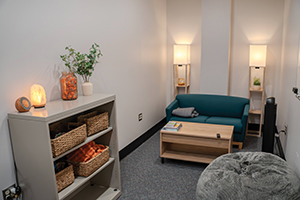
Virginia Commonwealth University recently added a sensory room at its
Cabell Library, which includes dimmable overhead lights with switch controls.
Referrals can pile up fast
While new markets can be scary, Hinck said the best way to earn that business is to be proactive. Monitor social media groups, especially on Facebook. Build relationships with occupational therapists. Introduce your firm to social workers and case managers in the public and private sectors and social service organizations that work on behalf of people who can benefit from using these spaces. Word travels fast.
“If you do a good job, it’s a never-ending source of referrals,” Hinck said.
Casey added that creating a sensory room doesn’t have to be complicated or intimidating for a contractor.
“Even a small room can become a quiet oasis with dimmable LED lights and controls that are budget-friendly, intuitive and easy to install using existing wiring,” he said. “The most important thing is to offer a safe, calm space where a person can take the time to reset during an overwhelming or overstimulating experience.”
stock.adobe.com/Vanitjan | lutron | virginia commonwealth university
About The Author

VOSS is a freelance writer based in the Chicago area and has worked extensively in the low- and high-voltage areas of the electrical industry. Contact him at [email protected].