Founded as Indiana Asbury College in 1837 and rebranded to its current name in 1884, DePauw University in Greencastle, Ind., is a private liberal arts college serving nearly 2,000 students on a campus spanning more than 650 acres. The university recently renovated and expanded the main library, a vintage building that lacked the infrastructure and amenities required to meet the modern-day needs of students and faculty members. But thanks to support from the team at Electric Plus Inc., Avon, Ind., as part of a $30 million upgrade of the landmark building, the DePauw University library now represents a state-of-the-art educational hub with capacity and functionality for the future.
Overdue for an upgrade
Founded in 2006, Electric Plus has more than 800 employees and four locations in Indiana—in Avon, Bloomington, Kokomo and Lafayette, including a dedicated preconstruction/prefabrication facility.
“We offer a full suite of commercial and industrial electrical construction and design/build services, support telecom, temperature control and fiber optic projects from our low-voltage group and serve clients across many industries, including the healthcare and educational sectors,” said Casey Brenneman, project manager at Electric Plus.
The DePauw Library renovation was a public bid project, and Electric Plus successfully teamed up with and was pulled in by the general contractor on the job, Cincinnati-based Messer Construction Co., in late 2021. The scope of Electric Plus’ work involved the complete gutting and renovation of the university’s main library, with a small addition.
According to foreman Daniel Bowen, the more than 75-year-old, four-story, 92,000-square-foot building hadn’t undergone a big renovation in years and had become a nondescript and outdated space that didn’t serve the university well.
“Though the red brick library was a centerpiece of the campus, we were informed that tour guides who showed prospective students around the campus would often avoid taking them inside the building because it was nothing to write home about,” Bowen said.
“It was all about our preplanning and early release of material so that it was there and ready. We didn’t want to be the reason the new library couldn’t open as scheduled.
—Casey Brenneman, project manager at Electric Plus
Providing power
Among their tasks, “we did a complete upgrade of the library’s entire power distribution system, set a new 12.47-kilovolt transformer and installed low-voltage infrastructure for security purposes and internet connectivity,” Bowen said, who added that the team used a building information modeling (BIM) system from Trimble, Westminster, Colo., to lay out the floor boxes.
“After removal of the building’s old fluorescent lighting system with strip fixtures hanging down from the concrete ceiling, we supported the installation of an all-new LED lighting system, incorporating Lutron [Coopersburg, Pa.] controls that provided energy-saving daylight harvesting and occupancy sensing capabilities and could be accessed remotely,” he said.
The Electric Plus team collaborated with representatives of Indianapolis-based EnvelopiQ, the project’s technology contractor, to help ensure that all systems worked as planned.
“EnvelopiQ provided the technology package to the project, but we met with them to understand where they wanted systems placed, and we handled the rough-in of raceway and other infrastructural components for all of their systems,” Brenneman said.
According to Bowen, the ability to support future expansion was important to the university because it had maxed out its previous library space. In addition to enhanced capacity, it also wanted the library—which previously featured closed-in spaces and numerous bookshelves—to better support how students and faculty members live and work today.
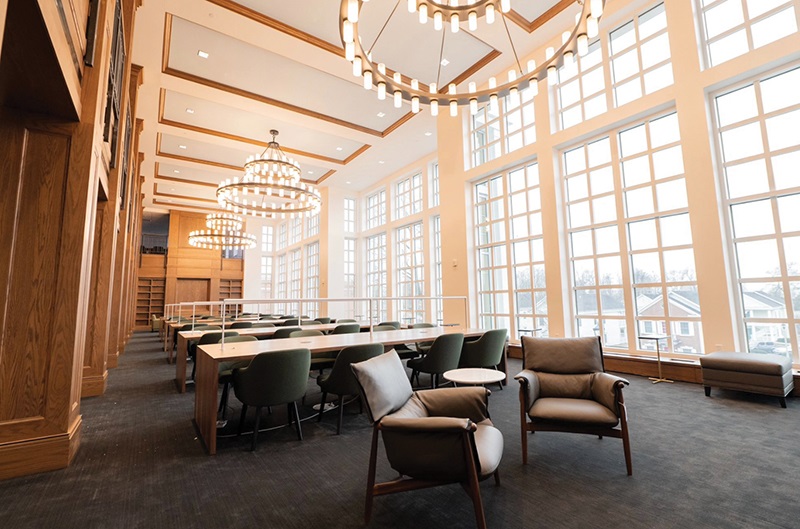
“As a result, the design of the new library, spearheaded by Indianapolis-based architect RATIO, featured a very open and airy concept incorporating more glass and windows,” Bowen said. “The whole front of the building was demoed out and the footprint was expanded to support the addition of a 3,280-square-foot reading room on one floor that extended up to the second floor and featured beautiful oak walls and huge chandeliers.”
Since the renovation, the new library contains fewer books and more computers, and its space is used for private and communal study areas as well as other modern-day student needs, including meditation rooms, a 3D printer lab, a secure archive room with collectible artifacts such as presidential podiums and special books, a new technology center and a brand-new cafe on the ground floor. An ample supply of comfortable chairs, sofas, tables and desks outfitted with electronic device-charging capabilities can also be found throughout the library.
One feature that wasn’t gutted in the renovation was the library’s former system of “treehouses”—small study carrels grouped four-to-a-cluster that seat students above other students vertically, like stacked cubicles.
“Students really liked those treehouses, so they were retained and refinished to fit the new space,” Bowen said.
After completing their work on the library in late 2022, the Electric Plus team proceeded to demo out and upgrade the university’s business school building, which was located next door to the library in the same courtyard.
“Like the library, the new business school also went to a more open concept featuring a grand two-story atrium entry with glass railings, a large chandelier and an extensive collection of new technology to remain on the cutting-edge of academia,” Bowen said of the roughly 10-month-long project, completed in late 2023.
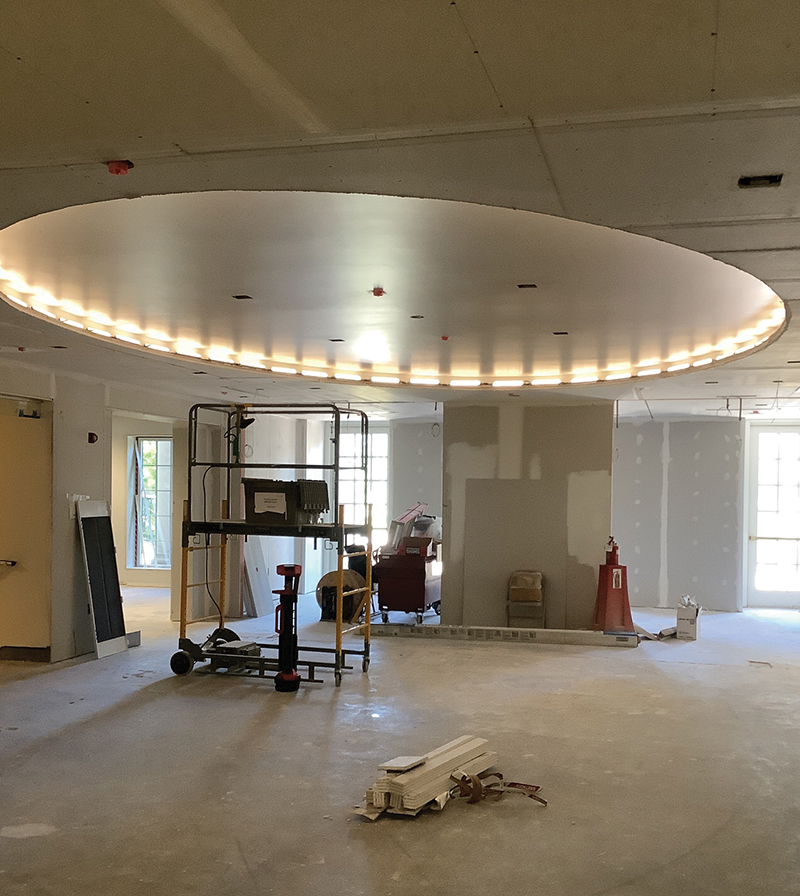 | 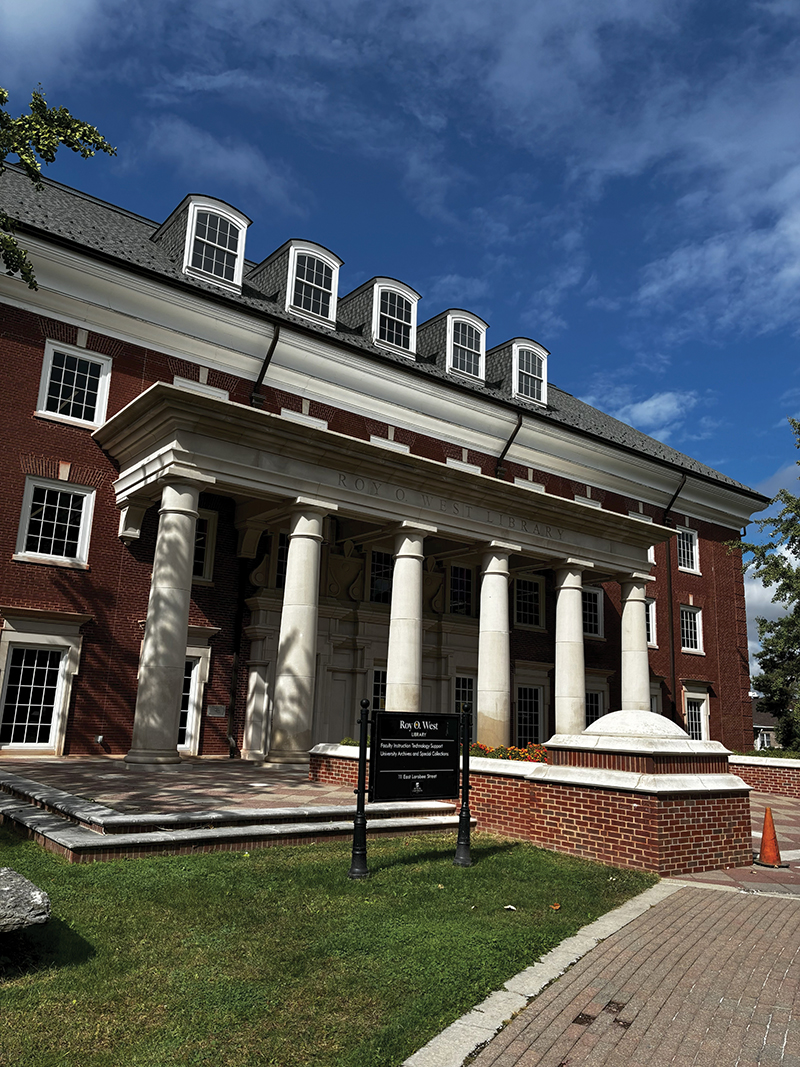 | |
Electric Plus’ expert wiring and rough-in efforts supported the installation of modern lighting and chandeliers in the new study areas. | The front of DePauw University’s main library. |
Working on an active campus
Though inclement weather wasn’t a concern because they were able to complete most of their exterior work and get the building enclosed before winter hit, the Electric Plus 5- to 16-member team dealt with a variety of other challenges over nearly two years on the project. Bowen said that one of the most difficult issues they faced was working on an active campus with students and faculty members walking around the building and courtyard at all times.
“Dealing with student traffic was a challenge because they were going about their business and not paying attention to us, so we had to be very focused on keeping students and faculty safe and out of the way of our equipment and deliveries,” Bowen said. “The students were excited about the upgrade and liked to peek their heads in the windows to see what was happening, so it was a constant struggle to keep them safe and out of our work area.”
While supply chain issues were making national headlines at that time, Brenneman said that good planning on the company’s part helped the team avoid many of the shipping delays on material that plagued other contractors during and after the pandemic.
“Our main switchgear was nine months out, but we purchased it early on in the project and used our prefab department for a lot of the rough-in, which alleviated a lot of delays,” Brenneman said.
Bowen said that one surprising challenge their team endured revolved around their own tech-savviness.
“This was a BIM-modeled project, and, while we were very familiar with that tool and process, some of the other trades we worked with on the job hadn’t seen or used that technology before, so getting them to understand and buy into it was challenging,” Bowen said. “We explained to them that BIM is what allows multiple trades to work in the same space at the same time, enabling an otherwise 2- to 3-year project to get done in one year. Getting the other trades to adhere to the process was hard, and it always seemed to be up to our team to change our plans, fix things and work around them.
“We’re very focused on the latest and greatest industry innovations and are always interested in the newest technology because we feel that it opens the door to more opportunities,” Bowen continued. “Every trade knows where their stuff goes and there’s always a sense of ‘me first’ on jobs, with everyone racing to get their things above the ceiling at the same time. While our fellow tradespeople understand BIM now, training them on the system was a learning curve that involved a lot of growing pains. The fact is, these types of projects require a high degree of coordination and communication, and BIM helps us plan and work more efficiently.”
‘A night-and-day difference’
Since the new library was unveiled in a special ceremony in January 2023, the school’s students, faculty members, administrators and librarians love it.
“It’s a proud focal point of the entire university,” Bowen said, describing the sparkling new space as open, inviting, vibrant and beautiful. “It’s truly such a night-and-day difference from what it was.”
Among key takeaways, that the project was a lesson in the importance of planning, coordination and being flexible, Bowen said.
“The beginning of this project actually got delayed due to supply chain issues that held up the delivery of the steel needed for the new part of the building, which required us to completely change our original work plan,” Bowen said. “However, our team’s tight coordination early on allowed us to regroup, develop an alternate approach and finish the project on time with no significant delay.”
“It was all about our preplanning and early release of material so that it was there and ready,” Brenneman agreed. “We didn’t want to be the reason the new library couldn’t open as scheduled.”
“There’s a great sense of pride associated with this project for us,” he said. “Seeing the building go from being torn out to the beautiful, high-tech facility it is today is truly astonishing, and there’s a lot of opportunity for future growth and flexibility with the power we provided to the structure.”
“My best friend went to DePauw University years ago and recently went back for a football game and sent me pictures of the library,” Bowen added. “He couldn’t believe it was the same building because it looked so different and incredible!”
Among Bowen’s favorite parts of the project, “I love the strong relationships we built with the DePauw team, and we’re honored that they asked us to come back to work on another of their campus buildings,” he said. “We love to see customers happy with the quality of our work and to be able to forge positive, long-term relationships with them. It’s been a great sense of accomplishment for Electric Plus to deliver a finished product that DePauw University is so proud of, and we look forward to continuing to support them in the future.”
Header image: A new lighting system illuminates one of the new glass-enclosed reading rooms at the DePauw University library.
Electric plus / DePauw university
About The Author

BLOOM is a 25-year veteran of the lighting and electrical products industry. Reach her at [email protected].