Hand Tools Then and Now
Pliers, wire strippers, screwdrivers and crimpers are all basic hand tools electricians have used for decades. However, compared to older versions, continuing advancements and improvements have made today’s hand tools more versatile, easier to use and more durable.
“On the surface, tools used today may seem very similar compared to those of 40 years ago,” said Tom Klein Jr., president of operations and research and development, Klein Tools, Lincolnshire, Ill. “However, there are key differences that modern tradesmen demand in today’s fast-moving work environment.”
New features in hand tools today have resulted in improved safety, ergonomics and productivity.
Tool Demands of the Modern Electrician
“Electricians entering the trade today want to carry as few tools as possible to save space, money and time,” Klein said. “As a result, tools used today tend to have multifunction capabilities, which is different from previous generations.“ Multifunctional tools combine several features into one essential tool for improved speed, mobility and job-site efficiency.
"Apprentices today also care about how their tools look more so than in the past. As a result, the industrial design and aesthetics of hand tools nowadays are much more developed than was historically the case. Also, ergonomics and safety considerations are reflected more so in tools today than ever before,” he said.
Klein Tools: Multifunctionality and Modern Aesthetics
The Klein Tools products that illustrate these points include the 11-in-1 screwdriver and all-purpose pliers, which has the functionality of a wire stripper and a long-nose plier. Both products improve productivity and lower cost by reducing the number of tools needed on the job.
“Although the conventional wisdom held by some is that hand tools are commodities, I believe quite the opposite to be true,” Klein said. “The proof is in the pudding that hand tools, just like automobiles or electronics, are continuously evolving in parallel with technological advances in the world and preferences of the marketplace.”
Greenlee: Advancing Ergonomics and Materials Testing
Dale Speggen, product manager at Greenlee, Rockford, Ill., said one of the greatest improvements to hand tools is the use of ergonomics to reduce the force and strain of using a manual hand tool, reducing fatigue, which can lead to injury. In addition, advancements in materials provide users with hand tools that are not only easier to use, but last longer.
“Greenlee employs an ergonomist and has its own ergonomics lab to test muscle fatigue [and] handle force, and determine optimal handle grip and location while in operation among other key design features,” Speggen said. This data-driven design helps Greenlee to develop safer, more ergonomic tools that reduce injury risks. “Tangible statistics help the engineering team develop better tools that ensure reduced muscle fatigue when using hand tools as well as the reduction in injuries including carpal tunnel syndrome.”
Speggen said metallurgists play an important role in the development of Greenlee’s tools by identifying the best materials for making each tool.
“The testing process then determines whether products will stand up to professional use on the job site,” he said.
Burndy: Engineered Crimping Systems
Paul Silva, product manager at Burndy, Manchester, N.H., said today’s crimping tools are lighter in weight and more ergonomic, with an emphasis on reducing repetitive motion injuries. They require lower handle forces when crimping or cutting, have improved crimp and cutting ranges, and feature ratchet designs to lower handle forces and ensure a complete crimp/cut cycle.
“Burndy manufactures tools, dies and connectors as part of an engineered system,” Silva said. “The combination is tested to meet industry-standard requirements. We offer hand tools with greater crimp/cut ranges, die embossment on crimped connections for inspectability and color coding on tools and dies to assure the correct tool and die combination is being utilized. Rotating die mechanisms allow the use of a wide range of connectors with a single tool.”
Ideal Industries: Insulated Tools and Multipurpose Efficiency
Jason Schaper, product manager, Ideal Industries, Sycamore, Ill., said modern technology and metallurgy have allowed for tools to become lighter and more durable, with sharper cutting edges that make work easier. This extends tool lifespan while reducing user fatigue with optimized balance and sharper cutting edges.
Modern manufacturing techniques ensure that products are made to the highest level of quality and consistency.Ergonomically friendly designs help prevent injury due to repetitive actions over time, and the further advancement of multipurpose tools have helped improve electricians’ speed and efficiencies. Developments to insulated tools have helped protect electricians in what can be an inherently dangerous line of work, Schaper said, aligning with increased safety standards and a greater awareness of arc flash and electric shock protection requirements.
“Among Ideal’s advancements are an 11-in-1 nut screwdriver that not only is 10 screwdrivers in one, but also has a patented wire nut wrench molded in the end of the handle, making it significantly easier to twist on and terminate wires with Ideal wire nuts,” he said.
Milwaukee Tool: Insulated Pliers and Ergonomic Redesign
Tim Albrecht, senior vice president and hand tools general manager, Milwaukee Tool, Brookfield, Wis., listed some of the most important advancements in modern hand tools. Multifunction tools reduce the number of tools needed, insulated tools fill growing demand and improve the in-hand “feel” of the tool, and ergonomic improvements increase comfort and reduce strain.
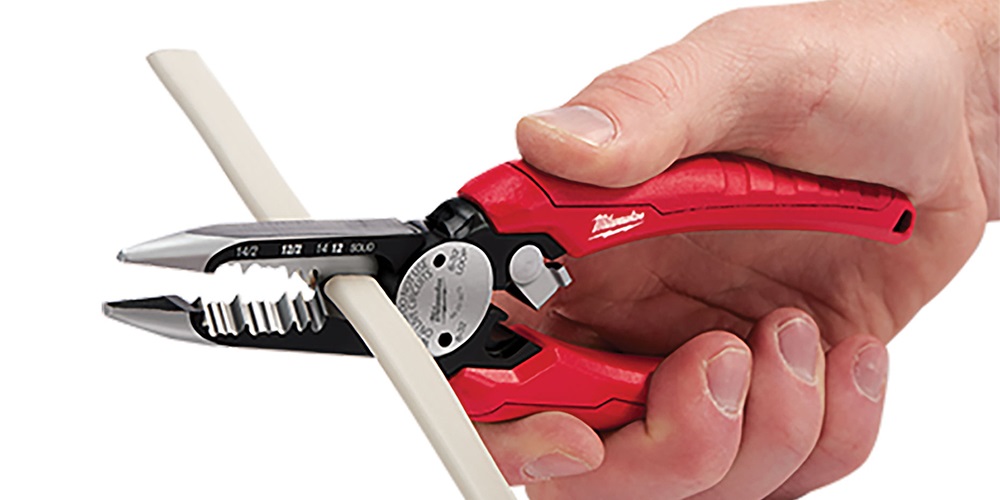
“One great example from the Milwaukee line is our 6-in-1 combination wire pliers,” Albrecht said. “Recently, we fully redesigned this tool to expand its wire-stripping capacity and included an all-metal swing lock, designed a longer curved cutting blade and improved the handle ergonomics. We also designed a version of these new pliers that is ideal for work with nonmetallic wire.
“Another is our UL Classified 1,000 [volt] insulated screwdrivers with flame- resistant insulation bonded to the tool shank as well as an outer layer of insulation. A visual wear indicator issues a warning to the user when it is time to replace the tool,” he said.
Channellock: Durability, Precision and 3D Prototyping
Jon DeArment, president and chief operating officer, Channellock, Meadville, Pa., said hand tool advances include use of more precise processes and tolerances than four decades ago.
“Additionally, we use more advanced heat treating with laser hardening of cutting edges and teeth, resulting in tools that last longer,” he said.
Channellock’s advances include extreme leverage technology (XLT) that positions the tool’s rivet closer to the heat-treated cutting edge, reducing the force necessary to make cuts. The company’s signature blue grips provide comfort to the user.
“The introduction of 3-D printing has allowed us to develop prototypes for new tools and potential improvements to existing products,” DeArment said. “It has been a welcome addition to our tool-design process, because it allows us to see how an idea would actually function before advancing too far along the process.”
“In a business that has seen its share of companies explore alternative manufacturing options that result in a loss of quality control, Channellock stands committed to its history of American-made products,” ensuring greater quality control, faster prototyping and more consistent production standards, DeArment said.
About The Author

GRIFFIN, a construction journalist from Oklahoma City, can be reached at [email protected].