You're reading an older article from ELECTRICAL CONTRACTOR. Some content, such as code-related information, may be outdated. Visit our homepage to view the most up-to-date articles.
It isn’t often that an electrical contractor (EC) literally goes airborne during system testing and commissioning. But that was exactly the case when Lauderdale Electric Inc., East Dundee, Ill., completed two projects for iFLY—an indoor skydiving/vertical wind-tunnel entertainment business based in Austin, Texas—owned by SkyVenture. With a small crew of technicians, the company was able to quickly complete two separate wind turbine and electrical connectivity and control installations on time and within budget at new iFLY facilities in Rosemont and Naperville, Ill.
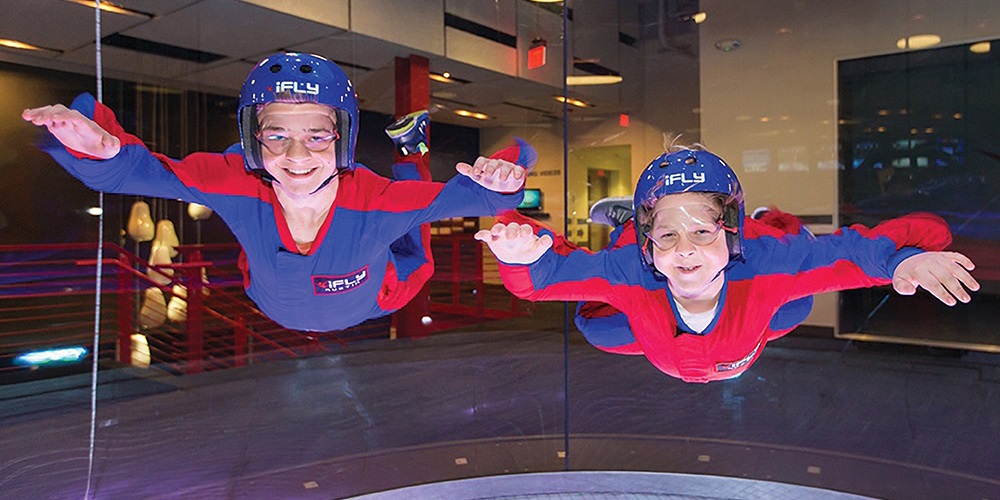
Bill Lauderdale, Lauderdale Electric’s vice president, said one of the project’s highlights was testing the wind-generating systems, bringing to life the installation’s massive turbine equipment that creates high-velocity winds in a 14-foot-diameter, all-glass, climate-controlled cylinder. Once completed, the company’s technicians donned flying suits, helmets and goggles to test the system in the 45-foot-tall enclosure to ascertain that the wind turbines were working properly—which indeed they were—clocking wind speeds up to 115 mph.
“We’ve all had some flight time,” Lauderdale said. “It’s really amazing and a bit harder than you think. The flight time is only five minutes, but, trust me, you are exhausted when you’re finished.”
Lauderdale Electric had an unusually small crew for the installation but was still able to provide quality electrical work and complete the two projects, which at one point overlapped. The rotating crew on the installations—many with decades of experience—included Bill Lauderdale; Beau Lauderdale, foreman; Bob Ross, Zeus Conejo, Viengkeo “Lon” Chanthalansy, Devin Daufenbach and Jeff Kowal, journeymen; Denny Butzow, controller; Steve Lauderdale, retired journeyman; Joey Sountala, shop manager; and Jon Novak, apprentice. (Roxanna Lauderdale is president of the company.)
Lauderdale Electric worked through the tight timeline, spending some weekends on site to make sure the job met deadline parameters.
The company landed the contract for the installation—which included electrical wire and pipe, control and the wind-turbine systems and related connectivity—based on its reputation for quality installations and its strong, established network within the contracting community.
“We have a great relationship with Weis Builders Inc., Minneapolis, that dates back nearly 10 years,” said Bill Lauderdale. “They reached out to us to bid the project and informed us after they won the contract that we were their preferred electrical contractor.”
Each iFly facility had a 180-day completion date. The Rosemont iFLY, near Chicago O’Hare International Airport, opened in May, while the location in western suburb Naperville opened in July.
The installation included the deployment of SkyVenture-manufactured, ninth-generation wind-tunnel technology, including four 10-foot, 350-horsepower [hp] fans that send air through concrete chambers from the building’s perimeter and into the fly tube, located at the structure’s center.
There was no room or time for error during construction.
[SB]“These projects were unforgiving,” Bill Lauderdale said. “Every floor box had to be precisely installed in the proper location, or it would create a multitude of problems that would require additional electricians and complicate the installation. The working partnership we developed with Weis Builders and iFLY was a key factor in the success of these projects. Through a thorough preplanning process with Weis Builders, we were able increase our efficiency and complete these projects on time.”
The thrill of flight
Wind tunnels that create a vertical air column in which a person can safely float have become a popular form of entertainment, according to Bill Adams, SkyVenture vice president. Founded by professional skydivers, the company manufactures a complete range of patented and trademarked wind-flow tunnel models and flight chambers. The first tunnel was built in Orlando, Fla., in 1998; today, there are some 32 iFLY and participating iFLY locations across the country.
Industry estimates for the global market for indoor skydiving are expected to exceed $1.6 billion in annual revenue by 2025. SkyVenture’s Adams said visits to its entertainment venues across the country have risen from an annual average of 50,000 to almost 100,000. SkyVenture has company-owned stores in North America and franchises its international tunnels, sells equipment and continuing services, and licenses the technology around the world.
Project challenges in the Windy City
The challenge for a typical iFLY building is its small size yet huge electrical service needs.
“Our footprint is only 150 feet wide by 50 feet deep and three stories tall with 3,000 kVa [kilovolt-amperes] service at 2,100 amperes [A],” Adams said.
Typical February weather in Chicago also tested technicians.
“Weather was absolutely a challenge as we were roughing in the floor slabs when it was minus-20 degrees outside at 50-feet up with open walls,” Lauderdale said about the Rosemont location, which was completed first. “I bought heated socks for my electricians, so they could actually feel their feet, and they used portable heaters to keep their hands warm, but huge gusts of wind kept blowing them out.”
The building footprint was so tight that it led to some difficulty in constructing staging to reach the third floor and penthouse areas. There were some 80 stairs to climb and an 18-inch-wide ladder to the penthouse. The penthouse houses four 600A variable frequency drive units required for the four 350-hoursepower motors that create the wind for the flight tunnels. The basement, some 18 feet below grade, was accessible by a small ladder. Here, Lauderdale Electric installed sump pumps and lighting fixtures designed to withstand more than 100 mph winds; workers also terminated multiple types of control wiring.
Initially, Adams and iFLY had expressed concerns about power consumption, as the company had experienced some problems with a facility in Texas. Lauderdale Electric’s staff visited the Texas location to assess the power consumption and devise a plan to ward off any potential issues at either new facility.
Adams was also concerned about running exposed conduit under the huge open-ceiling beams, so Lauderdale technicians installed floor boxes in the deck that fed the lights, heaters and receptacles. This step took extensive planning and a precise layout to ensure that the boxes were located properly. Lauderdale technicians used a software program that allowed them to do exact dimensions and plan everything out at the home office and then transfer these preplanned drawings to tablets in the field for deployment.
Another concern was installing the feeders to the penthouse from the 3,000A service outside. Foreman Beau Lauderdale, while collaborating with Weis Builders’ Site Superintendent Mike Ericksen, put together a plan that would eliminate exposed conduit and the junction boxes and created a solution to a problem that previously required three to five days and five electricians to pull and terminate. Two Lauderdale technicians executed the plan in less than one day—a new record, Adams said.
Meeting the heights
Lauderdale Electric specializes in a variety of high-profile projects, such as co-generation plants and renewable-energy facilities, but this was definitely one-of-a-kind.
“This is a project where you need young, well-conditioned employees because of all of the physical demands encountered every day,” Bill Lauderdale said. “I imagine my guys lost about 10 pounds each on these projects.”
“The thing that impressed me most about Lauderdale Electric was the quality of the installation, and the small crew size, they worked like a crew three times their size and they were fast and very smart about how they went about the process of bringing this complicated project to life,” Adams said. “We’re accustomed to EC crews of eight to 10 and they used three or four technicians.”
Lauderdale said the company prides itself in getting in and completing projects as fast as possible, while maintaining the quality and on-site performance his clients demand.
Another iFLY is planned for Chicago’s Lincoln Park neighborhood, and there’s a good chance that Lauderdale Electric will be flying as the go-to EC.
“We knew that, with a great game plan and using the best electricians that anybody could ask for, we could complete these projects within the timeline and still meet everyone’s expectations,” Bill Lauderdale said.