You're reading an older article from ELECTRICAL CONTRACTOR. Some content, such as code-related information, may be outdated. Visit our homepage to view the most up-to-date articles.
A rotary hammer is the tool of choice for most electricians who must make holes in concrete, block and brick. Small rotary hammers are used primarily for drilling holes to install anchors for hanging Unistruts for electrical conduit. Large hammers are used for larger diameter drilling to allow materials to pass through walls.
Although hammer drills may be used for making a small number of holes in softer materials, most electricians use a rotary hammer for drilling into concrete, said Mitch Burdick, product manager, concrete products at Bosch Power Tools.
“The rotary hammer is the power tool of choice when drilling into concrete,” Burdick said. “While rotary hammers often are incorrectly referred to as hammer drills, rotary hammers are dedicated tools specifically designed for all-day drilling into concrete. The main difference between these tools and rotary hammers is that the hammer drill uses an internal mechanism similar to two poker chips rotating against each other to create a small amount of impact energy to help drill into concrete.”
When significant numbers of holes must be drilled, rotary hammers provide the fastest, most efficient means to get the job done correctly, Burdick said.
SDS-plus, SDS-max or spline rotary hammers require bits to be matched to the appropriate tool. These bits include a carbide-tipped head and are designed to channel the impact energy from the hammers to the work surface to grind up the concrete during the drilling application.
“The latest trend for these bits is a shift from two-head cutters to four-head [or full-head] cutters,” Burdick said. “The cutters refer to the carbide teeth on the bit tip. Four-head cutters offer additional cutting heads in the 90-degree position on the tip and provide a number of benefits to the user. In some cases, speed is the obvious one, but the real payoff lies in a smoother drilling process for the user and a substantial improvement in bit durability. The flutes on these bits are also specially designed to efficiently remove or funnel the ground-up dust out of the hole, which reduces heat buildup on the carbide cutters, thus maximizing drilling performance over the life of the bit.
“Today’s rotary hammers are packing higher performance with only a marginal increase in tool size and weight, which leads to a direct increase in job-site productivity and an indirect improvement in tool ergonomics. Vibration-control technologies are being used to substantially improve the comfort of the tool during heavy-duty applications.
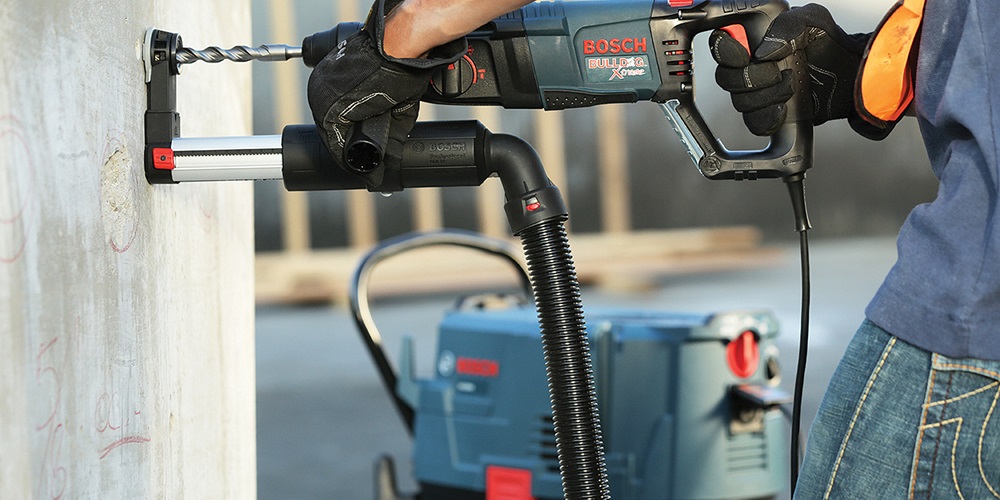
“Attachments continue to grow making the tools more versatile. Right-angle attachments allow rotary hammers to be used in extremely tight spaces. Dust-collection attachments specific to rotary hammers are becoming more and more popular as the need and cost for these solutions are insignificant to the fines that could be levied for not having them. These solutions focus on extracting dust at the source while the hole is being drilled, rather than just containing it in a controlled area. The benefits of these solutions are immediate and long-lasting.
“Cordless models have not taken over the rotary hammer market, but drilling performance of some cordless SDS-plus hammer brands is nearly the same as its corded brother. With the rapidly improving battery amp hours, battery run time is now increasing in leaps and bounds, even in heavy-duty applications, with little or no increase in battery size or weight. What’s left is price. Battery technology continues to be expensive.
“However, for personnel who work mainly on lifts, swing stages or in the remote corner of large job sites, the continued improvement in battery tools makes the cost for this tool mobility insignificant or in some cases, completely irrelevant. The cost to set up corded power includes additional equipment, including generators, fuel to power the generators and power cords,” Burdick said.
Hilti Business Unit Manager Aaron Brading said rotary hammers provide a highly efficient way to fasten conduit, boxes, cable and lighting supports.
“Recently, rotary hammers have increased in speed while decreasing in size and weight,” Brading said. “Of course, this aids in productivity because work gets accomplished faster, and the user experiences less fatigue with the lighter tool.
“One of the most significant changes to rotary hammers in the last few years has been the power source. More and more rotary hammers are moving to battery power. Rotary hammers are now available in 12-, 18-, 28- and 36V battery platforms. We are seeing more sales of cordless rotary hammers as customers shift to cordless tools. Rotary hammers do use SDS and shank drill bits. The bit is locked in place by ball bearings in the chuck of the tool that allow the bit to slide up and down as the hammering mechanism strikes the bit. The bits have a carbide head for drilling into concrete,” Brading said.
Another development is manufacturers’ expansion of dust-control systems for rotary hammers, Brading said. Dust control is a topic of growing concern in the construction industry, and manufacturers are offering more options to fit rotary hammers.
When only a few small-diameter holes are needed, some workers use the cam-action hammering feature on a cordless drill/driver because it seems to be more convenient than stopping work to get a second tool.
Wayne Hart, communications manager for Makita USA, cited two trends in rotary hammer features: reduced vibration and dust control.
Regarding vibration, Hart said contractors are learning that reducing vibration can mean increased accuracy with smaller rotary hammers.
“For example,” Hart said, “a 1-inch rotary hammer frequently is used for overhead drilling, and a rotary hammer with less vibration is strongly preferred for this type of application to help improve drilling accuracy… Makita engineers developed an internal counterbalance system that substantially reduces vibration, and it is available on rotary hammers in a range of sizes.”
Makita offers a trigger-activated HEPA dust vacuum attachment with a rubber gasket designed to maintain constant contact with the work surface.
“Dust is channeled to the clear dust container with a HEPA filter, which captures 99.95 percent of 0.3 micron size dust particles,” Hart said. “An added feature is a 2-second delay on the vacuum motor, which extends suction after the trigger is released to collect remnant dust and particles as the bit is being pulled out of the work surface, an ideal feature for overhead drilling.”
The vacuum attachments are available for rotary hammers that accept SDS-plus and SDS-max bits.
Hart said battery power hasn’t taken over the rotary hammer market, but as with other power tools, battery advances are offering electricians many options.
“For the most demanding applications, secondary cordless tools, such as rotary hammers, are still underpowered,” Hart said. “We understand the importance of staying within the preferred 18V platform and offer a rotary hammer powered by two 18V lithium-ion batteries for 36V power and run time. This is ideal for applications that take users away from a power source.”
Milwaukee Tool’s Group Product Manager Andrew Plowman said there are two options for drilling in concrete: a hammer drill or rotary hammer.
“A hammer drill has a higher RPM, or speed, than a rotary hammer, and does not hit as hard,” he said. “The percussion or hammering motion is created by one hammer plate spinning against another and requires the user to apply pressure to the tool. These tools are typically used for drilling smaller holes and in softer aggregates, such as cinder block. Rotary hammers have a slower RPM but hit much harder. The greater impact energy allows them to drill larger holes, into harder aggregate, and is much easier on the user.”
With continued advancements in gear and motor technology, tools are getting smaller, more powerful and overall are delivering greater productivity to the user without sacrificing durability.
“The ‘one-size-fits-all’ mantra is a design template of the past,” he said. “Today, users want rotary hammers that are optimized for their most common applications and deliver increased user comfort and productivity. Our cordless line has grown significantly in the last couple of years with additions to both the 12- and 18V line that cater to the demand for different hole sizes. Continuing innovations in the rotary hammer category will provide for the needs of professional users based on what they must accomplish on the job every day.
“Cordless options in the rotary hammer category will continue to grow, but the need for corded options will not go away anytime soon. With all of the power that is available in today’s lithium-ion battery packs, as well as advancements in motors and electronics, manufacturers will continue to be able to challenge conventional wisdom about what types of tools can be effective cordless solutions.”
About The Author

GRIFFIN, a construction journalist from Oklahoma City, can be reached at [email protected].