You're reading an older article from ELECTRICAL CONTRACTOR. Some content, such as code-related information, may be outdated. Visit our homepage to view the most up-to-date articles.
Electric motor failure can cause numerous problems, ranging from inefficient power use, equipment damage and costly downtime. In the worst-case scenario, it can result in a catastrophic fire.
Amprobe Business Unit Manager Jarek Bras said excessive heating is a common cause of motor failure.
“Overheating may be caused by the excessive current drawn during motor operation,” he said. “Problems also can result from a new motor being incorrectly set up with improper connections, causing the motor to rotate in reverse direction, potentially damaging the motor and the equipment it is powering.
“To help ensure an electric motor is properly connected and operating, technicians need tools [that] can perform capacitance measurements for start and run motor capacitors, low pass filter for variable frequency drives [VFDs], in-rush current monitoring during motor startup, true rms to make accurate voltage measurements in noisy environments, resistance and continuity to check for proper function of motor and transformer coils, phase sequence identification, and motor-rotation direction identification,” Bras said.
A user might want to know whether there are multifunction instruments for testing motors or if individual specialized testers are needed.
“With a wide range of applications and testing environments, each technician will find a different mix that best suits individual needs,” Bras said. “For some, a motor-maintenance clamp meter is a great, all-in-one tool and will serve as their go-to for all their motor-maintenance applications. For others, the speed and convenience of wireless testing will justify a mix of more specialized tools. With the introduction of new tools, technicians can now do more with fewer tools. Wireless motor-rotation indication and terminal clamp meters make diagnosing electric motor problems a quicker and simpler process.”
Depending on the application, electric motor test kits can range from one tool to several. For many technicians, a motor-maintenance clamp meter will meet all needs. For others, tools—such as insulation testers, infrared cameras, and phase sequence and motor rotation testers—may be needed.
“Technicians always should adhere to proper safety practices when performing motor tests,” Bras said. “Wear all required personal protective equipment [PPE] when in potentially dangerous environments and applications, and adhere to the PPE standards developed by the applicable organizations.”
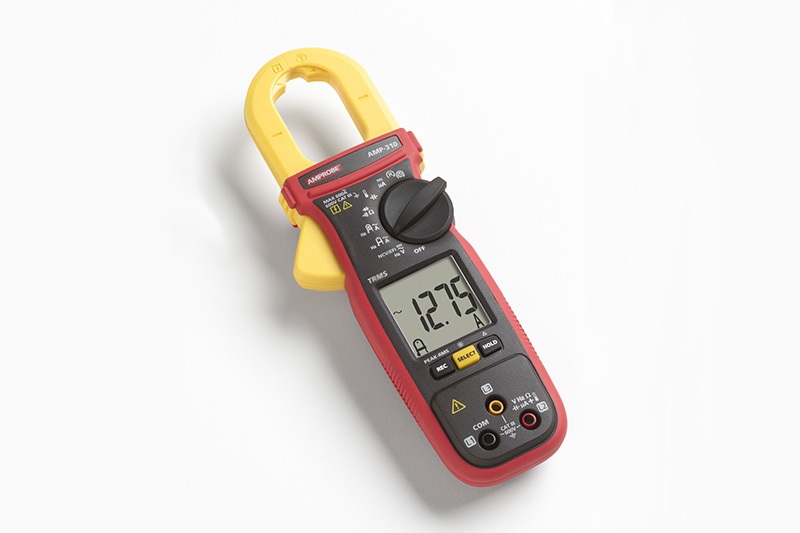
Amprobe offers a full line of motor-maintenance clamp meters and phase sequence and motor-rotation testers for testing motors, he said.
Flir Product Manager Sam Ruback said basic motor tests include measuring current and in-rush, voltage and frequency measurements with a VFD mode or low-pass filter, insulation tester and a thermal imager that can detect whether the motor is operating within temperature specifications.
“Additional tests that can be completed with a thermal scan are checking loose electrical connections and inspecting on the additional components such as belts being driven by the motor,” Ruback said. “A basic bearing inspection for operation temperature can also be made, but, depending on the motor, a high-resolution thermal camera may be needed to determine the status of individual bearings.
“For more in-depth electrical assessment, an insulation tester can check the insulation resistance of the wire insulation to ensure there are no breaks in the insulation. This can be helpful in situations where the motor is at the end of a long run and the wiring is traveling through harsh environments like a well or underground pump. Insulation tests check for open or shorted motor windings, insulation between windings and ground, and motor starter contacts,” he said.
Ruback said Flir motor-testing equipment includes an insulation tester, a digital multimeter with VFD mode, a 600-ampere (A) alternating current (AC)/direct current (DC) imaging clamp meter with infrared guided measurement (IGM), and thermal imagers.
Fluke Corp. Electrical Products Manager Luis Silva said the newest addition to insulation testers is wireless data transmission.
“This offers several advantages for teams implementing preventive maintenance programs,” Silva said. “Previously, data could be recorded with manual transcription, which induces errors and legibility problems. Now, data can be captured and sent from an insulation tester to a smartphone, saved in the cloud, and shared with other team members. Perhaps the biggest advantage [of] wireless transmission is the ability to store data and compare regularly scheduled readings for signs of degradation over time. With this data, the motor can be overhauled at a convenient, scheduled downtime window.”
Silva said basic motor tests are supply tests for motor overload, in-rush current, single phasing, and supply unbalance; mechanical tests for bearing failure, misalignment, mechanical imbalance, and looseness; and motor tests, including insulation spot tests, insulation step voltage, dielectric absorption tests, polarization index calculation, and temperature compensation.
The motor tests are perhaps the least understood.
“Insulation spot tests should be performed at regular, periodic intervals to check the integrity of the motor windings,” Silva said. “Reduced resistance measurements over time is often a precursor to winding failure. Insulation step voltage is a test that creates electrical stress on internal insulation cracks to reveal aging or damage not found during other motor insulation tests. It is performed by testing the insulation at two or more voltages and comparing the results. It should only be performed after an insulation spot test.”
A dielectric absorption test checks the absorption characteristics of wet or contaminated insulation.
“A polarization index calculation is the ratio of the insulation resistance of a machine winding calculated by using values obtained from a 10-minute measurement divided by a one-minute measurement,” Silva said. “The polarization index is an indication of the insulation quality. A low polarization index indicates excessive moisture or contamination.
“Temperature compensation is required to accurately compare measurements from different time periods. Insulation resistance is inversely pro- portional to insulation temperature—resistance goes down as temperature goes up. A test tool that measures temperature and adjusts readings for temperature variation is essential," he said.
According to Silva, a basic motor test kit could contain a noncontact voltage tester, the first tool used to test for the presence or absence of voltage; clamp meter with the ability to measure motor in-rush current; insulation digital multimeter (DMM) with VFD measurement capability; combination full-function DMM with the specialized insulation tests described above, plus a low-pass filter.
“The electrical tests on the motor itself are specialized and not normally found on a digital multimeter,” Silva said. “An insulation tester that performs basic DMM functions, plus the other motor tests described above, can be extremely helpful to electricians and technicians responsible for servicing a large number of motors.”
Fluke offers a full line of testers for electric motors, including DMMs and insulation testers.
Hioki USA Sales Engineer Bob D’Amico said the company markets power analyzers, insulation testers and DMMs for testing electric motors.
“Basic motor tests include shorting between the windings, capacitor testing, test for winding resistance, insulation tests, and test of power consumption,” he said. “Whether multifunction testers or individual testers are used depends on the price users want to pay. All-in-ones can be very expensive while individual models can be less than half the cost.”
Megger Senior Applications Engineer Jeffrey R. Jowett said the first step in testing a motor is to distinguish between electrical failure and bearing or other mechanical failure.
“If electrical failure is the cause, nameplate information is important; parameters indicated on the nameplate should be tested for compliance,” Jowett said. “Perform an insulation test to isolate deteriorated windings and shorts to ground. A clamp-on ammeter can be used to look for excessive or insufficient current draw and for load imbalance. Similarly, a voltmeter can check low- and high-voltage conditions.
“By far, the most important electrical test is the insulation resistance test. Insulation resistance is a handy and easily tested indicator of overall motor condition. Dirt, moisture, corrosives, electrical and mechanical stresses all cause insulation to deteriorate over time until eventual breakdown results. This deterioration can be readily assessed and tracked to head off final breakdown and loss of the motor.
“Multimeters should be used to check voltage and current draw and load imbalance, power quality meters and data loggers to check for harmonics, which can overheat the motor. A low-resistance ohmmeter or dedicated winding-resistance tester checks for deterioration of windings.
“For other functions, multifunction testers are being steadily improved in their ability to provide quality tests and features. But there is still the risk of quantity over quality. Currently, single-function testers, multimeters aside, are the tried-and-true option.
“A surge tester will pinpoint turn-to-turn shorts, where the insulation around the winding has broken down and shorted across to the adjacent turn. These are cumulative failures that, at some point, begin to affect performance. But they can often be corrected on the spot by application of insulating varnish.
“A power quality meter can be left in place for extended periods of time and will capture harmonics, which can also be a source of heat and failure,” Jowett said.
Megger's offerings include insulation testers, which are most important. Others include hipots, multimeters and clamp-on ammeters, motor and phase-rotation testers, winding resistance testers, low resistance ohmmeters, power quality testers and data loggers.
About The Author

GRIFFIN, a construction journalist from Oklahoma City, can be reached at [email protected].