Working with what we have is becoming Necessary when it comes to the nation’s transmission system. That’s one reason why regulators at federal and state levels are putting new emphasis on a class of network upgrades called grid-enhancing technologies (GETs). Two of these, advanced conductors and dynamic line rating, are already on their way to wider adoption.
The remaining two approaches generally included in this category, advanced power flow control (APFC) and topology optimization, are just starting to be commercialized. Though one of these is hardware-based and the other is software, they serve related functions by giving grid operators more insight and control over their networks’ power flow. As a result, operators are better able to address congestion and manage outages with their existing lines.
GET-ing it
Transmission operators and the utilities they serve are facing dual challenges of aging infrastructure and rapidly growing power demand. While building new lines seems an obvious solution, political and economic hurdles can force new construction efforts out a decade or longer due to planning and permitting difficulties.
At the same time, though, GETs developers have been bringing their innovations up through rigorous testing and piloting processes to the point that utilities and transmission owners are beginning to see their value. And increasingly, federal and state regulators are beginning to require transmission operators to consider the ways GETs could improve their operations and save ratepayer dollars in their long-term planning efforts.
This includes the Federal Energy Regulatory Commission (FERC), which has jurisdiction over interstate transmission. In recent orders, the group has mandated that transmission providers evaluate GETs and other alternative transmission technologies in their generator interconnection process and in long-term regional transmission planning and cost allocation. A number of state utility commissions are implementing similar requirements for utilities and transmission owners within their borders.
Federal and state regulators are beginning to require transmission operators to consider how GETs could improve their operations and save ratepayer dollars in their long-term planning efforts.
Changing the flow
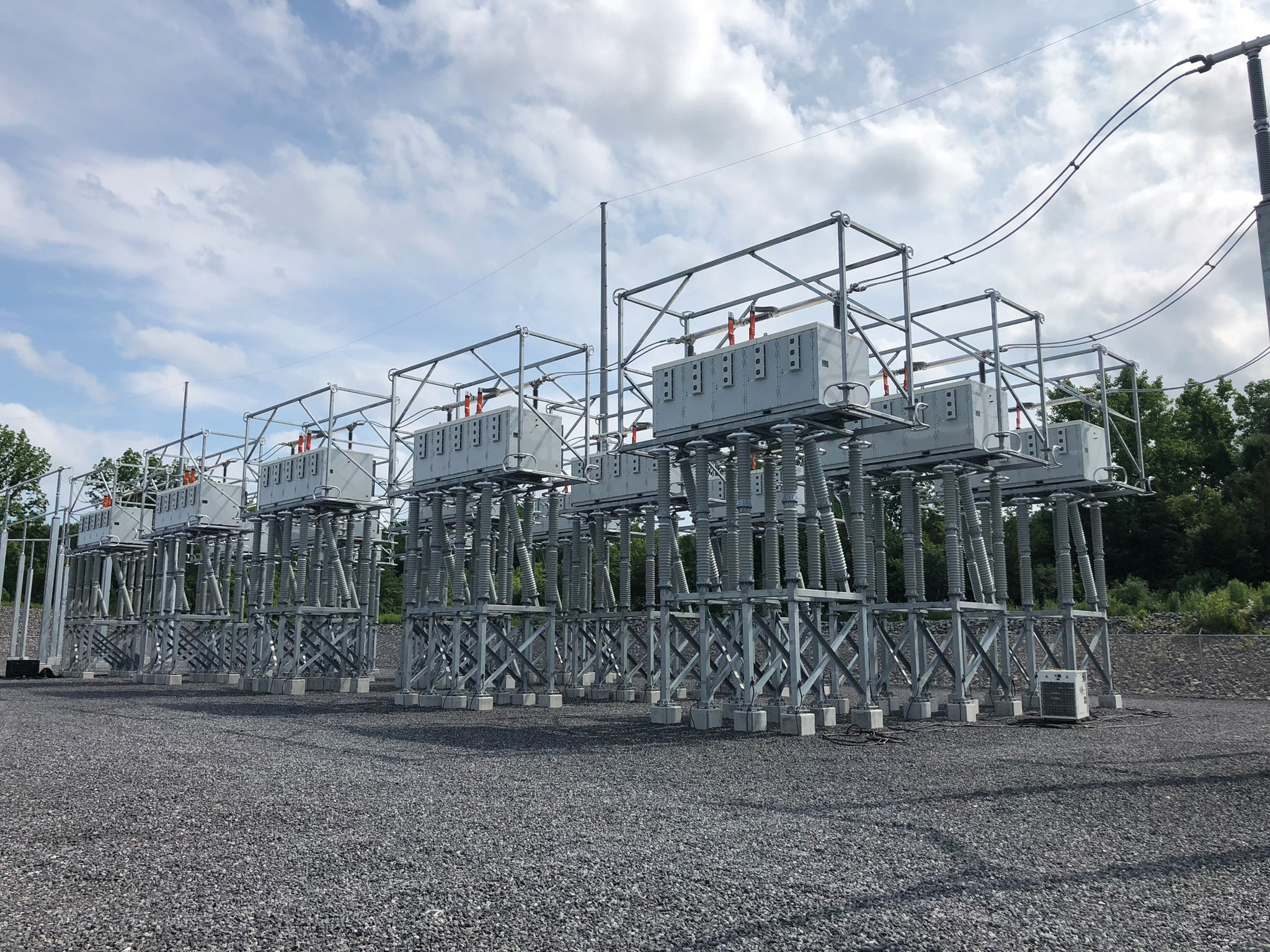
APFC is a new way of doing the work of phase-shifting transformers (PSTs). Packaged in enclosures about the size of a 20-foot shipping container and installed at substations, this equipment helps reduce line congestion by forcing power flows to shift to other lines. Smart Wires Inc., Durham, N.C., began as a startup in 2010, building off research initiated at Georgia Institute of Technology to develop an APFC product called SmartValve.
“It’s a highly intelligent, digital controllable valve that physically changes the characteristics of transmission circuits it’s installed on,” said Ted Bloch-Rubin, the company’s business development director for the Americas. “It does that by increasing or decreasing impedance, which is the attractiveness of power to flow along a circuit. And when you have that level of granular control over a transmission line, you can do a whole lot of things with it.”
More technically, SmartValve equipment “injects an inductive voltage in quadrature with the line curve,” Bloch-Rubin said.
This capability is useful at congestion points where a single line might be operating at near-capacity while other parallel circuits have room to spare.
“Most transmission networks are rated, at most, as utilizing 40%–50% of their overall capacity, and there’s a lot of latent capacity left in the system,” Bloch-Rubin said, describing a scenario he recently discussed with Pacific Gas & Electric executives regarding regions of their system.
“In this case, there are significant numbers of 138-kilovolt (kV) and 230-kV circuits that are significantly underloaded because of power flowing along the path of least resistance. We model that this power can actually run through existing circuits in the area without overloading them, in turn,” he said.
Alberto Del Rosso, program manager with the Electric Power Research Institute’s (EPRI) Technology Modernization Demonstration initiative, notes that because APFCs are digital in design, they offer a greater range of control than mechanically based PSTs. And their modularity gives operators flexibility to grow installations over time.
“It gives you the ability to say, ‘now I need 10 or 12 modules, and, a few years from now, I may need to expand that,’” he said, adding that such expansions can happen quicker than with more traditional approaches.
“The problem with phase-shifting transformers, nowadays, is the lead time to get one is about five years or longer,” he said.
Vermont Electric Co. is adopting APFCs to support an existing PST at the substation connecting the Vermont grid with New York’s. Shifting wind and solar loads were pushing an existing PST to its limits, so the utility will be installing SmartValves in series to help take the load off that aging equipment. Eventually, the APFCs will take on the full load once the PST reaches end-of-life status.
Power line wayfinding
While APFCs help utilities and transmission operators manage power traffic in the field, topology optimization is helping those organizations, along with generation companies, analyze and improve those flows over the long term. This is a software-based solution that uses the power of cloud-based computing to review grid conditions and individual conductor capacity. NewGrid, the leading provider in the field, compares topology optimization to navigation systems like Waze because of its ability to identify alternative routes as heavily trafficked lines become congested.
“The big idea is building off something system operators have been doing forever,” said Anna Lafoyiannis, EPRI’s senior team lead for bulk system integration of renewables and distributed energy resources. “They control the lines by switching transmission lines and substations in and out and, historically, they’ve done that in a more reactive manner—something happens, and you want to control it. The idea of topology optimization is to look at it more proactively, and it could possibly be used for economic benefits to reduce congestion, rather than only for reliability purposes.”
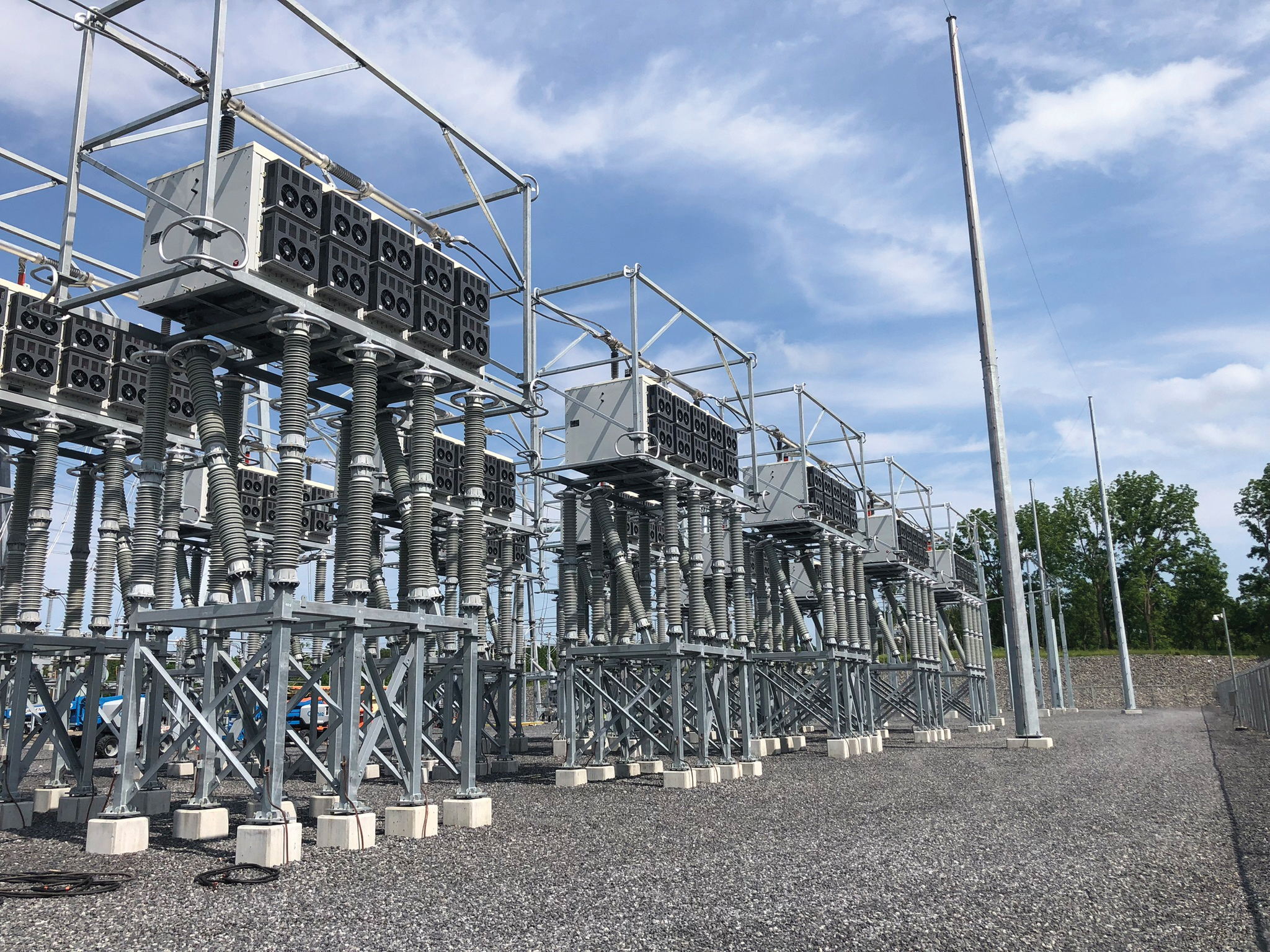
Smart Wires’ SmartValves are hooked up to Virginia Electric Co.’s connection to the New York State grid, enabling smooth transfer of intermittent wind and solar energy without overtaxing an existing phase-shift synchronizer.
This means that, similar to APFCs, topology optimization could help operators make better use of underused lines that could take pressure off congestion points. As a result, the entire system could gain much-needed capacity. The technology also has the capability to take a more active role in grid operations, actually carrying out the power-flow changes it sees as optimal through signals sent directly to switches and substations. Today, though, operators are using it as a planning tool, with humans still managing controls, according to Del Rosso. Lafoyiannis said organizations that have adopted the technology now turn to it a few times per month.
“They’re doing it primarily in response to outage conditions or to a request from a transmission owner,” she said. “This is not because there’s a technical limitation—it’s a choice that’s made to manage workload, also understanding that the more you switch the physical equipment, the more prone to reliability issues you might be.”
Combining forces
While these technologies were developed in isolation, Bloch-Rubin sees them as highly complementary approaches.
“It’s like the one-plus-one-equals-three situation,” he said. “Like, if I’m a user of topology optimization, I would love to have a tool in my substations that allows me to granularly control the amount of flow on my lines. And, as a SmartValve user, it would be helpful to have a highly intelligent software platform to provide operators with the best ways to use devices in the field to accomplish things they didn’t necessarily install the devices for in the first place.”
Many see potential value in tying both approaches in with the other two technologies grouped into the GETs category, dynamic line rating and advanced conductors.
“Generally, we think the best thing a utility could do is look at all three or four—look at advanced conductors and make a plan to optimize the existing grid, there’s really a step-change on the table,” said Julia Selker, executive director of the WATT Coalition, Washington, D.C., a trade association advocating for GETs adoption. “If you start using them, you open up a whole new world, potentially.”
Selker added that, while enabling greater capacity on the existing grid is a benefit for utilities and transmission operators, these power managers also see value in the new insights GETs provide on how their systems are operating in real time.
“I think it’s very important to know what your true limiting element is,” she said. “What we’re seeing is, the utilities want the data and the asset awareness, and then the capacity increases are icing on the cake.”
Providing utilities and grid operators with the information they need to feel confident that GETs will work in the field is the goal of EPRI’s Grid Enhancing Technologies for a Smart Energy Transition (GET SET) initiative, launched in July. Del Ross and Lafoyiannis are involved in this work.
“The motivation is to focus on really high-value research that can accelerate deployment—it’s not intended to solve every single question you might have,” Lafoyiannis said.
The three-year program includes reliability testing in the field and using EPRI’s extensive testing operations, along with financial and organizational planning guidance and a collaboration component bringing together technology providers, utilities, regulators and other stakeholders to share learnings and training opportunities.
The technologies included in the initiative have all reached commercialization, the highest tier in EPRI’s technology readiness scale. GET SET is intended to help move them out of the development pipeline and into broad adoption. The organization sees this as an especially important goal in this time when transmission construction has slowed just as demand is climbing dramatically upward.
“Any one of these grid-enhancing technologies is a good bridge, and the utilities are recognizing that they have been tested and through pilots—there’s a significant interest in using them,” Lafoyiannis said.
And, in the next three to five years, she’s hopeful GETs will be “moving from, perhaps, a more exotic option to being a part of a normal utility toolbox.”
STOCK.ADOBE.COM/ koya979 / Smart Wires Inc.
About The Author

ROSS has covered building and energy technologies and electric-utility business issues for more than 25 years. Contact him at [email protected].