With all the discussion around artificial intelligence, a powerful tool that often gets overlooked is vibe coding. Vibe coding is essentially talking to A.I. (ChatGPT for this article) as if it was your personal programming assistant. The key to this process is through preprompting, or giving the A.I. a persona, such as “Create a prompt that is an expert on creating easy-to-use and accurate HTML files to be used by an electrical contractor and ask any questions to clarify intent.” That simple phrase completely changes the quality of the response and helps the A.I. better understand the industry, workflow and type of tool you are trying to build. Once the A.I. has the proper context, the process becomes surprisingly practical for construction workflows.
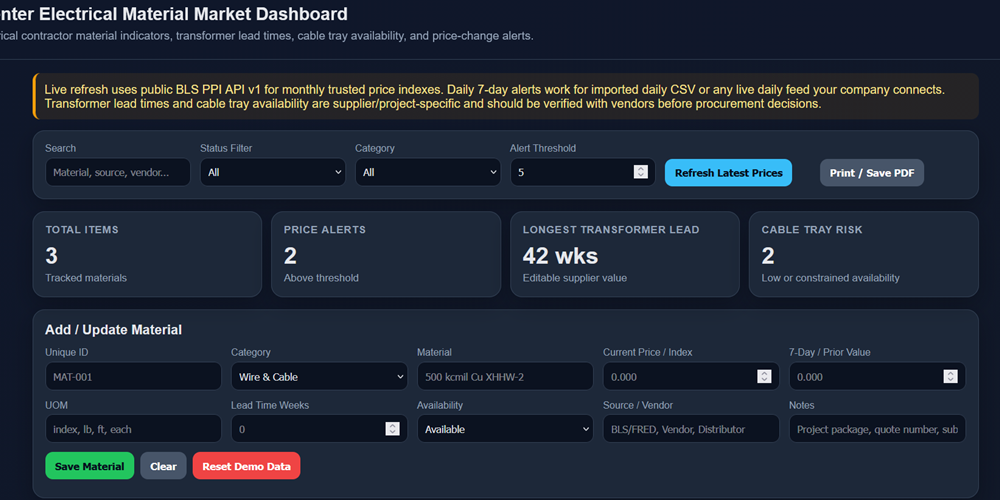
For practical industry use, say building data centers, one of the best examples is creating lightweight HTML dashboards for future material procurement and projections. A growing number of project teams are using A.I. tools to generate simple HTML-based dashboards that pull information from market APIs, supplier pricing feeds and publicly available news sources.
Using a tool like this, the electrical contractor can identify data-center-specific material pricing spikes or delays before they become procurement problems. A project manager or estimator could create a custom GPT using the prompt mentioned above, and a simple input like “Create an HTML dashboard that is specific to data centers with material used by an electrical contractor, transformer lead times and cable tray availability. Add color-coded alerts when there are pricing changes of more than 5% in seven days and use real market data from trusted sources. Add a refresh button to refresh using the lates prices.” Give the A.I. a couple of minutes to do its work, and the result is a dashboard that tracks data across trusted sources and is easy to read, and most important, customizable to your workflows. Now all you need to do is start tailoring it to you own uses. Giving simple commands like “add a button to load an estimate .csv file to compare materials” or “add/remove these materials and recreate.” The A.I. will automatically add the changes, update the code and provide a new file for you to download.
Another great use case is taking existing spreadsheets and creating a shareable dashboard for a team to either view or update. Using the same GPT, simply upload the spreadsheet and ask it to “build an HTML dashboard that that uses this spreadsheet, and create a dashboard to organize this information.” The A.I. will then scan and interpret the file and generate an HTML file that reflects the request. Then simply start telling it how you want to make it better. It is that simple.
Out-of-the-box A.I. tools have a come along way and are continuing to learn and grow. Along with that growth comes new opportunities for ECs to harness a new technology that is changing the way we can interpret, collaborate and gather data faster than any time previous. All you need to know is how to get started and a direction to go in. The tool to do so is literally at your fingertips: “List 10 practical ways to utilize this GPT to help with the interpretation, collaboration and gathering of data for a midsize electrical contractor.”
About The Author

CHRISTMAN specializes in innovation and construction technology from an electrical contractors point of view. He is passionate about elevating the industry. He can be reached at [email protected].