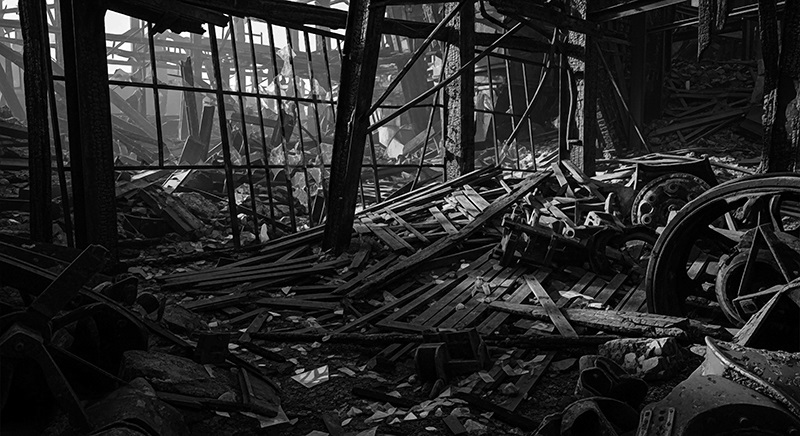
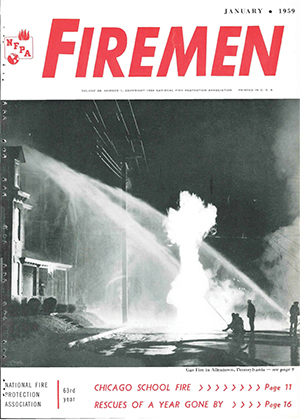
On Dec. 1, 1958, fire swept through Our Lady of Angels Catholic Elementary School in Chicago. Within minutes, flames spread from a utility room to a stairwell and beyond, causing portions of the roof to collapse and trapping and killing 92 students and three nuns. Limited egress and time lost in notifying the fire department brought about horrifying results. Several children were wounded or killed jumping from the second floor. One father living nearby managed to rescue several children using a ladder from home, only to watch his daughter perish.
The United States had seen larger fires, but this one laid bare the circumstances in Chicago and in thousands of other jurisdictions throughout the country that were not implementing national fire safety codes in schools.
“The codes at the time just weren’t being utilized and enforced in Chicago,” said Shawn Mahoney, senior engineer, technical services at the National Fire Protection Association (NFPA), Quincy, Mass.
Following the fire, legislative action in Chicago resulted in school-specific changes:
- Fire alarm boxes had to be installed within 100 feet of school entrances and, more important, connected with internal school fire alarm systems. This mandate ushered in a new era of direct notification to fire departments, a feature of today’s fire alarm systems.
- Sprinklers were required in all public and private schools two stories or more.
- Stairwells had to be enclosed to prevent fire and smoke spread.
- Interior walls and trim had to be made of noncombustible materials.
- There had to be two exits per floor.
- Monthly fire drills had to be held to enforce preparedness.
“It’s important to note that all of these requirements were already included in the [NFPA’s] Building Exits Code at the time,” Mahoney said. “A major change that occurred as a result of this fire and the Cocoanut Grove Nightclub Fire [in] 1942 was to update the code in ways to increase its use and ability to be referenced.”
NFPA began tracking school adherence to the code in earnest soon after the Our Lady of Angels fire. By 1960, an NFPA survey determined that major improvements in life safety were made in 16,500 schools across the United States.
Life Safety Code
The Building Exits Code was revised and eventually renamed the Life Safety Code, which emphasized building construction requirements and other preventive measures such as those adopted in Chicago and elsewhere.
With regular inspections, the changes went a long way in addressing the basics of fire safety. Even so, lag in code adoption persists, and schools have become complex. Those combined circumstances require more electrical work in schools and, as always, the need for strict adherence to fire code.
Code lag
Chicago follows NEC 2017, which predates NFPA 855, Standard for the Installation of Stationary Energy Storage Systems, Mahoney said. “But that’s nothing unusual.”
Echoing Mahoney’s observation about code lag is Mike Botten, vice president of sales and marketing for LVC Cos. Inc., Golden Valley, Minn., which got its start installing fire alarms.
“Throughout most of the country, code implementation varies and code lag averages around four years,” Botten said “Each city and state can be different. Minnesota is now on NFPA 2023 and the latest is 2026, which is typical for many states. That’s often because local ratification of new code tends to be a ponderous process.”
A possible remedy for code lag among neighboring jurisdictions is statewide code adoption, said Dean Austin, senior electrical specialist for NFPA. For six years, he served as chief of the electrical division for Michigan, which has mandated consistent code adoption across its local jurisdictions.
“Right now, Michigan is on NEC 2023, working on 2026,” Austin said. “That goes for all jurisdictions in Michigan. In other states, it’s a mixed bag.”
Statewide consistency also can relieve electrical contractors of having to research and address varying code requirements.
“Even better is when states cooperate with other states granting reciprocity for electrical and contractor licenses,” Austin said. “Several northwestern states allow for this.”
Strides over time
Although code lag persists, there have still been significant strides in fire safety. Analog-addressable devices that detect smoke, heat and fire debuted in the 1980s.
“This was a big change, because you went from analog devices representing a larger zone to being able to pinpoint a specific device in a specific area,” Botten said. “Twelve smoke detectors in a hallway would be considered a zone of the past, and you would have to guess which room might be affected. Now you know the exact device detecting the highest concentration of smoke.”
Newer fire alarm systems automatically notify fire departments with number codes tied to street addresses and building locations in case of emergencies—sometimes in advance of building occupants even being aware of any problems.
“Newer fire alarms have done a fantastic job of working to inform building occupants and first responders of specific threats with color-coded lighting—red for fire, blue for active shooter and green for tornadoes,” Mahoney said. “The systems can also provide notification when systems are impaired, such as closing of a control valve to a sprinkler system.”
The systems simultaneously notify a central alarm center affiliated with the fire alarm service regarding alerts and maintenance needs. That alarm center contacts building maintenance personnel and owners.
Another huge stride, voice messaging, came in the 1990s. It offers more detailed emergency instructions than bells or blaring horns. These can be preprogrammed or prerecorded in male or female voices and in different languages.
Today’s fire alarm systems also support live voice for intercom-style announcements from a central school office or principal who can simultaneously and remotely view live video footage of common areas, lobbies and hallways inside buildings.
For distribution of cellphone alerts, most schools and college campuses require distributed antenna systems for boosting cell signals. The systems also include geofencing, which confines alerts within specific risk areas.
In schools with a significant population of students with special needs, printed emergency messages and instructions appear on LED signs to replace flashing lights and loud voice messages. The idea is to prevent sensory overload and unnecessary panic.
“The LED message boards can be a considerable investment, but schools are getting them,” Botten said. “It’s an added layer of safety.”
While few schools exceed 75 feet in height, for those that do, stairwells and elevator lobbies must be equipped with smoke evacuation and air pressurization to prevent smoke from accumulating and fire from spreading in evacuation routes. The fire alarm systems operate automatically to activate HVAC response.
Leading causes of fires
NFPA says the leading cause of school fires is fires being set intentionally in utility areas, labs and locker rooms. Due to privacy considerations, locker rooms cannot contain cameras, but HALO smart sensors and motion detectors can monitor air quality and human activity. The sensors detect smoke, vaping and THC levels.
School kitchens are also vulnerable to intense fires due to open flames, cooking oils and other flammable materials. These require specific ventilation and extinguisher response. LVC pre-engineers these specialized systems.
Electrical wiring issues account for 17% of fires, according to NFPA, but the percentage may be inflated because the category includes unsolved fire causes, Austin said. Even so, electrical installation and maintenance are essential for life safety.
“Even the best-made 1-hour and 2-hour firewalls are of no value unless the electrical contractor takes measures to seal holes created to accommodate wiring,” Austin said. “If you don’t and smoke gets through, the best notification system might not matter.”
It’s also crucial to use structured cabling and proper supports to suspend wiring and fiber in overhead grid areas, Austin said. On-site solar-power generation, electric vehicle charging, battery storage systems and backup generators involve additional installation requirements.
Egress and automation
Egress is more complicated than in the past, and no less crucial. Building automation to support open passage for egress and evacuation, along with locking for security, is also critical, as first encoded in the 2018 edition of NFPA 101.
“The new requirements ensure that any locking means will still allow students and occupants free access to exit spaces in an emergency, safe space for sheltering in place, but also enable first responder[s] to enter,” Mahoney said. “The goal of these requirements is to prevent the use of devices that could lock a door and prevent egress or prevent access for first responders.”
Sprinklers have changed the least and remain heat-activated, but they, like all other devices and measures, must be considered part of the “fire and life safety ecosystem,” Mahoney said.
“The new requirements ensure that any locking means will still allow students and occupants free access to exit spaces in an emergency, safe space for sheltering in place, but also enable first responder[s] to enter.”
—Shawn Mahoney, NFPA
Essential fire alarm standards
As in 1958, safety hinges on local legislation and enforcement of NFPA and International Building Code standards. In a December 2025 NFPA blog, Mahoney listed codes pertaining to fire alarm installation.
- NFPA 72, National Fire Alarm and Signaling Code, is a design standard, but it also covers required inspection, testing and maintenance.
- NFPA 70, National Electrical Code, provides requirements for fire alarm installation, which are listed primarily in Article 760.
- NFPA 101, Life Safety Code, pertains to new and existing structures and is an occupancy-based code covering fire detection, alarm and communications systems as well as building rehabilitation.
- NFPA 1, Fire Code, provides minimum requirements necessary for a reasonable level of fire safety, life safety and property protection.
- The International Building Code covers fire alarm and detection systems and applies to all buildings except for one- and two-family dwelling units otherwise covered by the International Residential Code. The code is typically enforced by a building department.
- The International Fire Code applies to all new and existing buildings, including one- and two-family dwellings, and it provides requirements to protect properties from fire and explosion hazards. It covers fire alarm and detection systems.
Mahoney was careful to point out that state and local jurisdictions frequently amend local code requirements, making it important to stay current on related project requirements within each jurisdiction.
nfpa | Vecteezy | Chicago Public Library
About The Author
.jpg?sfvrsn=a64b988b_1)
DeGrane is a Chicago-based freelance writer. She has covered electrical contracting, renewable energy, senior living and other industries with articles published in the Chicago Tribune, New York Times and trade publications. Reach her at [email protected].