Between 2010 and 2020, the U.S. population aged 65 and older saw the largest and fastest growth in any decade since the 1880s, topping 55 million, or 16% of the population. The 45–65 age group was another 25%.
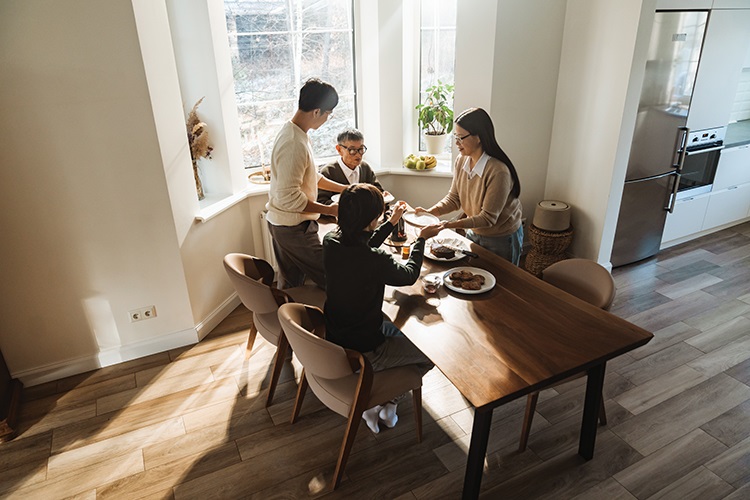
As people get older, their visual systems undergo changes that can affect focus and visual comfort. According to the Illuminating Engineering Society (IES), older people need three to five times more light than young people for detailed visual tasks. They are also more sensitive to glare. Because of this, age is an important factor in residential lighting design.
The IES offers guidance in CG-1-20, “Lighting Your Way to Better Vision.” This document summarizes measurable light characteristics, identifies older people’s particular visual needs and provides recommendations.
Higher light levels in spaces are recommended because aging reduces light entering the eye. Minimizing direct and reflected glare is important because light is prone to scattering within older eyes, heightening glare sensitivity. As older eyes take longer to adapt to lighting changes, levels should be uniform within and across rooms. Additionally, light can be used to enhance important colors, promote circadian rhythms and support individuals with conditions such as glaucoma and diabetic retinopathy.
Lighting design considerations
Lighting design consists of general ambient lighting, task lighting and accent lighting appropriately layered for the space’s use. The light interacts with interior surfaces and may be supplemented by daylight. Light contains properties that affect color hue (correlated color temperature) and fidelity (color rendering). The IES guide describes a range of spaces inside and outside the home and outlines specific considerations for each. Below are general recommendations applicable to the entire home.
For ambient lighting, a major consideration is whether to use direct or indirect light distribution or a combination. Generally, direct light can focus high light levels for tasks and accenting focal points. A potential downside is a greater possibility of direct glare and excessive shadows if the light output is not properly controlled with good optics. The guide recommends luminaires that properly shield the light source from view or have a diffuser to soften brightness.
Indirect light, in contrast, uses interior surfaces (ceilings and walls) to reflect light into the space for softer distribution, often resulting in less glare and shadowing. A negative, however, is it may not produce enough light for detailed visual tasks. Low light levels may result if the interior surfaces are a darker color, and the space may appear visually dull. Options include luminaires with the light source concealed from direct view, light valances and uplighting floor lamps.
Direct/indirect light combines the advantages of both, though with limited opportunities. With ambient and other lighting layers, it can be helpful to enable control with dimmers, which can mitigate glare and provide more flexibility to create scenes well suited to different uses of the space.
Interior finishes should be a lighter color, with a flat finish in general areas and potentially a satin or eggshell finish in kitchens and bathrooms. The guide suggests a paint light reflective value of 80–90 for ceilings and 60–80 for walls. The light source can be cool-, neutral- or warm-white, with warm-white traditional in home lighting. A color rendering index rating of 80-plus is recommended.
The sun is an ideal light source, but daylight should be properly controlled. Ideally, the daylight will be balanced (no extreme contrasts of light and dark), entering the space from multiple directions. The guide recommends some form of covering that allows daylight penetration while reducing glare. If skylights are used, they should be made of diffused glass or plastic to minimize glare.
The guide concludes with a checklist of questions homeowners or contractors surveying an existing home can ask: Do the parking area and all outdoor pathways have adequate lighting, with yellow or white strips marking curbs and steps? Are all stairs properly illuminated? Is the lighting in corridors uniform? How many windows are in each room? Is the lighting comfortable, without glare or strong shadows? Do spaces feel bright? Is the light uniform in the space and from room to room? Do bedroom and bathroom light switches have a glowing annunciator? Are the bathroom lights placed so one can stand in front of the mirror without excessive shadows on the face? Do the closets have their own lighting? Does the kitchen have undercabinet task lighting?
Get the report for free at the IES store here.
stock.adobe.com/Drobot Dean
About The Author

DiLouie, L.C. is a journalist and educator specializing in the lighting industry. Learn more at ZINGinc.com and LightNOWblog.com.