If you’ve ever signed a contract for a software tool, only to watch it gather digital dust in a file folder, or worse, auto-renew for another year only to remain unused, you’re not alone. In today’s fast-moving world of construction technology, these scenarios are all too common. The flood of new tools, apps and platforms promises better coordination, faster closeouts and streamlined workflows. But without someone on your team to evaluate, pilot and implement those tools in real world conditions, you risk trading money for more confusion.
Enter the construction technologist, a role rapidly moving from luxury to necessity in today’s fast-paced electrical contracting industry. Technologists help contractors navigate the sea of innovations, avoid costly missteps and align technology adoption with actual workflows on-site and in the office.
So who are they, what do they do and how do you find one for your company? Let’s break it down.
The problem: Innovation without integration
Today’s electrical contractor wears a lot of hats: estimator, project manager, procurement lead, BIM operator or sometimes even IT support. Meanwhile, the digital tool set keeps growing. Reality capture platforms, A.I.-driven scheduling, prefabrication software, cloud collaboration tools and mobile BIM viewers are just a few, and they are rapidly becoming the standard on competitive bids.
With limited time and bandwidth, most companies can’t keep up. Potential high-tech job opportunities are missed. Trial licenses expire unused. Even promising tools may fall flat due to poor implementation or lack of support.
As one construction technologist put it, “Without someone to connect the technology to the actual workflow, the software just sits on a shelf. You end up wasting money, frustrating your team and, worse, losing trust in technology that is here to stay.”
The result? Missed opportunities and a creeping sense that technology is passing your company by. To borrow one of my favorite phrases from Josh Bone, executive director of ELECTRI International, you end up with “paralysis by analysis,” i.e., you’re so overwhelmed with options that you do nothing.
What a technologist actually does
Let’s be honest, answering cold calls from software sales can seem like a waste of time, but it can lead you to a program that changes the way you do business. A technologist can take these calls and determine how a new software will affect process. Think of them as your field-to-office translator. Their job is to bridge the gap between flashy software demos and the gritty realities of electrical work.
There are several ways a technologist can contribute to your work.
- Tech scouting and filtering: The technologist takes the first pass at evaluating tools from cold calls, conferences and online buzz. They act as a filter, ensuring only relevant, process-aligned technology makes it to decision-makers.
- Process mapping: Before pitching a solution, they map out your existing workflow, who does what using which tools and where bottlenecks occur. This clarity helps you avoid “tech for tech’s sake” and instead focus on meaningful improvement.
- Champion identification: The technologist finds a technology-friendly field or office user willing to pilot new solutions, give honest feedback and help guide adoption.
- Testing and return on investment evaluation: If a tool shows promise, the technologist coordinates a limited pilot, measures its effects and helps evaluate ROI across safety, schedule, labor savings or quality gains.
- Implementation and training: With buy-in and results in hand, they help roll out the tool more broadly, ensuring it integrates into your standard operating procedures, not just your software stack.
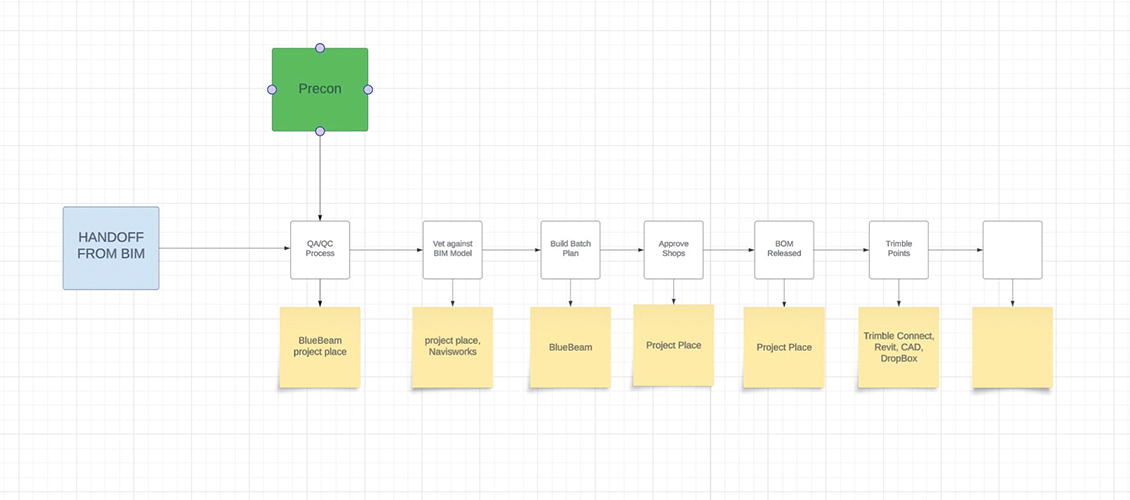
An example of a process map created by a technologist
Finding your construction technologist
In many cases, your ideal technologist is already on your team—they just haven’t been given the title.
When searching for a potential technologist within your company, start by identifying the individuals who are already the go-to tech help on the job site, i.e., the people their co-workers hand tablets to when something isn’t working. These are often the ones who naturally gravitate toward digital tools, on and off the clock.
What sets them apart is technical curiosity and a practical understanding of field operations and office workflows. They tend to be patient, solution-oriented and eager to explore new technology.
“Technologists often rise from within,” according to one senior field coordinator. “The guy helping everyone with BIM in the trailer? That’s your future technologist. They already speak both languages.”
How to train your technologist
While enthusiasm and experience go a long way, training can accelerate their growth. As it is almost impossible to find formal construction technology training, one of the best ways for the technologist to gain insight is through technology-heavy conferences. They are able to see the technology, ask questions and evaluate.
Social networking is also a valuable tool—as is being able to ask other contractors that have implemented the technology how it affected their process, how it went and how their long-term customer support experience has been. Consider programs at construction innovation conferences to help gain knowledge about emerging technology.
How do you avoid the “shelfware” trap? Let’s look at a real-world example. A contractor buys a digital inspection and reporting tool designed to streamline QA/QC documentation. It works beautifully in the demo. But no one uses it. Why?
- The tool wasn’t mapped to their current inspection process.
- Field users weren’t trained or included in the pilot.
- It doesn’t integrate with their current workflow.
A technologist could have caught all of this with a few pointed questions: How will this software integrate to our existing tech stack? What is the implementation or onboarding plan? Will we be able to test this on our current workflow for 30 or 60 days?
In a worst-case scenario, without a technologist, you purchase the software and the contract auto-renews. Now you’re paying thousands annually for a tool that frustrates your team and adds no value. Multiply this scenario across three or four platforms in your tech stack, and the case for a dedicated technologist becomes hard to ignore.
Return on investment
Determining the ROI of having a technologist is difficult to evaluate. They do not bring revenue into the company, but what they implement can save the company money through process improvement. Keep this in mind: saving money is the same as making money for the company.
Electrical contractors that empower technologists are seeing tangible improvements across several key project metrics. With schedule timelines tightening, real-time reality capture and BIM integration significantly reduce RFI delays.
Labor productivity has also improved, with simultaneous localization and mapping-based (SLAM) mobile scanners showing up to an 80% reduction in on-site scanning time. Safety outcomes are stronger as well, with prefabrication workflows guided by BIM decreasing time spent on ladders and in confined spaces, directly lowering job site hazards. Additionally, quality control has improved through the use of artificial intelligence-assisted document reviews, which accelerates contract vetting, streamlines specification reviews and enhances overall compliance.
Culture can play a big role. Younger, tech-savvy electricians may be more engaged when paired with tools they understand such as tablets, drones, BIM platforms and A.I. Perhaps, most important, technologists help build a culture of curiosity and experimentation, critical for future-proofing your business in an industry where innovation is no longer optional.
It is easy to fall into the mindset that failure is bad, but remember that some of the greatest process improvements have come after numerous failures. A failure is only a failure if you did not gain knowledge and document the lessons learned. And failure only inhibits progress when you give up.
But where do you start?
What if you are not ready for a full-time technologist? Start small by assigning the role part-time to someone with interest and aptitude. Build a process map for one sector of your business, then pilot one technology with clear metrics and documentation. Build a technology committee with representatives from the field, office and leadership. Use process mapping exercises to align technology decisions with real workflows. You don’t need a million-dollar innovation lab. You just need someone who knows how to ask, “Will this improve our process?” and how to answer the question.
A construction technologist can help ensure you adopt the right tools, map them to real workflows and avoid costly technology missteps. You might already have the right person; you just need to give them the title, training and trust.
Construction technology isn’t slowing down. From A.I. to prefab and drone scans to cloud-based scheduling, your competitors are experimenting, learning and gaining ground. The time to start with a technologist is now. The longer you wait, the greater the chances are that your company will end up in the rear-view mirror, instead of leading the charge.
Technology Resources
Conferences and education sessions: Construction industry organizations host conferences and education sessions all year about emerging technologies and have technology-driven social networking opportunities.
ELECTRI International: The nonprofit research and innovation arm of NECA is dedicated to advancing the electrical construction industry. It has resources for effective technology and implementation on and off the job site through unbiased and educated opinions.
Peer contractors: Many large contractors have filled this role. Most are willing to share how they found them and lessons learned on technology implementation.
—J.C.
stock.adobe.com / Neko funny | stock.adobe.com / peshkova
About The Author

CHRISTMAN specializes in innovation and construction technology from an electrical contractors point of view. He is passionate about elevating the industry. He can be reached at [email protected].