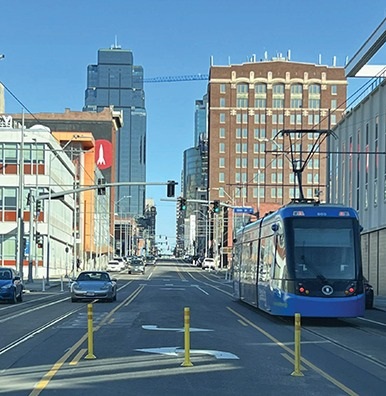
The KC Streetcar is a light rail streetcar system in Kansas City, Mo., that is free to ride and operated by the Kansas City Streetcar Authority. The original 2.2-mile route, opened in 2016, cost $102 million to construct and connected downtown Kansas City’s River Market area to main railway hub Union Station, providing riders with access to various restaurants, businesses and the city’s art district. It has logged more than 17 million passenger rides since opening and was extended southward by 3.5 miles in 2025–2026. It now includes stops at the University of Missouri-Kansas City and the city’s riverfront area, which features popular destinations such as Berkley Riverfront Park and the Kansas City Current soccer stadium.
Expanding the streetcar system with additional infrastructure and modern traffic and lighting systems was no small undertaking. But working together with the city of Kansas City and the Kansas City Area Transportation Authority from 2022–2024, the team at Capital Electric Line Builders, an Everus company, successfully delivered its $17 million electrical portion of the project. The project helped the city achieve its vision for a more connected, accessible and sustainable urban core.
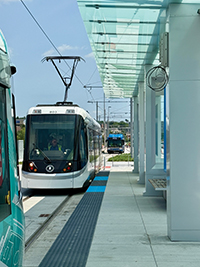
Capital Electric Line Builders’ support of the KC Streetcar
extension allows area residents and visitors to access
even more of the city’s major attractions with ease.
While Kansas City operated a streetcar from the late 1800s until the 1950s, Kevin Minor, Capital Electric’s vice president of signals and lighting, confirmed that the reintroduction of a modern streetcar system through the heart of the city was long overdue.
“Kansas City is a very broad and congested city where parking was always a problem,” Minor said. “In addition to getting gas-powered buses off the streets, the city saw the development of a free light rail system as a way of helping residents access the city’s key destinations without having to worry about parking. The KC Streetcar hits major attractions, avoids congestion, helps with parking and connects all of the city’s arts and entertainment districts together—stretching down Main Street from Pershing Road to East 51st Street and connecting major cultural and commercial hubs including Union Station, the River Market, the Power and Light District, the University of Missouri-Kansas City and Country Club Plaza—all on one travel pathway.”
A ‘full circle’ project
The original Kansas City Streetcar began operating in the late 1800s to serve the bustling city at the turn of the 20th century, but was officially taken out of service in 1957 as residents began moving to the suburbs and the city core experienced a period of economic decline.
“Kansas City has been undergoing a revitalization since the early 2000s, thanks in part to investment by entities like Kansas City Power & Light [now called Evergy], which helped build the popular shopping, dining and entertainment area downtown known as the KC Power & Light District,” Minor said.
“Developers helped breathe new life into the city’s businesses, restaurants and convention center, which brought a lot more residents downtown and helped spur demand for and construction of trendy new apartments and high-rise lofts,” said Colby Atwell, president. “The KC Streetcar was a natural extension of that development for the growing population.
“The path of the new KC Streetcar goes exactly where the original streetcar did generations ago,” Minor said, “so while so much has changed since that time, the new KC Streetcar brought us full circle in many ways.”
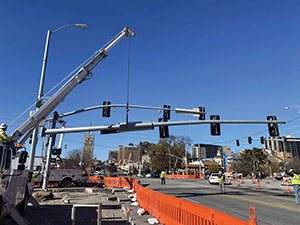
Capital Electric Line Builders crew members raise a
traffic signal arm into place over a busy street in Kansas City.
When plans for an extension to the original 2.2-mile route were announced in 2021, Capital Electric Line Builders submitted a quote on the extension project. It was awarded the contract and began work in 2022.
“We worked for the joint venture of civil infrastructure firm Stacy Witbeck [Alameda, Calif.] and rail construction firm Herzog [St. Joseph, Mo.],” said Chase Neal, senior project manager.
The scope of the firm’s responsibilities on the extension project immediately included installing temporary traffic signals at 19 intersections so the new infrastructure could be built through the old with minimal interruption to the flow of traffic.
“We addressed preproject work, drawings, product ordering and plan finalization between December 2021 and March 2022, and then got going on underground work that spring, when we moved existing underground cabling aboveground so that fellow subcontractors could proceed to install sewers, rails and other civil infrastructure underground without obstructions,” Minor said.
In addition to installing the temporary signals to manage traffic during construction and then 19 new permanent traffic signal systems, Capital Electric Line Builders installed more than 125,000 feet of signal cable and 34,000 feet of conduit, 40,000 feet of lighting cable, 353 overhead catenary system poles to power the streetcars (including combination poles that also support lighting and signals) and 32 signal poles with concrete footings.
What’s old is new again
With a field team that included 20 workers across multiple crews, Capital Electric Line Builders was challenged to blend the old with the new in Kansas City’s highly trafficked and congested city center.
“We were ultimately installing new underground infrastructure in century-old spaces that were jam-packed with antiquated cables,” Neal said. “At one intersection where we needed to install a traffic signal base, we had to get a huge truck and equipment on-site to pull out an old base that was installed two upgrades ago.”
As part of their underground activities, the team had to work around other obstacles too.
“We ran into old steam lines that used to power everything—including radiators in nearby homes—that threatened to melt our PVC conduit, and we also kept hitting original streetcar tracks,” Minor said.
He noted that some of the conduit they encountered was so old it was made of wood, a material commonly used pre-1920s before the industry moved to metal and plastic.
Seasonal weather issues also presented the team with their share of challenges.
“There were thankfully no major snow events that delayed things for a long time, but even 2 inches of snow obscured marks showing where we could dig safely and required snowplows to clear the area and the placement of traffic cones that blocked lanes while snow was being cleared, which caused disarray,” Neal said. “At the same time, Kansas City summers get hot, so our crew members took caution on 100°F days by working earlier in the morning to get as much done as we could and taking regular water and shade breaks to avoid getting overheated.”
“To squeeze 353 large foundations into congested downtown areas clustered with old conduit was amazing, and we didn’t hit one telecom, water or other utility line that was properly marked,” Minor said. “For our team to work in that dense of an area and install the magnitude of foundations and conduit we did without hitting a single piece of properly marked infrastructure by a local utility was a huge accomplishment.”
With safety also being a top priority, “We’re proud to say that we worked 39,000 man-hours over the two-year period of this project without a single recordable injury,” Neal said.
Right people in the right places
“This was a complex and rewarding project in a dense urban environment with 125-year-old underground infrastructure, limited right-of-way and high pedestrian and vehicle traffic,” Neal said. “It required precision, coordination, constant attention to safety and a lot of grit.”
Much of the success goes to having the right people in the right places—a strategy that helped avoid everything from safety issues to scheduling snafus and more.
“You need someone strong leading the pack on a job of this magnitude, and our general foreman Darrick Shipley was critical to our operations and did an outstanding job,” Neal said. “Because he was always thinking two weeks ahead and keeping things flowing, he was largely responsible for our in-field success on this project.”
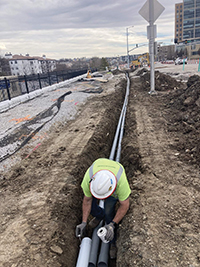
A Capital Electric Line Builders crew member installs
conduit during construction of the KC Streetcar extension.
Strong industry relationships were also part of the team’s recipe for success.
“Through this project, we strengthened our relationship with Stacy Witbeck and Herzog, and we look forward to the opportunity to work with them again in the future,” Neal said. “Our work on this project demonstrated how good our company is at what we do and the strong support we can provide. Another extension has since been proposed that would take the KC Streetcar even further out to the airport and Royals Stadium, and we anticipate being involved on that job.”
“This train reinvigorates the whole anchor shopping district at its new final stop at Country Club Plaza and connects the city’s old shopping district with the University of Missouri and the whole downtown,” Minor said. “You can go shopping, dine out and see a KC Current soccer game with ease thanks to the KC Streetcar now connecting all of these areas together.”
“Kansas City has a lot of different pockets of entertainment, and the KC Streetcar finally ties all of these pockets together for the first time,” Neal agreed. “Everyone in the area knows the KC Streetcar—it’s an iconic train that represents a great development for the city because it makes it so easy for people to see and access everything Kansas City has to offer on one transit system.”
“This project is a testament to what’s possible when expertise, collaboration and public service come together,” said Minor, a lifelong Kansas City resident. “Our city is thriving with the support of this train, and it’s gratifying to know that our team played a role in making that forward motion possible.”
About Capital Electric Line Builders
Founded in 1967 and headquartered in Parkville, Mo. (with additional locations in Dayton, Ohio, and St. Louis), Capital Electric Line Builders builds and maintains electrical infrastructure throughout the Midwest region, from generation point to the meter on the house. As part of the company’s full-service offering are specialized transmission and distribution, traffic and signalization, and intelligent transportation systems divisions. The company currently has about 650 employees.
capital electric line builders
About The Author

BLOOM is a 25-year veteran of the lighting and electrical products industry. Reach her at [email protected].