You're reading an older article from ELECTRICAL CONTRACTOR. Some content, such as code-related information, may be outdated. Visit our homepage to view the most up-to-date articles.
All of that dark fiber we have been discussing the last few months is getting used for some fast-growing applications, and the fastest may be connecting cell towers. Cell phones have evolved into mobile data devices. Smartphones and tablets consume vast amounts of data. AT&T claims that its data usage has grown more than 500 times since the introduction of the iPhone in 2007.
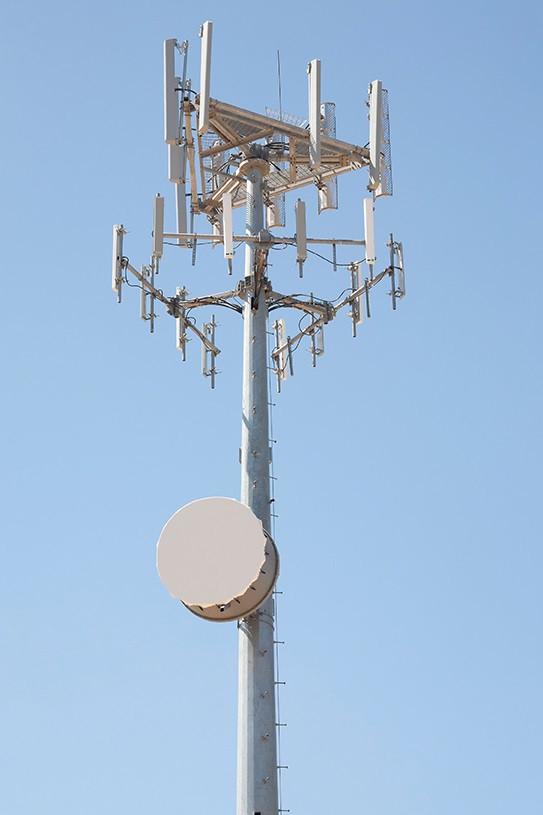
You have undoubtedly noticed one effect of this: the proliferation of antennas on cell towers. Each antenna has a limited bandwidth, so adding more bandwidth means adding more antennas. In addition, the operating companies have sold many cell towers to independent owners. This reduces costs for the service providers—now they just pay rent instead of bearing all of the cost of operating the tower—but it opens the towers to hosting antennas from multiple carriers, adding even more antennas.
There are more than 200,000 cell towers in the United States, and all of them are being upgraded to meet user demands. The upgrades have two parts: first, providing more bandwidth to the tower and, second, adding the extra antennas and associated hardware.
Cell towers connect wireless phones to the regular phone system. In the past, when phones were used mostly for voice calls and texting, cell towers were connected over regular copper phone lines, while some rural towers were connected over microwave relay links. Neither of these have adequate bandwidth capacity needed on most towers today. Almost all of these towers—except in rural areas where the fewest customers are located—are being connected over fiber.
The connection to the cell tower is a standard telco type, so the tower is handled like another phone switch. The tower has equipment that converts the cellular signals (3G, 4G or LTE) to telco fiber optic protocols for connecting to the phone system. The connection to the tower is single-mode fiber installed as part of a standard outside plant (OSP) cabling installation.
In some cases, fiber already connects the towers, so the upgrades are made by lighting dark fibers in the connecting cables if available or adding wavelengths to current fibers in a dense wavelength division multiplexing system. If the towers do not have fiber, construction is required to bring fiber to them.
Another interesting thing is happening at the tower itself. When towers had three antennas spaced out to cover one-third of the area around the tower, it was common to have equipment on the ground to convert the signals to the antennas to radio frequency (RF) and transmit to the antennas over coaxial cable large enough to carry the high-frequency signals and power for the antennas. With about two dozen antennas on the towers, these coaxial cables were too heavy and created too much wind resistance for the tower. The solution was to convert them to fiber optics with what is called a fiber-to-the-antenna (FTTA) system.
An FTTA system is an all-digital system with fiber optics. On the ground, an electronics package called the base band unit (BBU) converts from telco protocols that transmit signals on fiber up the tower to a remote antenna unit (RAU) at the top of the tower. The RAU converts the signal to RF and drives several conventional antennas over coaxial cable. The next-generation system, which is just coming into use, will combine the RAU and antenna into an active antenna, eliminating the need for the extra coaxial cable.
Beside signals over fiber, it is necessary to send power up the tower for the RAU or active antenna. This is usually done with a composite cable that includes fiber optics for the signals and copper power conductors. The copper conductors are terminated in a distribution box on the tower’s top that also includes lightning arrestors. Power is generally 48 volts direct current.
Needless to say, terminating an optical fiber while hanging on to the top of a cell tower would be difficult, so tower cables are factory-terminated and ready to install. Techs installing the cable still need fiber training because the fiber connectors need cleaning, inspection and testing to ensure no damage was done during installation.
Using fiber optic test equipment at the top of the tower is not a good idea either, so testing is usually done from the ground, and each pair of fibers is tested with a fiber loopback attached to the cable atop the tower. Tests include insertion-loss testing with a light source and power meter and sometimes optical time-domain reflectometer (OTDR) testing with a high-resolution OTDR.
Tower work pays well but is dangerous. Technicians need to be trained on tower climbing, and safety must be everyone’s first concern.
The Fiber Optic Association’s online self-study website, Fiber U (fiberu.org), has a free FTTA self-study program that expands on this topic. The association also has video on the subject at www.youtube.com/thefoainc.
About The Author

HAYES is a VDV writer and educator and the president of the Fiber Optic Association. Find him at www.JimHayes.com.