Every tradesperson understands that the efficiency of their work is directly tied to how well their tools are organized and protected. Tools must be functional and within arm’s reach. Enter the toolbox! The once humble toolbox has become much more
than a simple place to toss wrenches and screwdrivers—it is now part of a highly engineered system designed to support the ever-evolving demands of the modern job site. This article briefly explores the evolution of toolboxes, modular storage
systems, and job site and truck storage solutions. You'll also find a few things to consider when making tool storage selections.
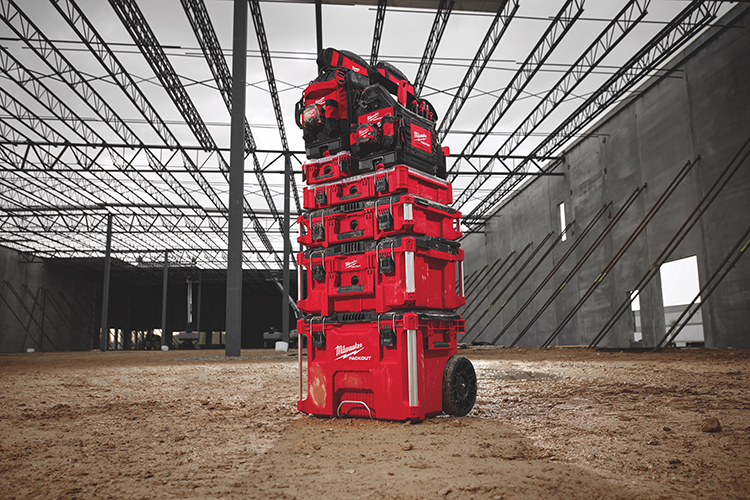
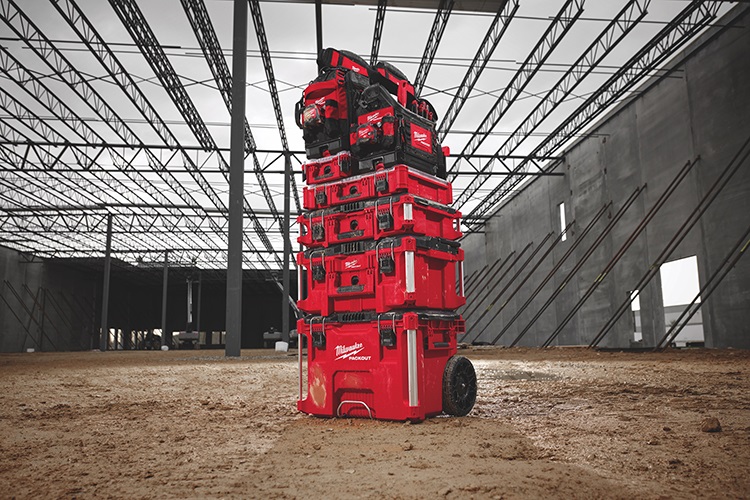
Milwaukee Tool's Packout
Rolling Tool Box system
Toolbox evolution
Tool storage and transport have been around as long as the tools themselves. Historically, craftsmen such as blacksmiths, carpenters and masons used leather pouches, wooden crates or custom-built boxes. While this was simple, effective and got the job done, most of these options lacked compartments and were not designed for mobility, productivity or longevity.
As the Industrial Revolution advanced and the need for portable tool options became more common, the early 20th century began to see the first recognizable metal toolboxes. They were rugged, made of sheet metal or steel, but they were also heavy, prone to rusting and not very weatherproof. After World War II, cantilever-type boxes and early plastic models made for easier organization, and portability debuted.
By the 1970s and 1980s, toolboxes constructed of high-impact plastics started to gain in popularity as they were considerably lighter than those made of steel and still reasonably durable. Plastic also allowed for more innovative designs, such as compartments for smaller parts, custom-molded inserts and removable trays. It was during this time that roll-around tool chests gained popularity, particularly in large commercial or industrial installations.
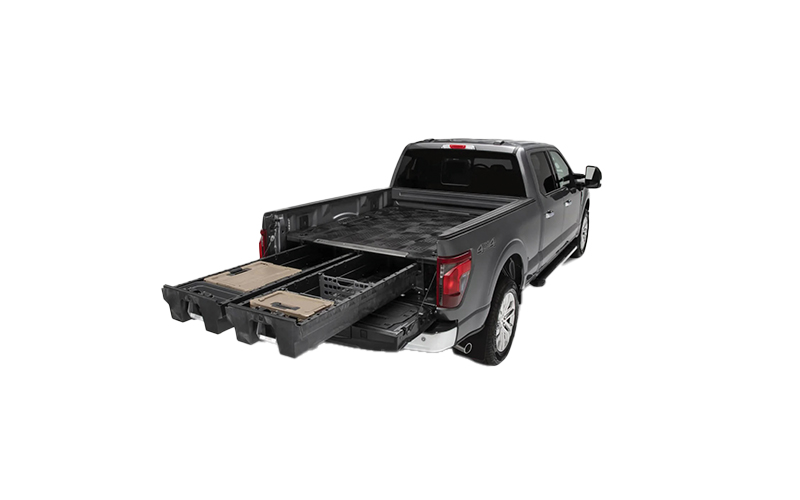 | 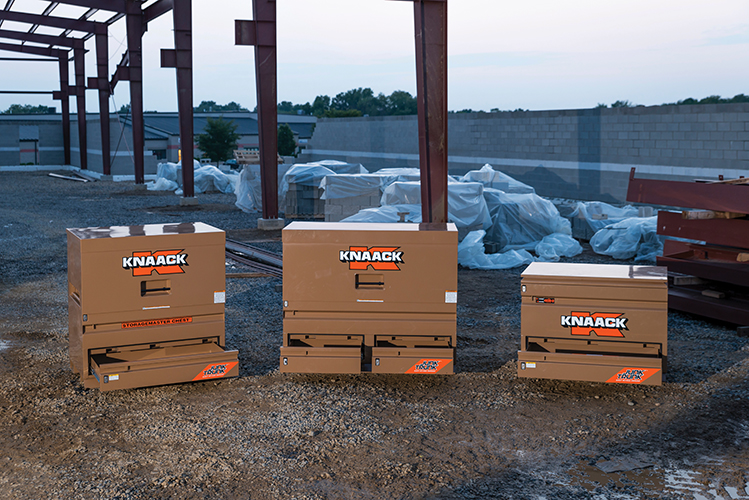 | |
Decked’s full-length truck bed drawer system | Knaack’s 79-D Piano Box, 89-D Piano Box and 4830-D Chest |
Modular systems
While the older style of tool storage is certainly still a viable option, today’s toolboxes are part of a more system-oriented approach. Modern workers require mobile, customizable and weather-resistant storage solutions.
Tools must be protected and readily accessible. Modular, interlocking toolbox systems have taken the center stage. They enable users to mix and match configurations depending on their needs or tasks. The toolbox, once a basic accessory, is now a professional-grade asset that speaks volumes about a tradesperson’s preparedness.
Brookfield, Wis.-based Milwaukee Tool’s Packout system is perhaps the gold standard of modular storage and has become synonymous with job site efficiency. It was first released in 2017 and was quick to gain traction in the trades with its stackable, interlocking design that enables a customized storage solution to fit specific job site or task needs. Simply select a base unit (typically one with wheels and a handle, such as the rolling toolbox) and then add additional storage components as necessary.
Each box quickly and securely connects to the one below it, reducing load shifting during transport. Milwaukee offers an array of boxes, totes, drawers and organizers. It even makes coolers, coffee mugs and a radio, which are all designed to stack and lock together. The product line is constructed of impact-resistant polymers with metal-reinforced corners that will hold up under rugged job site conditions. Adding to the versatility are IP-65-rated seals that protect interior contents from dust and water intrusion.
Klein Tools, Lincolnshire, Ill., offers a modular storage platform with its MODbox line, first released in 2023. Klein’s design focuses heavily on functionality and electricians’ specific needs. Perhaps the most unique feature of the MODbox is the top rail accessory mounting, which allows users to attach small parts bins, tool holders, work light holders and even a cupholder—all without having to open the main bin or remove stacked boxes to get to these items.
Tool pouches (designed to work with Klein Tools’ tool vest) can also be clipped to the top rail, further expanding the system’s versatility. Certain pouches can be loaded up for different tasks, stored on the MODbox and then quickly changed out without having to reload pouches.
The boxes are extremely durable, with reinforced bases, large wheels for traversing uneven ground and IP-65-rated seals on
the lids—all designed around surviving real-world job site abuse. The telescoping handle is removable—a blessing when putting it in the bed of the truck—and designed to hold conduit benders and levels.
Klein Tools also offers several inserts that can hold screwdrivers, wire strippers and meters. This system is designed with the electrician in mind and is particularly useful for organizing everyday tools and minimizing unnecessary clutter. Its accessories are convenient and designed to enhance workflow.
Job site and vehicular storage
However, there are times when larger tool storage is required or where security is a concern. This is where the gang box comes into play. Typically seen on large commercial projects, these are large, robust and typically wheeled—like a mobile tool vault.
Knaack, Itasca, Ill., offers a range of gang boxes for many storage needs. All its boxes are built from heavy-gauge steel and feature reinforced hinges and more to withstand theft and the wear and tear of the job site. Some models feature crane-lift brackets, four-way skid bases for forklift access and even power strips and grommets for interior tool charging.
But what about those of us who work out of our trucks? Sure, we could just launch all our tools into the back and hope for the best. But sorting everything out later takes time—and time is money. And what about keeping tools dry and in good working order? Truck beds get wet, and water and tools don’t mix.
Decked, Ketchum, Idaho, offers a storage solution: two full-length storage drawers integrated into the truck bed. Each drawer can hold up to 200 lbs. and is completely sealed against water and dust intrusion. The deck that comprises the top of the system can hold up to 2,000 lbs., which is definitely useful for larger items that don’t fit into the drawers. Decked also offers several customizable options such as foam inserts, dividers and gear locks, so everything is secure.
Another advantage of the Decked system is that no drilling is required to secure it to the truck bed because the factory tie-down points keep it in place. This system also saves your knees and back; there’s no need to crawl up in the bed to retrieve tools. Simply pull the drawers out for instant access.
Milwaukee Tool is in the final stages of developing its modular storage system built to optimize organization in vehicles and shops. The Packout Rack system features customizable sliding drawers to access tools and parts without having to unstack the boxes. The system is compatible with Packout toolboxes, organizers and bags and is designed to scale across the side walls of a vehicle or shop space. It is due to release in early fall 2025 and will be compatible with the Packout storage items a user already owns.
Additional considerations
Here are some considerations when choosing a toolbox system:
- Application and scale—Do you work in one place or are you constantly mobile? Is the storage system going to serve a single person or an entire crew? A large gang box isn’t conducive for a service electrician, and a small modular storage system might not meet the needs of an entire crew.
- Security—If theft is a concern, heavy-duty gang boxes are the best option to keep tools safe and secure.
- Modularity and organization—If users are constantly shifting gears, then a modular storage system is definitely the way to go, as it allows customizable setups for a specific task or job site.
- Weather and environment—For outdoor work or sites exposed to weather, tool storage systems with weather-resistant construction and IP-65-rated seals are best.
- Durability—Consider where you’ll be using the toolbox. Job sites demand a level of toughness, so look for boxes with reinforced hinges, rust-proof components and impact-resistant materials.
Conclusion
Toolbox design is becoming a much more technical endeavor. We are likely to see systems integrate electronics, enabling functions such as inventory tracking, smart locks or Bluetooth-enabled location tracking. There will likely be more lightweight composite materials to reduce weight without making compromises to durability.
Customization will also continue to expand. Many manufacturers are creating trade-specific kits that anticipate workers’ most used tools, and this will reduce the need for after-market inserts or add-ons.
We should also expect to see continued innovation in vehicle-integrated systems, especially for those in the service industry who would benefit from full mobile workstations.
Each one of these advances aims to make tradespeople faster and more efficient, safer in their work activities and much more organized. The right toolbox setup can make all the difference.
knaack / Decked | milwaukee tool