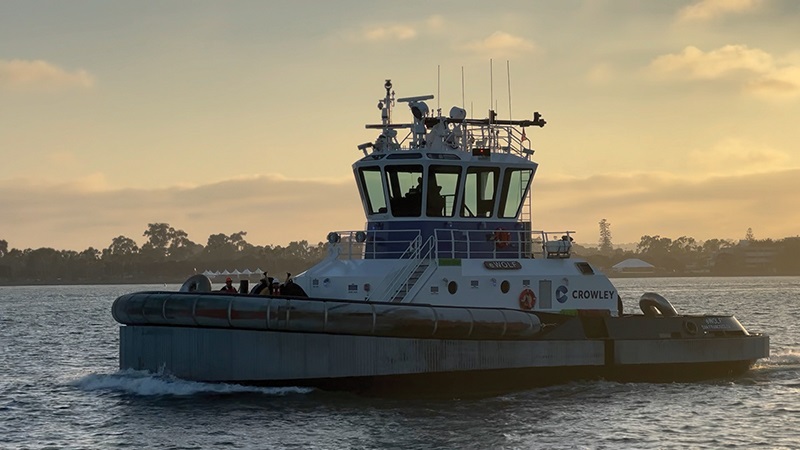
Crowley, Jacksonville, Fla., is a logistics, marine and energy solutions provider that made headlines in 2024 for adding a new member to its fleet of tankers, barges, container ships and other vessels—the nation’s first all-electric tugboat, known as “eWolf.”
The result of a more than three-year-long process from design to construction, the 82-foot-long eWolf was crafted by Coden, Ala.-based shipbuilder Master Boat Builders Inc. and was ultimately delivered to its home port in San Diego in mid-2024, where it immediately went into service in the port’s Tenth Avenue Marine Terminal. Unlike its fellow tugboats, however, which are all used to help push, pull and otherwise steer large ships into port, eWolf can run on 100% battery power rather than diesel fuel, enabling its zero-emission and far quieter operation.
From the get-go, construction of the electric charging station for eWolf was critical to the project’s success. Baker Electric & Renewables LLC, Escondido, Calif., installed a custom charging apparatus portside for the tugboat.
Creating a custom electrical switchyard
“This was our first project with Crowley,” said Philip Brault, senior director of service and special projects for Baker Electric. “We were wrapping up some work at another part of the Port of San Diego several years ago, and the construction manager from that project recommended us to Crowley based on our port and EV infrastructure experience.”
At the Port of San Diego and along the West Coast, “Crowley operates a fleet of tugboats, which are used to assist large vessels in navigating tighter ports of entry and helping them dock,” said David Lacombe, senior project manager within the special projects group at Baker Electric. “There’s a huge statewide push to go green and lower emissions, and this project represented Crowley doing its part to move that mission forward and lower [its] carbon footprint by demonstrating both the ability of U.S. shipyards to build an all-electric tugboat and that such vessels could be commercially viable.”
Standard 1,600A service equipment with 200A circuits feeding shore power to tugboats and other vessels already existed at the port, enabling the ships’ electrical systems to function while moored without running their engines and consuming fuel.
“The scope of our project involved upgrading the existing infrastructure on the pier with greater capacity to feed power to the new electric tugboat when it arrived in port,” Lacombe said. “Following our preplanning activities in early-to-mid 2023 to ready the project, we mobilized and started work in December 2023.”
“We had to request a brand-new, larger service from local utility San Diego Gas & Electric, pour new pads and refeed the existing service,” he said.
The job required the Baker Electric team to upgrade from 1,600A to 3,000A service and from a 750-kilovolt (kV) transformer to a 1,500-kV one.
“After bringing in the larger service, we built a whole new equipment yard on a piece of land next to the port to house all of the new electrical equipment involved, which included a distribution board, isolation transformers, AC-to-DC converters and more,” he said. “Our electric charging setup for the tugboat was completely custom and is essentially a large electrical switchyard designed to create 1 megawatt of output.”
Lacombe said this was a unique project for the company.
“I’ve been in the EV space for the last decade and have done some complex projects and large-scale trucking hubs, but this job was something else altogether because it involved all custom switching,” Lacombe said. “Even the cable positioning device [CPD] we used—an apparatus that helps connect ships to shoreside electricity by moving the cabling strategically to the right location—was a custom, permanently mounted cable dispenser crane from German company Igus. It was a one-off component with little-to-no precedent to reference.”
Navigating challenges
While eWolf represented the first tugboat of its kind in the United States, Lacombe said that others like it exist in Europe. The team worked with different global component manufacturers to replicate the technology here—a reality that made communication between all of the players essential.
“We had coordination calls with the German company creating our CPD as well as with Cordyne, the Texas-based industrial control systems company that created our AC-to-DC converters, and others because it was critical that all parties were clear on exact specifications and schedules,” he said.
According to Lacombe, the size and complexity of the custom components came with their share of challenges, especially given the tight deadlines they were working under to ready the entire charging system in time for eWolf’s arrival to the Port of San Diego in mid-2024.
In particular, “the CPD from Germany was sent to us in a 40-foot shipping container because it was a huge piece of equipment, and as the result of a manufacturing delay, it didn’t arrive to us until later in 2024, four months longer than planned,” Lacombe said. “The company ended up sending us a temporary cable so that we could charge the tugboat until the final CPD arrived.”
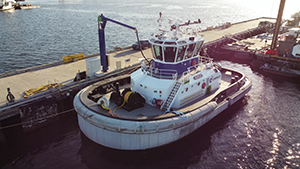
eWolf charging dockside in the
custom electrical switchyard
Another challenge was how the actual DC circuit out to the tugboat’s dock at the pier was run.
“The run from the switchyard to the dock is over 500 feet long and encompasses a mix of exposed conduit aboveground, underground conduit in trenches and a good portion running alongside the pier itself to get power to the spot where the boat docks,” Lacombe said. “The only way for us to get the size package we were working with out to the boat in the last 200–300 feet was to run it on the side of the pier underneath the existing infrastructure and bumpers.”
To achieve this, the team used two negative-reach “knuckle booms” (a type of aerial lift) positioned below their weight-bearing base instead of upwards.
“Working under the pier to run that conduit was challenging because of its potential exposure to debris in the water, so we protected the wires by using heavy-wall, 5-inch rigid metal conduit, each stick of which was 10 feet long and weighed 140 pounds,” he said. “We had two crew members positioned on top of the pier and two people in each manlift under the pier to lower down each stick, and had all of the appropriate safety measures in place for that process, including a safety raft in the water at all times. The process ultimately went smoothly because we’d engaged in so much preplanning beforehand.”
That slow-moving but very important operation took the better part of two weeks during the last third of the project, and once those conduit runs were completed, the team proceeded to pull and terminate the wire. Trenching across the parking lot near the entrance to the pier was complicated by the presence of abandoned concreteencased piping and electrical infrastructure. Baker Electric crew members successfully addressed this by carefully digging around these structures to avoid hitting them and then snaking conduit under or around them to connect to the dock conduit run.
‘Huge and important work’
With 8–10 crew members working on the project at its height, “design and installation of the whole custom electrical yard took nearly a year and we were substantially complete by late 2024,” Lacombe said, who noted that the custom charging system now enables a much faster and more efficient approach to powering eWolf.
“While the boat can charge on standard shore power, that’s a very slow process,” he said. “Our charging station speeds that up significantly and enables the boat to charge to full duty cycle within a couple of hours.”
Though the team had to rely on a temporary charging cable until the custom CPD arrived, “we got everything energized by our deadline and successfully completed the job on time and on budget,” Lacombe said. “Our team members were there to support the first charging in case anything was needed from us, and Crowley brought in its own team members as well as technical people from the other component manufacturers to review a checklist of details and ensure that everything was in order.
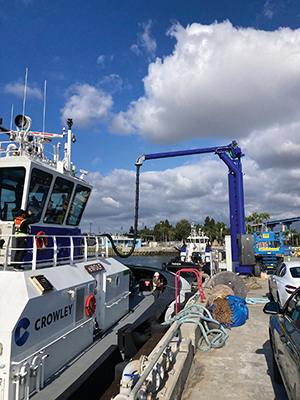 | 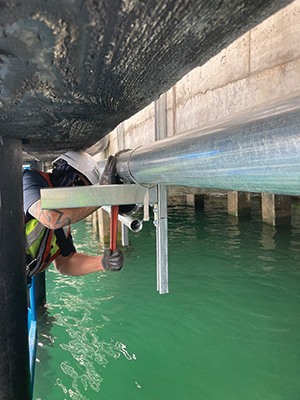 | |
| A custom cable positioning device helps charge eWolf dockside. | Installing conduit under the pier's existing infrastructure and bumpers was challenging. |
“Following the successful commissioning and testing process, the tugboat captain gave us a tour of eWolf and confirmed that it was in action and working full shifts,” he said. “Crowley would like to do more of these boats and transition at least some of their existing fleet to electric models, and we’re here to support them if and when they do.”
Among his top takeaways, Lacombe said that the project offered a great opportunity to learn something new.
“We went into it as an EV charging project and it turned into much more than that in a good way,” he said. “It was great to work with Crowley and the other partners and amazing to be part of the collaboration it took to get through a unique project like this in the United States and get it done correctly and on time. It’s a feather in our cap, as not a lot of our competitors have done ground-up EV tugboat distribution systems like this,” he said. “We’re happy to have been part of it and we hope to see more of this kind of work.”
“We’re very thankful to have been part of such a unique and innovative project,” Brault said. “When a project like this comes along that allows us to leverage our electric vehicle charging experience to solve a complex and important need for our customer and the community, we dive in and get to work. This project reflects our team’s expert capabilities and our commitment to delivering reliable, well-executed solutions, even when the work pushes us beyond the ordinary.”
About Baker Electric Inc.
Founded in 1938 and based in Escondido, Calif., “we’re a full-service electrical contractor that handles everything from large-scale construction and commercial and utility-scale solar projects down to service calls for local businesses,” said David Lacombe, senior director of service and special projects at Baker Electric, which has over 1,200 employees. “We also do quite a bit of EV charging work, and I specialize in EV charging infrastructure, though this project was the first boat we’ve done.”
—S.B.
baker electric Inc. | stock.adobe.com/polygraphus
About The Author

BLOOM is a 25-year veteran of the lighting and electrical products industry. Reach her at [email protected].