The American Society of Heating, Refrigerating and Air-Conditioning Engineers (ASHRAE) and the Illuminating Engineering Society (IES) recently updated ANSI/ASHRAE/IES Standard 90.1, Energy Efficiency Standard for Buildings Except Low-Rise Residential Buildings, with a 2025 edition.
Commercial building energy codes regulate design energy efficiency. While some states write their own codes, most adopt, in whole or part, model codes and standards such as 90.1 and the International Energy Conservation Code (IECC). While the majority adopt it, the IECC references 90.1 as an alternative compliance standard. Additionally, 90.1 is recognized by the Department of Energy as the national reference standard and serves as the basis for building rating systems such as LEED.
The lighting section of 90.1 contains prescriptive and mandatory requirements. Over the years, the overall trend is reduced power allowances and more detailed control strategies, clarifications to promote compliance and updates for changing market conditions. True to form, the 2025 version of Standard 90.1 updated lighting power density (LPD) values, revised exterior lighting zones and strengthened lighting control requirements.
Let’s review what’s new for lighting in the 2025 version. This information is provided for general educational purposes. For more information consult the standard, available at ASHRAE.org/technical-resources/bookstore/standard-90-1. For interpretations, consult the authority having jurisdiction.
Reorganized requirements: Standard 90.1-2025 reorganized the lighting requirements tables, keeping the list of space types but separating LPD and lighting control requirements.
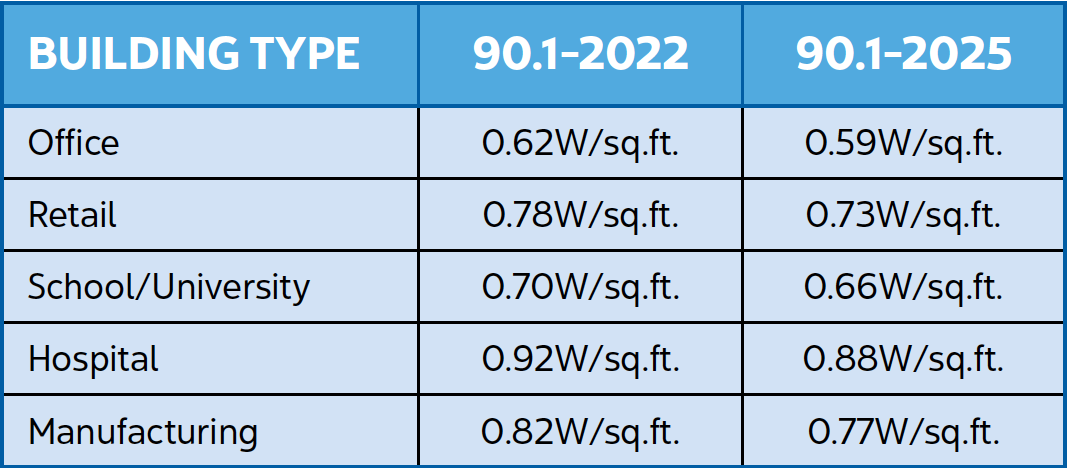
Lighting power allowances: The 2025 version of 90.1 limits maximum LPD, expressed in watts per square foot (W/sq.ft.). Looking at the building area method of compliance, interior power allowances were generally reduced. The table above provides examples for popular building types, reflecting a roughly 5%–10% reduction in maximum interior lighting power allowance.
Applicable to the space-by-space method of compliance, the additional interior power allowances for decorative lighting were also reduced. The 2025 version of Standard 90.1 decreased the additional interior lighting power allowance for decorative lighting from 0.70W/sq.ft. to 0.50W/sq.ft.
Additionally, 90.1-2025 also added an additional lighting power allowance of 1W/sq.ft. for interior exit stairways to coincide with increased stairway illumination required by newer versions of the International Building Code.
Meanwhile, on the exterior side, the base allowance and tradeable surfaces received significant power reductions.
Outdoor lighting zones: Exterior lighting base power allowances are set based on lighting zone, which reflects population density. The 2025 version of 90.1 gave these lighting zones a revision that includes more detail about what applications are in each.
Horticultural lighting: The 2022 version introduced a requirement that horticultural luminaires achieve a minimum efficacy using a new metric called photosynthetic photon efficacy. Additionally, the luminaires must be controlled by automatic shutoff at specific programmed times. The 2025 version increased the required level of efficacy.
Lighting power reduction control: Power reduction is currently required in transportation facility concourses and passenger loading areas by occupancy sensor control when ceiling heights are 15 feet or less. When the ceiling heights are greater than 15 feet, lighting power may be reduced with an occupancy sensor or schedule-based controls.
Occupancy sensors: The biggest change in 90.1-2025 is that occupancy sensor timeouts are generally reduced from 20 to 15 minutes, covering lighting and, where occupancy sensing is used, automatic receptacle control.
Occupancy sensors are now required as a mechanism for automatic shutoff in computer rooms and data center IT equipment rooms.
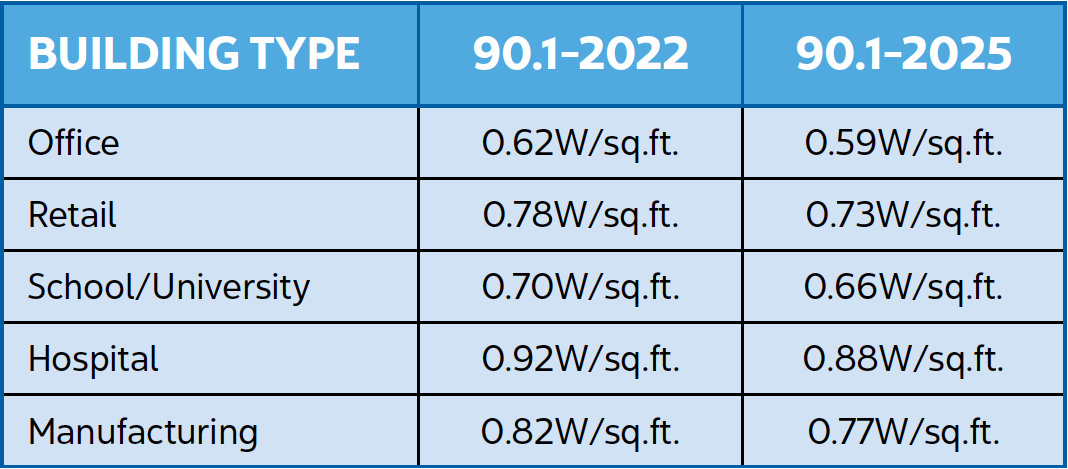
Looking at the building area method of compliance, interior power allowances
were generally reduced in the 2025 version of 90.1. Listed are several
popular building types, which show a roughly 5%–10% reduction
in maximum interior lighting power allowance.
The 2025 version also clarifies requirements for occupancy sensors in large offices (over 300 sq.ft.). The controls can automatically turn on the lights to a maximum 600-sq.ft. zone when it becomes occupied. When zones are vacant, they are to be turned off or uniformly reduced to 20% or less of full power. Within 15 minutes of the entire office being vacated, all general lighting must turn off.
Daylight-responsive controls: The 2025 version of 90.1 requires daylight-responsive lighting controls in secondary sidelit daylight areas if total wattage in the area is at least 75W.
Exterior lighting controls: Standard 90.1-2025 reduced maximum control zoning for occupancy sensors, where required, from 1,500W to 600W.
ASHRAE/ANSI/IES Standard 90.1-2025 enhances energy efficiency by reducing power allowances and strengthening lighting control requirements. While some time may pass before this version sees significant adoption, it may be useful to learn the changes now.
About The Author

DiLouie, L.C. is a journalist and educator specializing in the lighting industry. Learn more at ZINGinc.com and LightNOWblog.com.