While the tide is rising or falling on some lighting trends and others are still in their infancy, all should be on electrical contractors’ radars. David Shiller, lighting industry consultant and editor of the news and opinion blog LightNOW, recently published the white paper “Lighting Trends for 2026.”
Trend roundup
LED drivers are becoming more versatile. Shiller noted that LED drivers are growing in capabilities related to channels, input voltage range, dimming protocol and control-driver integration. Notable examples include new 120–480V AC universal-voltage drivers, growth in 6-in-1 dimming protocol drivers, and three- and five-channel drivers for tunable LED arrays that lay the groundwork for color-mixing white-light LED luminaires that don’t need phosphor-converted LEDs. He highlighted one manufacturer now offering a 24V DC constant-voltage driver that features an onboard dimmer, which has potential to bypass compatibility issues.
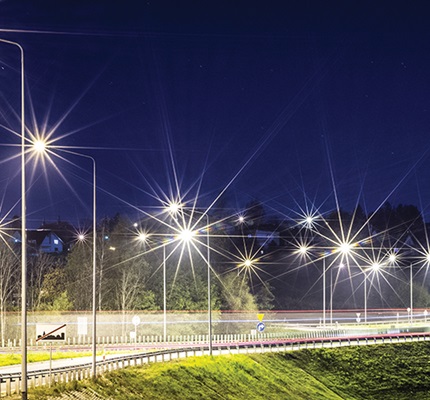
Interest in off-grid lighting is growing. This category encompasses luminaires powered by batteries or solar panels. Shiller mentioned solar streetlights and cordless portable luminaires as examples, while noting new approaches such as solar mirrors in orbit, area lighting provided by drones and wireless power beamed using infrared lasers or other beamed electromagnetic energy.
3D-printed lighting continues to develop. Technology advances and expanding capacity have led to expanded luminaire offerings from manufacturers such as LightArt, OCL Architectural Lighting, Signify and Tivoli. With tariff policies affecting supply chains, 3D printing may receive a boost as a reshoring strategy.
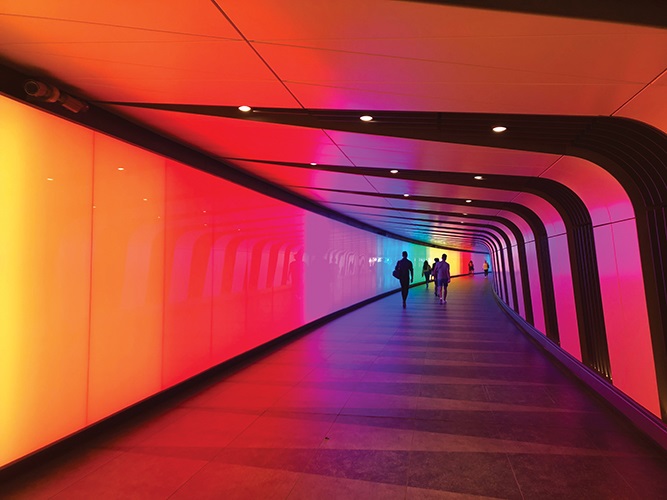
Manufacturers continue to innovate with LED color capabilities. Shiller noted expanding applications for color tuning such as architectural and landscape lighting. He pointed to an overseas manufacturer that developed a system that automatically adjusts color output based on the colors of the illuminated merchandise.
Field-adjustable lighting is growing in popularity. Luminaires offering field-selectable wattage, color output and light distribution are popular due to their versatility.
The high end of lighting controls is trending toward integration. Noting the tiering of lighting controls between simple, low-cost controls and advanced networked lighting control systems, Shiller said there is a significant push underway for integrating lighting and HVAC systems.
While this may occur through integration with a building automation system (BAS), the 2025 Bluetooth NLC Lighting-HVAC Integration profile promises the ability to connect directly to smart thermostats without a BAS, expanding the potential for adoption. Integrating smart lighting and shading remains another opportunity. There is also growth in hybrid wired/wireless lighting control solutions.
Sports lighting is a growing market with more manufacturers and specialized products. This includes the school/municipal/small court market. Shiller noted that pickleball/tennis courts are being installed more frequently. Meanwhile, aging pole infrastructure coupled with intensifying storms is promoting specification of new light poles in these and other outdoor lighting projects.
Lighting remains a convergence point for different technologies. Besides solar power, lighting increasingly shows potential to incorporate other technologies, notably sensors. The biggest realized potential is in pole-mounted area lights incorporating solar panels, environmental sensors, gunshot detection and potentially even A.I. computer chips that turn lighting systems into virtual distributed data centers. Shiller pointed to one interesting luminaire—a residential portable floor lamp incorporating an integral TV projector and Bluetooth speakers—as illustrative of how boundaries are being pushed.
Tariff policies have shaken up the lighting market. Shiller said tariffs, with resulting cost uncertainty and supply chain disruption, have had the biggest consequences for the business of lighting in the past year. Besides inflationary effects, tariffs have created a drag on the U.S. economy, including the lighting market, and have had both positive and negative effects on merger and acquisition activity.
Data centers are big business. A bright spot in the cooling construction market is data centers, as their construction may have ripple effects on lighting. As big energy users, they may affect the cost of electric power, which in turn will make aggressive lighting retrofits more economically attractive and may result in rebate programs boosting cash rewards to reach energy savings goals.
Commercial lighting rebate programs are evolving in response to LED saturation. Majority adoption of LED light sources in commercial buildings has diminished energy savings from lighting, traditionally a deep well of savings. In response, programs are beginning to offer rebate bonuses, incentivize LED-to-LED upgrades and more strongly promote lighting controls as a part of LED upgrades.
A.I. is a disruptive technology with effects that still aren’t fully known. It is changing e-commerce and the internet as a whole, Shiller observed. He said some rep firms are predicting they will reduce their lines in favor of fewer manufacturers with better A.I.-optimized data. Otherwise, results have been mixed. Shiller noted JLL’s 2025 Global Real Estate Technology Survey, in which 92% of corporate real estate executives reported piloting A.I. solutions, but only 5% said they realized most or all their expected results.
Download a free copy of this report
stock.adobe.com/Nataliia Semenenko
About The Author

DiLouie, L.C. is a journalist and educator specializing in the lighting industry. Learn more at ZINGinc.com and LightNOWblog.com.