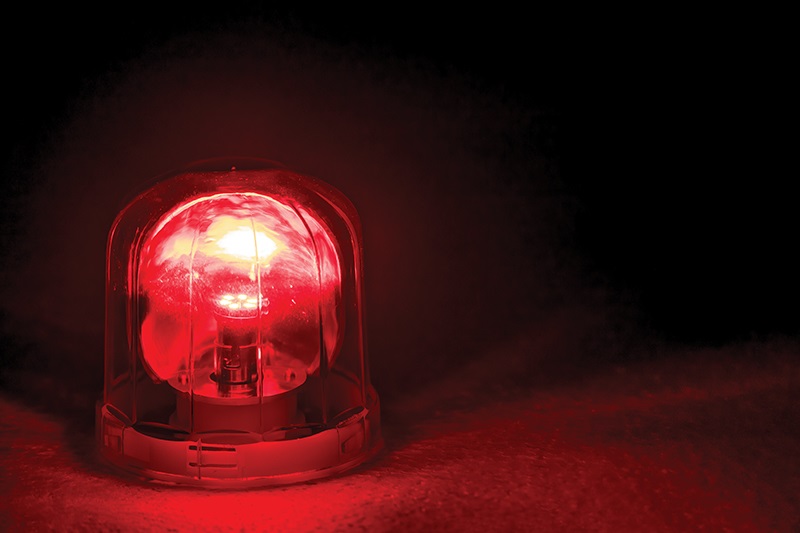
It’s been three years since I last wrote about visible notification appliance requirements, so I thought it was time for a review of the requirements based on the 2025 NFPA 72. As a reminder, visible notification appliances must be installed as required by building, fire or life safety codes. Installation locations, candela ratings and testing are required by NFPA 72, chapters 14 and 18.
You have to be creative when laying out and installing strobe lights, because there are many factors to consider. How will the space be used? What furniture or equipment will be in the room? How high are the ceilings?
The codes require visible notification appliances in occupiable areas. NFPA 72, 3.3.200 defines an occupiable area as, “An area of a facility occupied by people on a regular basis.” Pretty basic. NFPA 72, 18.5.2.1 states, “The designer of the visual notification system shall document the rooms and spaces that will have visual notification and those where visual notification will not be provided.”
Installation is tied to use
Knowing how the space will be used will serve as a guideline for determining how many strobes will be required and whether they will be installed on the walls or ceiling. Wall-mounted strobes are required to be installed between 80 and 96 inches above the finished floor. NFPA 72 allows a performance-based design alternative, which would allow installation of the strobes higher or lower as needed, with corrections to the candela ratings to provide an equivalent amount of light as if they were installed between 80 and 96 inches.
Ceiling-mounted strobes may be installed up to 30 feet. NFPA 72 Chapter 18, Notification Appliances, provides many options. If you have a large open space, say 60 feet by 60 feet, you could install one strobe with a minimum of 135 candela, or you could virtually subdivide the room into four 30-foot by 30-foot areas and install one strobe with a minimum of 34 candela in each area.
Keep in mind that you can’t put them just anywhere. Paragraph 18.5.5.7.4 states, “In square rooms with appliances not centered or in nonsquare rooms, the effective intensity (cd) from one wall-mounted visual notification appliance shall be determined by maximum room size dimensions obtained either by measuring the distance to the farthest wall or by doubling the distance to the farthest adjacent wall, whichever is greater, as required by Table 18.5.5.7.1(a) and Figure 18.5.5.7.1.” This also applies to ceiling-mounted strobes in 18.5.5.7.8.
Remember that indirect viewing of the strobe light is allowed in rooms. Occupants don’t need to actually see the strobe; they only need to see the light. It could be reflected off the walls, ceiling or floors. In corridors 20 feet or less wide, you have a choice. You can use the corridor method (18.5.5.8) for direct viewing or the room method (18.5.5.7), which allows indirect viewing.
Ceiling-mounted strobes offer more choices. In many applications, it is easier to see the reflected light from ceiling-mounted strobes than from wall-mounted ones. Big box stores are good examples for this application. With all the shelving, you will get better distribution of light from ceiling-mounted strobes. Office areas with cubicles around desks is another example.
Sleeping areas are treated a little differently. You have to install a strobe within 16 feet of the pillow and, if installed closer than 24 inches from the ceiling, you must use a minimum of a 177-candela strobe. If installed 24 inches or more from the ceiling, you can use a 110-candela strobe.
Whether or not you need to install a strobe light in the bathroom in the sleeping room is pretty much up for debate. The Americans With Disabilities Act does not require them, but the local fire marshal might. It is a good idea to install one in the accessible rooms anyway rather than debating the issue.
You are only required to verify correct candela ratings at the initial acceptance test. When conducting the annual system test, you only have to verify the strobe flashes.
My final article
All good things must come to an end at some point. This will be my last article for ELECTRICAL CONTRACTOR magazine. I have been writing for the magazine for about 22 years now, and it has been a great experience, but it is time to move on. I want to thank Wayne Moore for recommending me to write these articles and quizzes, and I want to thank the editorial staff for the support they all have shown during my time here. I also want to thank the readers for all the great comments and questions I have received over the years. I wish you all well.
stock.adobe.com / vchalup
About The Author

HAMMERBERG, SET, CFPS, is an independent fire alarm presenter and consultant currently residing in The Villages, Fla. Tom represented the Automatic Fire Alarm Association on multiple NFPA technical committees as well as actively participating in the ICC code making process for many years. He is NICET Level IV certified in fire alarm systems and a Certified Fire Protection Specialist. He can be reached at [email protected].