Many of us that have been in the trade for some time can remember having to cut branch conduit with a hacksaw, or if we were lucky, a corded reciprocating saw or band saw. But with the vast advancements in tool technology, along with much better batteries, today’s electricians have more metal cutting options at their disposal. This month’s article discusses some of the most common saws electricians use—reciprocating, band saws and circular saws—along with one that is brand new to the industry.
Reciprocating saws
There is no tool more synonymous with cutting metal than Brookfield, Wis.-based Milwaukee Tool’s Sawzall. It cuts through just about any material in just about any application, making it extremely versatile. Having the blade protrude from the front of the saw allows it to be used in tight spaces or cut through larger, thicker items (by using a longer blade). Before this revolutionary tool was released in 1951, there was nothing like it on the market.
It has gone through a few upgrades over the years, culminating in the M18 Fuel Super Sawzall 2722-21HD Kit. The Super Sawzall generates the same power as a corded reciprocating saw but cuts up to 3,000 strokes per minute—faster than most of its corded counterparts. The tool comes with a variable speed trigger and a five-speed dial to give us precise speed control for any cutting application.
It also includes an orbital action mode, which can be turned on and off, so the blade can move in an elliptical pattern (in lieu of just back and forth), making it ideal for aggressive cuts in softer materials. Rounding out the features of the tool are a Quik-Lok blade clamp, allowing for toolless blade changes, as well as an integral rafter hook that gives a convenient way to store the saw in between cuts.
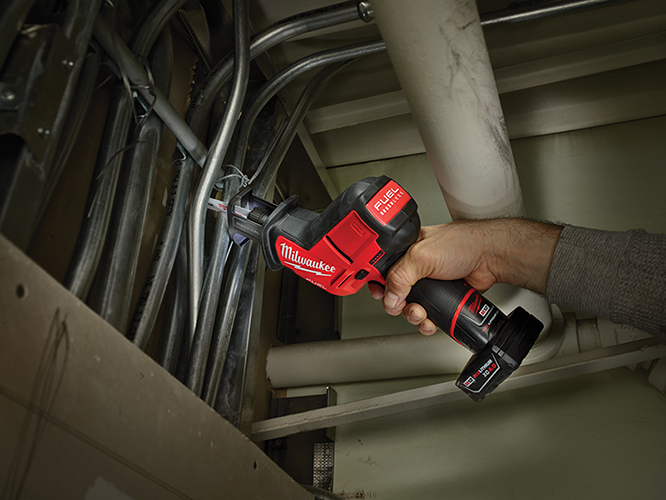
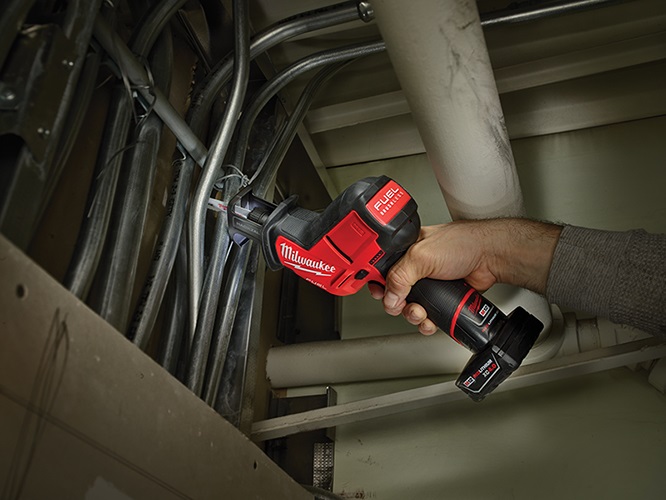
Milwaukee Tool M12 Fuel Hackzall
Even though the Sawzall is reasonably compact and light, there are times when an even smaller reciprocating saw is preferred. A single-handed version was needed. Enter Milwaukee’s M12 Fuel Hackzall reciprocating saw kit. Weighing in at a little over 3 lbs. (compared to the 12-lb. weight of the Super Sawzall) and at almost half the length of its larger brother, the Hackzall is much more adept at getting into tight places and reducing overall user fatigue. Don’t let its small size fool you, though—it will still produce up to 3,000 strokes per minute and is designed to be used with one hand.
While the Hackzall is much smaller and lighter, excelling at one-handed or overhead work, some concessions must be made—namely, the variable speed dial and rafter hook. However, it still sports the toolless blade change option, uses the same blades as a standard reciprocating saw, and has a dual-gear counterbalance mechanism that significantly reduces vibration, resulting in faster starts when cutting metal. The tool is also offered in an 18V version.
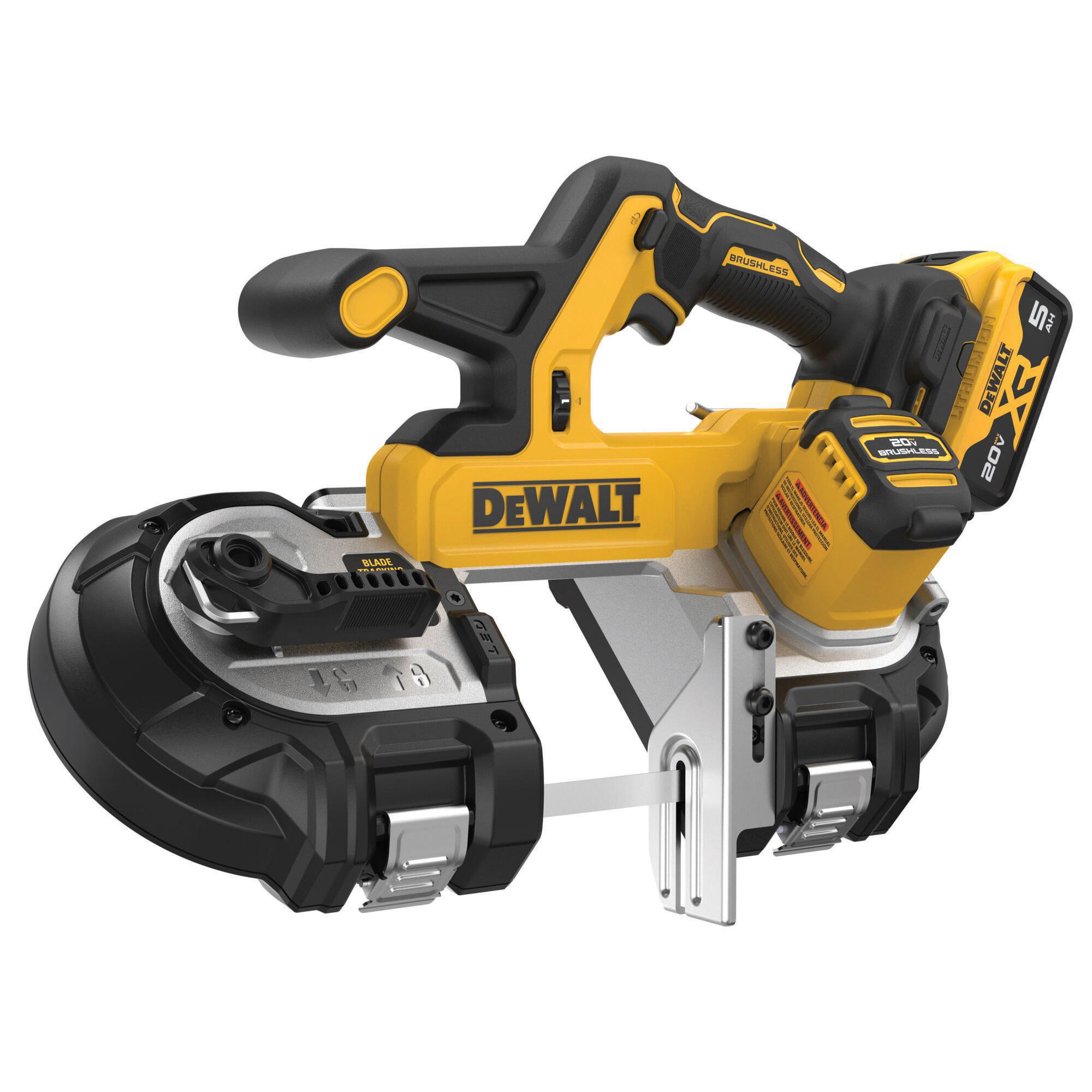
DeWalt 20V Max XR midsize band saw
Band saws
Where the Sawzall is more of a Swiss Army knife type of tool, in that it will cut just about anything, a band saw specifically is geared toward cutting metal items more efficiently and producing a much cleaner cut. Where a reciprocating saw operates on drawing the blade straight back and forth, the band saw uses a thinner blade shaped like a large “O” driven in a continual circular fashion by two wheels.
DeWalt, Towson, Md., has long manufactured tools and offers three categories of band saws. The first is the 20V Max XR deep cut band saw. With a full 5 inches of cutting capacity, this is the tool to grab when cutting 4-inch and smaller conduit. The band saw uses a standard 447/8-inch blade and features a variable speed dial, allowing full control of the cutting speed up to its maximum of 490 SFPM (surface feet per minute). It will perform just as well as its corded counterpart, without having to be tethered to an extension cord.
Where a full-size deep cut band saw is best suited to the largest of cutting applications, there are times when we don’t require that much capacity. DeWalt offers the 20V Max XR midsize band saw that is smaller and lighter and a bit more conducive to typical day-to-day cutting operations. Weighing in at slightly over 8 lbs., it is 4 lbs. lighter than the deep cut band saw, dramatically reducing user fatigue. Even with its smaller size, the tool still sports a 33/8-inch cutting capacity, enabling it to cut up to 2½-inch rigid conduit without the pipe needing to be rolled.
However, despite being smaller in size than the deep cut band saw, it still has many of the same desirable features—variable speed trigger, a tool-free adjustable shoe and an integrated LED light to illuminate the cutting surface in dark workspaces.
While most electricians do not install large conduits every day, there is even a band saw for us too. DeWalt’s Atomic 20V Max cordless 1¾ inch band saw excels at smaller installations. Operating on the same 20V system as its larger siblings, this tool comes in at only 6.6 lbs. and slightly over 16 inches in length. It is ideal for overhead or one-handed cutting applications and greatly reduces user fatigue when installing branch conduit. With a 1¾-inch cutting capacity, it will easily cut through deep strut and up to ¼-inch conduit. But once again, do not let the small size fool you—it can slice through a piece of ¾-inch EMT or a piece of strut quickly and with minimal effort.
The tool also features a variable speed trigger and speed dial to maximize performance based on material being cut. And for those of us operating on the 12V platform, the tool is also available in that voltage.
Circular saws
Metal-cutting circular saws are also quite popular, with many electrical workers either opting to supplement cordless kits with one or using them solely. The Bosch, Farmington Hills, Mich., GKM18V-20N professional metal-cutting saw is a standout in this category. Designed strictly around cutting metal, it will deliver up to 4,250 RPMs that easily cut through EMT, strut, threaded rod, sheet metal (think wiring troughs or panel cans) and angle iron. Coming in at slightly more than 5 lbs., it is just as at home cutting something overhead as it is cutting something on the ground.
One of the more interesting components of the tool is the integrated chip collector that collects the bulk of the metal shavings produced when cutting. This feature cuts down on time spent cleaning up and creates a safer working environment by reducing the amount of metal shavings from flying around.
Additional features include a 30-tooth, 53/8-inch carbide-tipped metal saw blade that provides a full 2-inch cutting capacity, an LED light to assist in better line of site, a saw hook to assist in hanging the saw when not in use and a stainless-steel shoe that reduces metal chip build up to prevent the cutting surface from being marred.
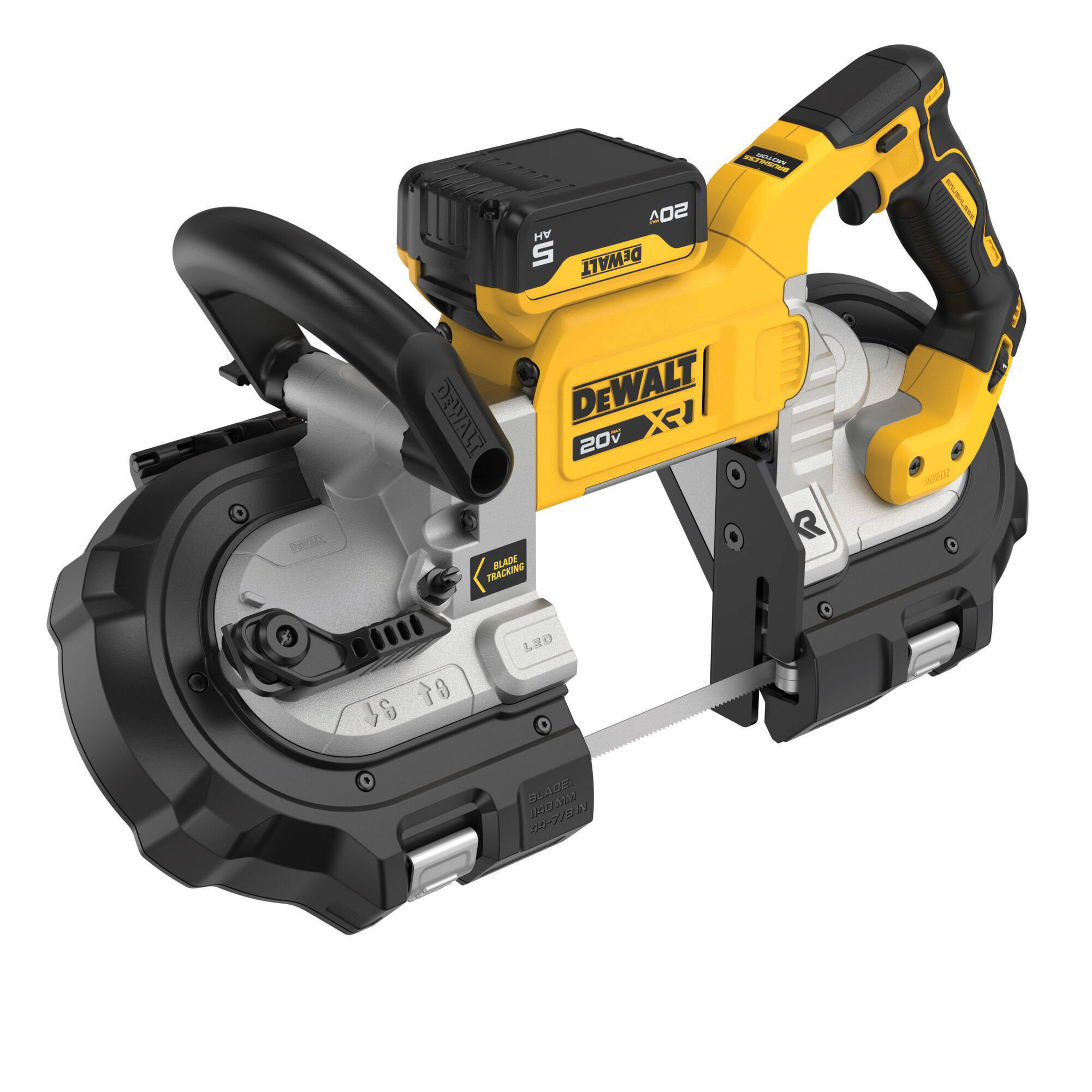
DeWalt 20V Max XR deep cut band saw
Metal cutter
Milwaukee Tool’s M18 Fuel ½- to 1-inch steel pipe cutter is optimized for cutting steel pipes in the plumbing and mechanical sectors. However, I certainly believe that it can add excellent value to the electrical space for cutting branch conduits up to 1 inch. In a departure from the standard metal-cutting saw, this tool features an integral (and foldable to be out of the way when not needed) cut fence that enables the user to produce accurate, straight cuts on conduit.
Straight cuts are essential for getting a good fit on standard EMT fittings and for materials such as threaded conduit. The cutter also features a large cut window that allows users to easily line up the blade with where the conduit needs to be cut.
Perhaps the most notable feature of this tool is the sliding blade guard. As the blade cuts from the back, it is only exposed when it is actually cutting into the conduit, preventing the user from inadvertently coming into contact with the rotating blade.
The saw uses an exclusive blade made especially for the tool that produces minimal burrs in the conduit, allowing for much quicker installation. In addition, when the tool is used in an overhead fashion (think cutting a rack of conduit to get all the ends to line up), the blade guard closes once the cut is complete and won’t damage anything on the backside of the cut. Rounding out the features of the tool, an LED light illuminates the work surface, and a handy metal clip enables users to hang the cutter on a tool belt in between cuts.
The best saw for you
Cutting metal conduits, strut and wiring gutters makes up a large part of our day-to-day tasks, and there are metal-cutting tools available for every application. For all-around versatility, it is hard to beat a reciprocating saw. For quicker, straighter cuts in larger metal items, a band saw may be a better choice. And if you are looking for speed or cutting something larger than will fit in a band saw, a circular saw may suit the situation best. Whatever the scenario, there are a multitude of cordless portable tools to suit our needs. When in doubt, one of each does not hurt!
dewalt | Milwaukee Tool