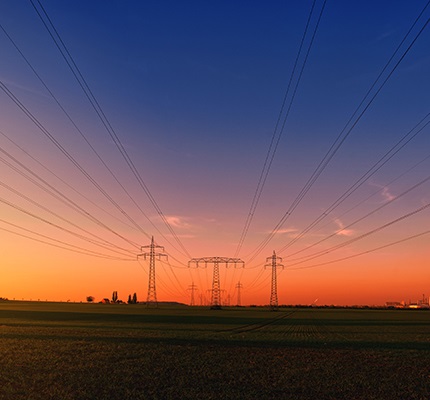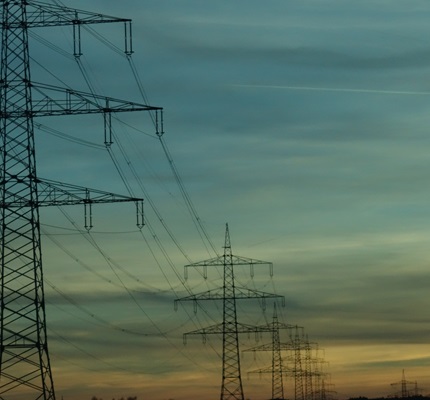
With a combined population of nearly 1 million residents, Seattle and Bellevue, Wash.—just 10 miles apart—have undergone significant population and industry growth in recent years and are major centers of economic activity.
So it came as no surprise when local utility Puget Sound Energy (PSE) invested in improvements to the area’s electric grid to enhance reliability and boost capacity to meet the region’s growing demand for electricity. Known as “Energize Eastside,” the improvement initiative involved construction of the new Richards Creek 230-kilovolt substation in Bellevue and the upgrade of roughly 16 miles of existing 115-kV wood pole transmission lines between Renton and Redmond in King County to a new 230-kV double-circuit steel pole configuration.
Founded in 1952 and based in Canby, Ore., Wilson Construction Co. specializes in everything from transmission and distribution projects to substation and underground work, all supported by its team of environmental and permitting professionals and fleet of six helicopters.
“We work on projects nationwide, from the West Coast to the Midwest and New England, and currently have about 800 employees,” said Chuck Woodard, Wilson Construction’s vice president of major projects and transmission. “Throughout our nearly 75-year history, we’ve been a team-oriented utility contractor that takes pride in handling complex projects.”
Energize Eastside certainly fell into that category.
“After the project was put out to competitive bid, Wilson Construction was selected based on our ability to provide the best value, and project construction ran from August 2021 to November 2024,” Woodard said.
The team had its work cut out for them, as the original transmission lines at the center of the project dated back to 1923—having been installed to help boost the region’s then-coal mining industry—and hadn’t been upgraded since the 1970s.
“We were responsible for modernizing the system from two 115-kV single-circuit lines to a single double-circuit 230-kV line, which is a complex upgrade based on the additional and extensive regulations that 230-kV lines are subject to by the Federal Energy Regulatory Commission [FERC] as well as the large population in that area,” said Jon Gannon, then-superintendent of the Energize Eastside project for Wilson Construction and now the company’s vice president of transmission operations. “We felt confident, however, because we’ve worked with Puget Sound Energy on their last several 230-kV projects and have a great track record with them on these upgrades.”
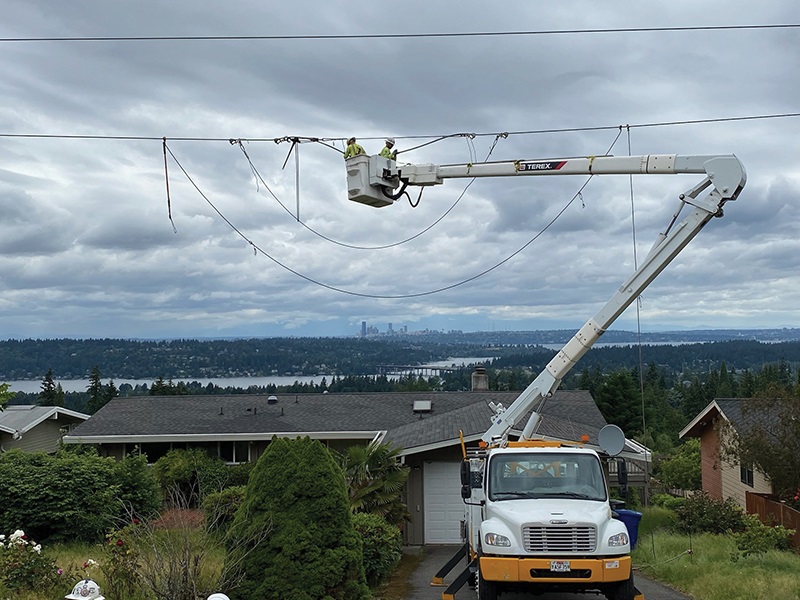
Crews prepare to pull wire over Tyee Middle School in Bellevue, Wash.
From urban to rural landscapes
While the need to install 152 new structures using a combination of direct-embed, micropile and concrete foundation types to support the new system was involved enough, a range of challenging conditions presented additional layers of difficulty for the team.
Among them, the 16-mile-long section of transmission lines being upgraded cut through a variety of urban, suburban and rural landscapes encompassing high-density residential neighborhoods, business districts, schools, retail settings and more. This required the Wilson team to interact and coordinate with nearly 600 individual homeowners and many other community members who lived or worked within 100 feet of the right-of-way corridor to help ensure a smooth upgrade process.
“Jon did a great job of identifying all of the people impacted by the upgrade and managing those relationships, from inspectors, town administrators and electric outage office personnel to business owners, homeowners, organizations and other utility customers engaged with the project,” Woodard said. “We had four crew members dedicated full-time to coordinating with property owners in every neighborhood where we worked daily to ensure the streets were safe and clean for both our teams and the residents. In partnership with PSE, we put a lot of time and effort into social and community engagement activities, including arranging for food and coffee trucks for the neighborhoods to show our appreciation to residents for accommodating us and allowing us to work in close proximity to their homes and daily lives.”
The Wilson Construction team also navigated its share of technical and logistical challenges, including moving thousands of tons of steel poles through heavy Bellevue traffic and extremely tight neighborhoods.
At the same time, “sequencing our work in a linear and efficient manner across multiple permitting jurisdictions was a monumental scheduling feat,” Woodard said. “It involved coordinating with major organizations and agencies such as school districts and college campuses, regional transit agencies, corporate entities and highway crossings to meet our construction schedules.”
Gannon noted that many construction activities had to be carefully scheduled around school recesses, after-school sports and activities, and pickup times to minimize disruptions and prioritize student safety.
To address this, “we came up with unique plans to control traffic and provide alternative access routes for students, and we altered our work hours to accommodate bus schedules and after-school activities like summer tennis camps by starting our wire operations a little later and having the activities begin a little earlier,” Gannon said. “Most stakeholders were very accommodating if we had to work in their space, and we were very diligent about collaborating and engaging in daily communication with them to remove delays.”
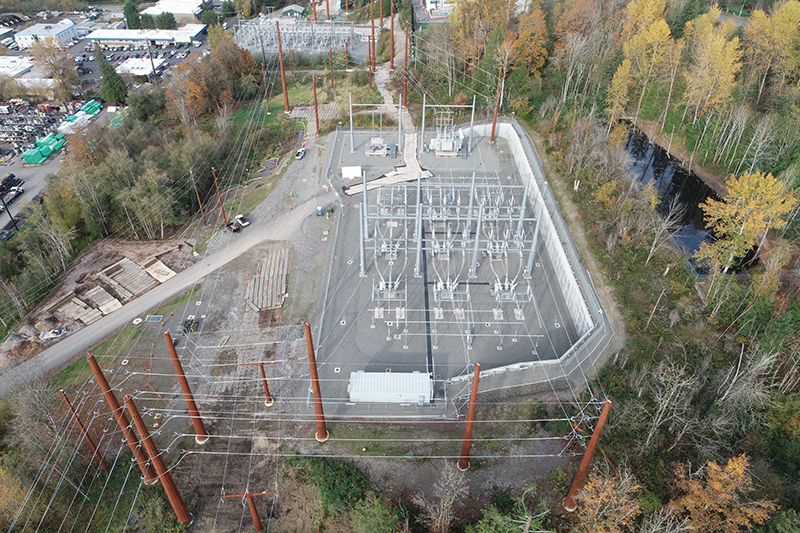
An aerial view of the Richards Creek substation in Bellevue, Wash., after project completion when all structures and the substation became operational
One of the most notable challenges involved the full closure of Washington State Route 520 and the rolling slowdown of the 13-lane U.S. Interstate I-90 through Bellevue for more than 20 combined hours so the team could complete their highway-based wire operations, which required planning and coordination with officials to obtain the necessary permits and execute the work in a tight timeframe with precise sequencing of work by a large workforce.
Working on I-90 from midnight to 5 a.m. on several nights with the help of 25 traffic control and 10 off-duty police officers who stopped traffic in 5- to 8-minute intervals, “we removed and added wire to get conductor across the highway in the few minutes we had,” Gannon said. “We only got five to seven of these stops per night, so we engaged in a lot of planning to prepare everything prior to each night’s work, operated efficiently in the field and got a lot done.”
Special measures also had to be taken on the project to protect the environment along its 16-mile route.
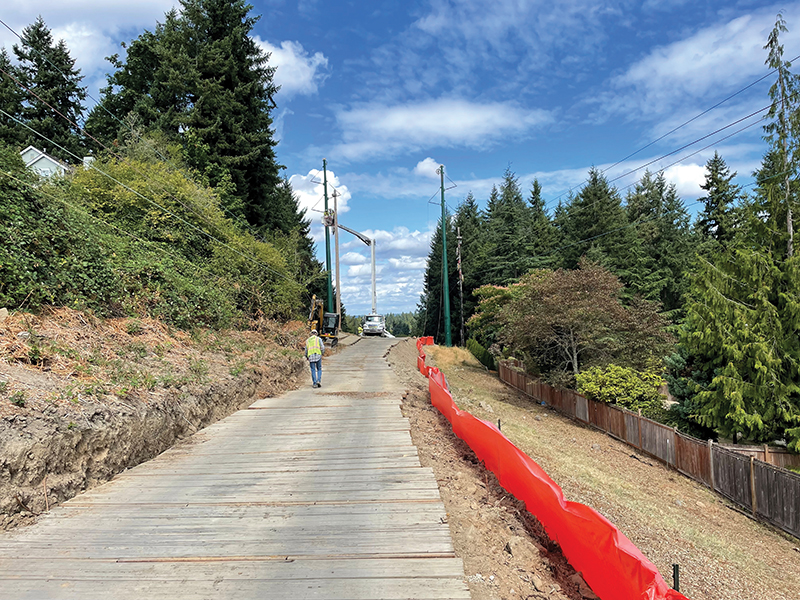
The matted access that was required near pipelines through neighborhoods
“Because the existing 115-kV right-of-way was moving to a higher voltage, extensive vegetation clearing was necessary, resulting in the removal of over 4,000 trees to meet clearance requirements,” Gannon said, and added that nearly 13,000 trees, shrubs and herbaceous plants were installed, irrigated and warranted for one year to adhere to environmental mitigation measures requiring a 3:1 ratio for wetlands protection.
The team additionally had to arrange for the delivery and installation of more than 6,500 mats to protect the underground infrastructure within the shared corridor containing 16-inch and 20-inch high-pressure petroleum pipelines located within proximity to nearly 80% of the foundations being installed.
“We had to submit detailed specifications for every piece of equipment to the pipeline company so that engineering calculations could define the depth of matting required across the pipeline,” Woodard said.
Finally, the team had to think outside the box to access the sole micropile foundation along the 16-mile stretch, which required careful prefabrication and precise delivery. Based on its difficult-to-reach location on a very steep slope with a protected wetland access point (rendering it unable to support the use of heavy equipment), a special custom-engineered micropile foundation was necessary. The Wilson team addressed this by using custom-fabricated, all-terrain pole dollies to haul the 130-foot steel pole in place with a Caterpillar D6-style bulldozer and then set it in place using an 800-series wide tracked crane, ensuring safe installation under difficult conditions.
Stellar Results
Following completion of construction by the Wilson team, PSE energized the full project in late 2024. And thanks to the dedicated efforts of nearly 30 Wilson Construction crew members and more than a dozen subcontractors, the project was completed safely without a single person missing a day of work due to injury.
For that reason and many others, Energize Eastside will remain one of the team’s most complex and proudest achievements.
“With typical site conditions, we’d be able to build a 16-mile line in two months, but this job took over three years based on its many inherent challenges, including community scheduling limitations, pipeline protections, outage restrictions and other stops and starts,” Woodard said. “The collaboration among all parties, however, demonstrated how effective planning and mutual trust can overcome even the most challenging logistical conditions.”
“We had an experienced team with vast knowledge and were able to pull it all together for a trusted customer,” Gannon agreed.
Woodard and Gannon also credited much of the team’s success to the strength of their utility partner.
“The team from Puget Sound Energy had great vision and did such a great job of supporting us throughout their project,” Woodard said. “We worked through many engineering and scheduling challenges as a very cohesive group that communicated well and was extremely dedicated.”
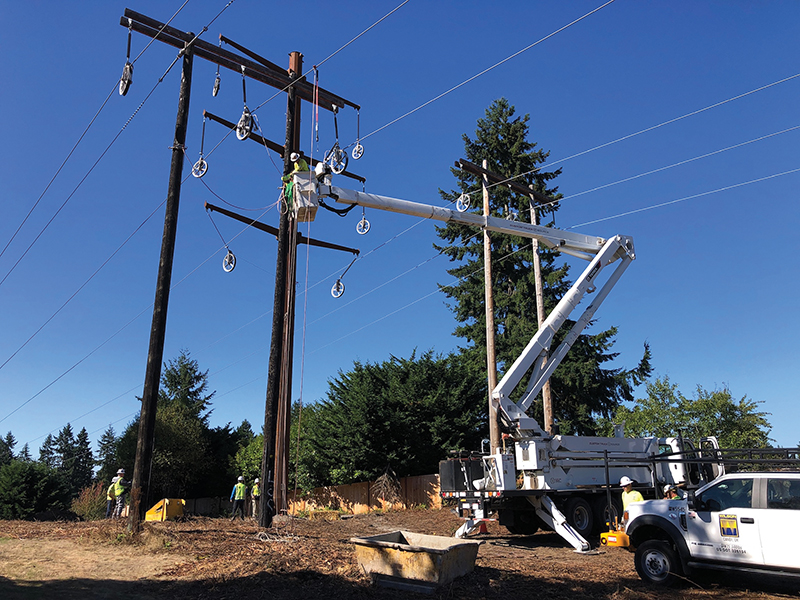
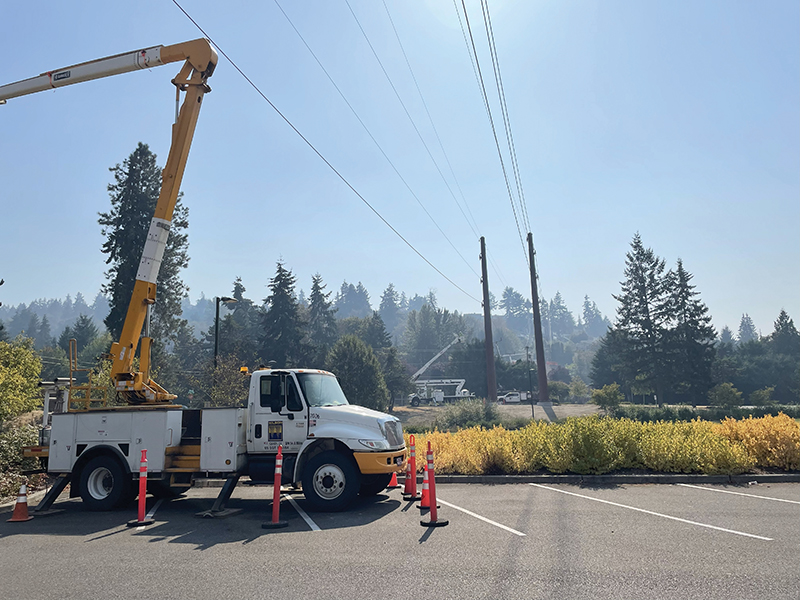
Crew members remove the rest of the existing wood structure and transfer ropes to the new steel structure.
“The original scope of the project grew during construction, but the utility supported our efforts to keep the job moving forward effectively and was always right there in our corner to help with anything we asked for or needed,” Gannon said. “They felt they’d selected the right team to complete this job and really stood behind us.”
“We believe that PSE appreciated the respect we had for the communities we worked in and the quality of the outcome, and I know that our team’s personal dedication put PSE in a positive light,” Woodard said.
Looking back on the experience, “I loved our whole team, and even though it was a tough project, I enjoyed every minute of it,” Gannon said. “Energize Eastside was the last project I was in charge of as a superintendent and that role couldn’t have ended on a better note for me.”
For Woodard, a fifth-generation Pacific Northwest native, Wilson Construction’s receipt of a 2025 NECA Project Excellence Award for Energize Eastside in the “overhead transmission” category was an honor and a career highlight.
“You have to plan for excellence, and that’s how we approach all of our projects,” Woodard said. “It’s about putting your customers first, making them successful, prioritizing safety and quality and working together as a cohesive team. That’s the Wilson way.”
Wilson Construction Co./Puget Sound Energy
About The Author

BLOOM is a 25-year veteran of the lighting and electrical products industry. Reach her at [email protected].
.tmb-art-li-th.png?Culture=en&sfvrsn=9278ce2b_1)