A new force in physical security applications is emerging: the integration of autonomous drone systems with traditional security devices. These types of integrations, made possible by software programming, open interfaces, artificial intelligence and analytics, are heightening detection and protection and bringing immediate, real-time response to schools, corporate facilities and campuses.
One of the first integrations between autonomous security drones is distributed as part of a partnership agreement between Talkaphone, Niles, Ill., and Sunflower Labs, San Carlos, Calif.
MacGuard Security Advisors, Jonesborough, Tenn., led by Kirk MacDowell, founder and CEO, orchestrated and facilitated the collaboration between the two companies. According to MacDowell, the blend of high-end technology with traditional devices is where the industry is headed.
“It’s a classic example of connecting the dots and two companies coming together,” MacDowell said. “Talkaphone, an existing client, wanted to expand their product offering, and we immediately recognized the synergy between their fixed emergency communications systems and Sunflower Labs’ autonomous drone technology. The result is an integrated platform that is reinventing rapid and immediate, real-time response.”
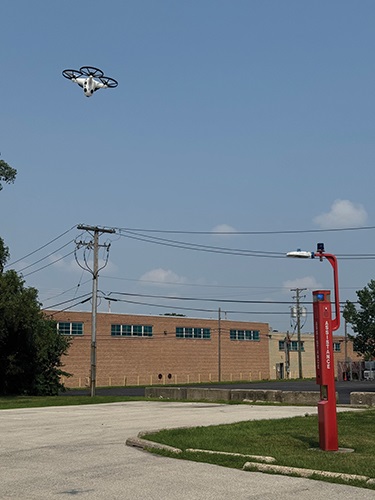
Talkaphone is a long-time, established provider of blue light phones, area of refuge and related voice-based communication solutions. Sunflower Labs is the maker of autonomous security drone systems for intelligent outdoor surveillance, with its A.I.-powered Bee security drones integrating with Talkaphone units. When the emergency call button is activated on a Talkaphone tower, the Bee deploys to the precise area to observe, capture images and assess the situation before responders arrive—relaying pertinent information to end-users.
“It’s a great way to enhance an existing deployment and create new security applications,” said Steve Johnson, president and CEO of Talkaphone. “Sunflower Labs has a mature offering meant specifically for security, so it was ready for integration and we had everything in place within six weeks. The Bee can be used to respond to an action, such as the emergency phone or call box button activation. It can also be used to conduct routine patrols, fly over buildings to assess potential maintenance or provide virtual safety escorts.”
Johnson said that pairing the technologies creates a compelling value proposition.
“The beauty of the autonomous drone is when you push the button on the emergency tower, the drone automatically deploys in less than five seconds,” he said. “That gets eyes on the situation immediately, and the units can also be deployed with floodlights to aid in determining the threat level.”
Aerial defense and observation
Some 90% of deployments are to address uncertainty and provide dynamic observation, said Alex Pachikov, co-founder and CEO of Sunflower Labs. “The drone allows you to observe in a way similar to a human security guard. A drone can fly out to the area for an eye on the situation and to follow someone out to safety or deter bad guys. It’s a way to have the same level of vigilance as a guard, that’s much less costly and faster.”
A single Bee covers up to a 600-meter radius or more than 250 acres, arriving to an event in under a minute. Each drone lives in a base station called the Hive and carries all FAA approvals.
Under optimal conditions, the Bee is capable of observing an event anywhere on a 4-acre property within 30 seconds. The Sunflower Labs platform is an open API programmed to integrate with the Talkaphone product.
“Autonomous drone surveillance can be the glue between all kinds of products,” Pachikov said. “A.I. is having an impact on our product category and we can deal with events so much more effectively with additional visual information.”
Autonomous security drones aren’t competing with security teams but complementing guards or bridging the gap in areas that don’t have enough visibility, he added.
“Our products work well with third-party cameras as well as motion or activity sensors to extend security coverage. Drones can also integrate with access control. For example, let’s say someone is banned from a facility and attempts multiple times to enter their invalid password at an access control reader. The Bee can head to that location after a certain number of failed entry attempts,” Pachikov said.
Drone integration with physical security devices is beginning to progress, with video analytics helping to immediately pinpoint areas quickly in an emergency or assist people under distress. Collaboration between technology providers would be a smart move to bring new applications to flight.
talkaphone