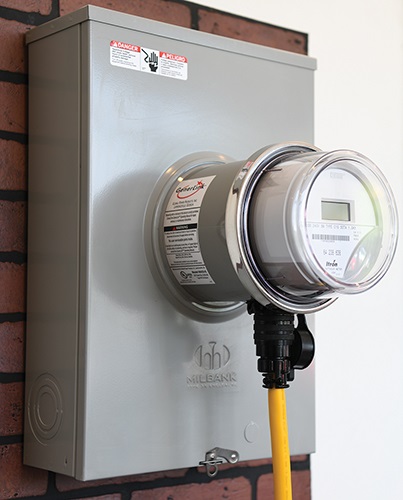
I first encountered meter-mounted transfer switches in 2001 or 2002, when the manufacturer brought them to our office at Underwriters Laboratories. These devices were relatively new on the market and their installation was only allowed with special permission from the electrical utility company.
The manufacturer wanted to submit these meter-mounted transfer switches to UL for listing. I explained to him that electrical metering was part of the electrical utility company requirements and 90.2(B)(5)(a) excluded metering from the National Electrical Code, so listing was therefore not required. He then explained that he knew that, but would still like these devices to be tested and listed. To the best of my recollection, he filled out the paperwork and submitted it to UL for testing and listing.
New text in the Code
I also pointed out to him that there was new text in 230.82(2) of the 2002 NEC specifically addressing equipment that could be connected on the supply side of the electrical service, such as meters, meter sockets or meter disconnect switches nominally rated not in excess of 600V, provided the metal housings and service enclosures were grounded. I reminded him that the electrical utility must also give permission for this to occur, unless these meter-mounted transfer switches were used for submetering after the utility supplied service.
Section 250.142(A) and (B), covering use of the grounded circuit conductor for grounding equipment, also permitted these devices to be installed on the supply side and load side of the service and be connected to the neutral conductor under certain circumstances. For example, 250.142(B), Exception No. 2 stated that it was permitted to connect meter enclosures to the grounded circuit conductor on the load side of the service disconnect if the following conditions applied: (1) no service ground-fault protection was installed; (2) all meter enclosures were located immediately adjacent to the service disconnecting means; and (3) the size of the grounded circuit conductors were not smaller than the size specified in Table 250.122 for equipment grounding conductors. This provision still exists relatively unchanged in the 2020, 2023 and 2026 NEC.
Meter-mounted transfer switches were not added to the NEC until 2020, when it was inserted into 702.5(B) with a reference back to 702.4(B)(2) and an informational note. This new text read as follows: “Transfer switches installed between the utility meter and the meter enclosure must be listed meter-mounted transfer switches and must be approved. Meter-mounted transfer switches must be of the manual type unless rated as determined by 702.4(B)(2).”
The informational note referred the user to UL 1008M, Meter-Mounted Transfer Switch Equipment, for more information.
In addition, 230.82(11) in the 2020 NEC further required meter-mounted transfer switches rated not more than 1,000V to have a short-circuit current rating equal to or greater than the available fault current. It was required to be listed and be capable of transferring the load to be served. The meter-mounted transfer switch was also required to be marked on its exterior with text showing it was a meter-mounted transfer switch and not service equipment.
The fact that it was not service equipment did not prevent the installer from making a grounding electrode conductor connection to the grounded conductor in the meter enclosure as long as the connection was accessible as required by 250.68(A), as I explained earlier about permission to use 250.142(A) and (B). However, the meter-mounted transfer switch was and still is not acceptable for use as the emergency disconnect required in 230.85.
Remember, these devices are designed and installed for connecting an optional standby system to a home or small commercial business in accordance with Article 702. Section 702.5(B) and the two informational notes in the 2023 NEC state the following: “Transfer switches installed between the utility meter and the meter enclosure shall be listed meter-mounted transfer switches and shall be approved. Informational Note No. 2: Manual and nonautomatic transfer equipment use human intervention.”
The mandatory part of 702.5(B) hasn’t really changed since the 2020 NEC; however, Informational Note 2 states that meter-mounted transfer switches require manual and nonautomatic human intervention. This requires compliance with 702.4(A)(1)—if the connection of the load is manual or nonautomatic, the optional standby system must have the capacity and rating to supply all of the equipment intended to be operated at one time. The optional standby system’s user can select any loads connected to the system. This helps ensure the standby system has adequate capacity for the standby load.
Installing these devices in accordance with the NEC and the electrical utility will ensure an adequate standby power supply.
NFPA
About The Author

ODE is a retired lead engineering instructor at Underwriters Laboratories and is owner of Southwest Electrical Training and Consulting. Contact him at 919.949.2576 and [email protected].