For electricians, there are few tools as critical, or as overlooked, as the crimper. Not every device or piece of equipment has a lug that readily accepts the wire by itself. Whether we are terminating feeder wires in a panel, making up control wiring or installing data connections, the integrity of those crimps can determine the reliability of the entire system.
Poor crimps can lead to nuisance failures and components overheating, voltage drop problems and even potential safety issues. Of all the things electricians do every day, conductor terminations and splices are the most important. If a wire is going to fail or have issues, it will almost always be at the termination.
That is why selecting the proper crimp tool (and using it correctly) is a clear marker of the level of craftsmanship we put into the installation. The current market offers everything from basic hand crimpers to ratcheting and hydraulic options designed for specific applications. Let’s take a look at what sets these tools apart and how to ensure we are choosing the correct one for the job.
Small wire crimps
Most of us are familiar with the standard pair of wire crimpers used for installing types of spade connectors, butt splices or fork connectors on smaller conductors. These manual crimpers will certainly get the job done, but how can we ensure we are applying the correct amount of force for each crimp? When considering the quantity of crimps done on a daily basis, factor in fatigue and efficiency.
Lincolnshire, Ill.-based Klein Tools’ ratcheting crimper for insulated terminals alleviates both of these issues. The tool uses a ratcheting mechanism that ensures proper and uniform crimps by locking onto the connector and not letting go until a full crimp cycle is done. The adjustable compound action of the crimper puts more crimping power into each squeeze, which means we have to exert less force on the tool. The crimpers also feature heavy-duty molded grips for added comfort when using them for an extended period of time.
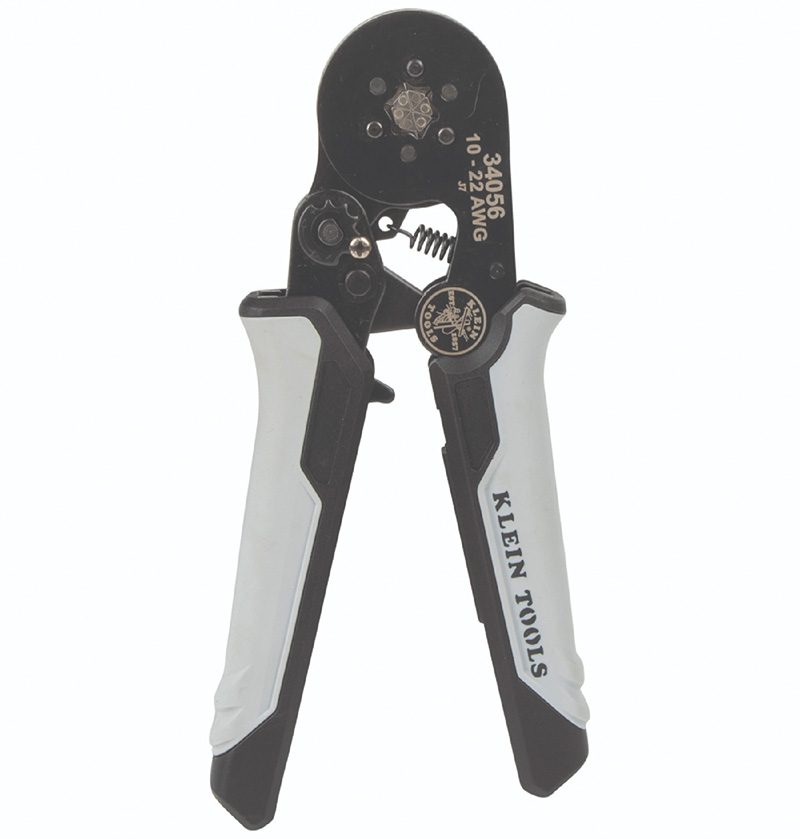 | 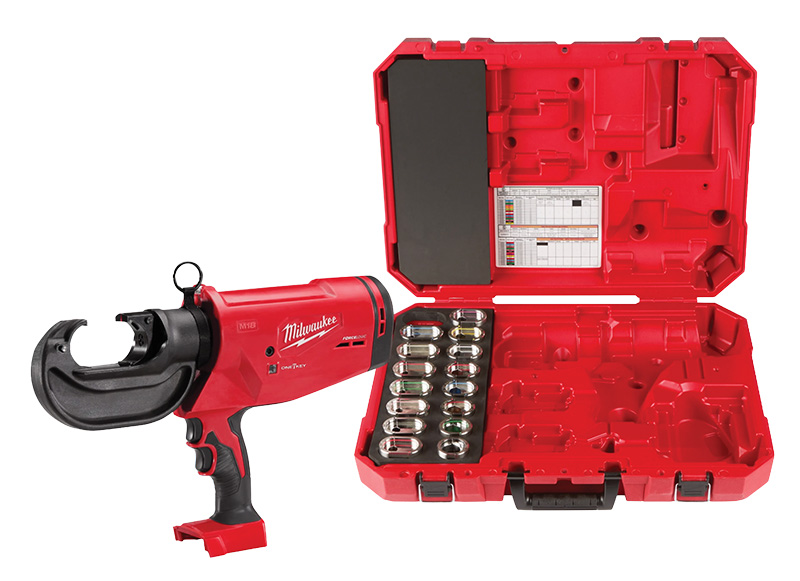 | |
| Klein Tools 34056 ratcheting ferrule hex crimper | Milwaukee Tool M18 Force Logic 750 MCM crimper set |
Control panels are another place where crimps on conductors are quite common. Just because the wires are smaller doesn’t mean the termination techniques are less important. Terminating the fine, braided, stranded wire under terminal blocks or devices can potentially damage the fine wires if we don’t put some type of ferrule on the ends. Because those fine wires have a tendency to stray somewhere they shouldn’t, the ferrules keep them corralled in the proper terminal.
Considering the quantity of control wires in any given control panel, ratcheting crimpers can really help when it comes to efficiency, uniformity and hand fatigue. Klein Tools offers a ratcheting ferrule hex crimper made just for these situations. The ratcheting mechanism works much the same as a standard crimper, but this tool also uses six precision dies to crimp in a 360-degree hex shape, resulting in durable and dependable connections. Designed for 10-22 AWG wire, the ratcheting portion automatically adjusts to the ferrule size, so efficiency is maximized by not having to change tools or crimp heads. Rounding out the features are an adjustment dial for fine-tuning and comfort grips for all-day usage.
Klein Tools also offers a square-shaped crimping tool in lieu of the hex crimper.
Large wire crimps
When working with larger conductors and equipment, we don’t always have the luxury of mechanical connections in the equipment to land wires on. Job site specifications may require compression connections for these larger terminations. And with those larger conductors (and larger crimp fittings) comes the need for more force to make the crimps. Hand power alone won’t produce enough force (not to mention the exertion required). Thankfully, there are options for these types of crimps as well.
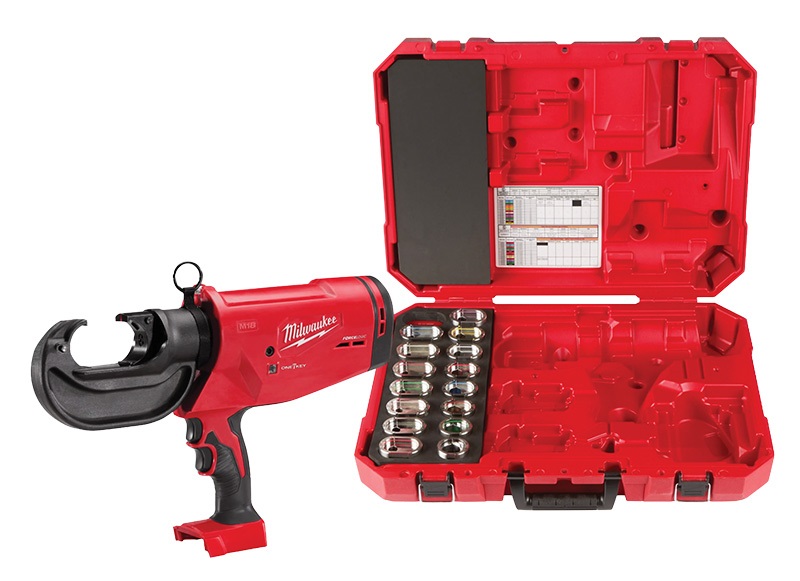
Brookfield, Wis.-based Milwaukee Tool’s M18 Force Logic 750 MCM crimper set is designed for versatility. The tool can produce 12 tons of force and includes interchangeable dies that cover from No. 6 up to No. 750 kcmil copper conductors. The crimping head itself rotates 350 degrees, and the red marks provide for quick and accurate alignment on the connector. The unit’s onboard electronics can do additional functions including instant pressure verification, precrimp battery checks and even recording and storing metrics from each crimp that can be made into a professional report and turned over during the commissioning phase of a project.
But what if the number of large conductor terminations we make doesn’t justify the price tag for a battery-driven hydraulic unit? Or maybe we don’t want the hassle of swapping dies back and forth when terminating different sizes of conductors. There are hand-driven hydraulic options to accommodate these requirements.
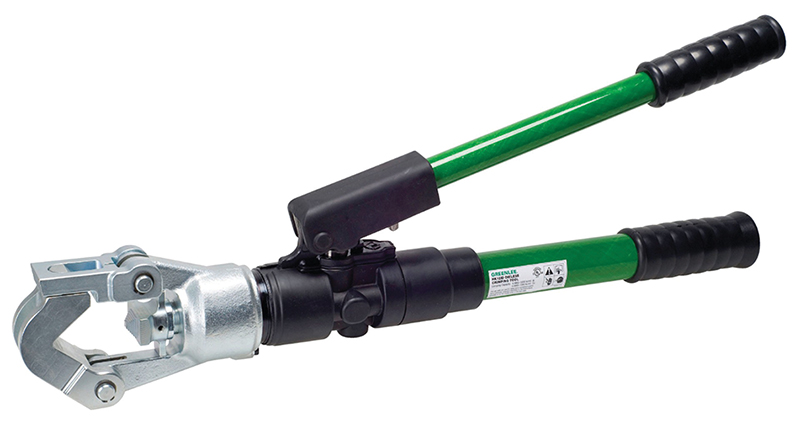
Greenlee HK12ID hand hydraulic dieless crimping tool
The hand hydraulic dieless crimping tool from Greenlee, Rockford, Ill., focuses on simplicity and function. It uses hand power in lieu of an electric motor to drive the hydraulics, and can produce 12 tons of crimping force. It features a two-speed pump that speeds up the crimping time, and the head can rotate 350 degrees to access tight spots. However, the most attractive feature is the dieless indent-style crimping head that allows us to crimp from No. 4–1,000 kcmil CU and No. 6–1,000 kcmil AL without changing dies. That feature is more efficient and can be less costly to operate considering how loose dies can become lost and are not free to replace.
Communications cable crimps
As technology continues to expand, an abundance of the electrical equipment we install today often requires some sort of communications cabling. Some types of equipment are wholly or partially automated (requiring communications between individual components) while others may allow for remote access only. Either way, the need for communications cables, and thus the need to terminate them, is becoming more common.
Anyone who has terminated data cabling before knows that those wires are very tiny and there isn’t much room in the connectors to move them around where we would like them to be. The Klein Tools ratcheting ethernet cable crimper for pass-thru helps with this issue. The tool operates much like a standard ethernet cable crimper, but with a twist. It will crimp 4-, 6- and 8-position modular connections and has a full-cycle ratchet mechanism that ensures a complete connector termination with minimal effort. The tool also features a 28-22 AWG capacity and even an on-tool wiring guide to assist in minimizing wiring errors.
The main feature is the crimper dies themselves. By using a pass-through connector, users can strip the wires long enough to manipulate them, and the tool will cut the excess wires off the end. This feature alone makes it an invaluable addition to a tool arsenal.
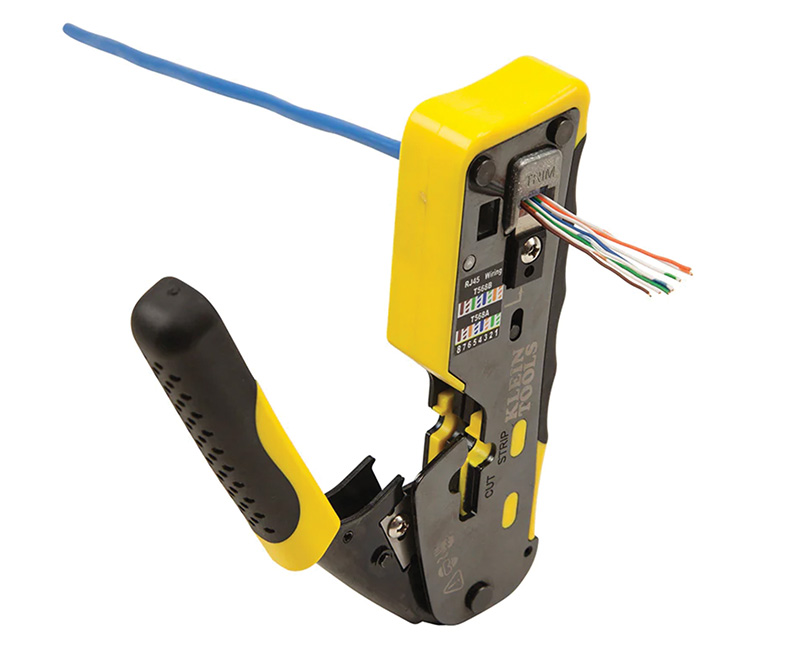 | 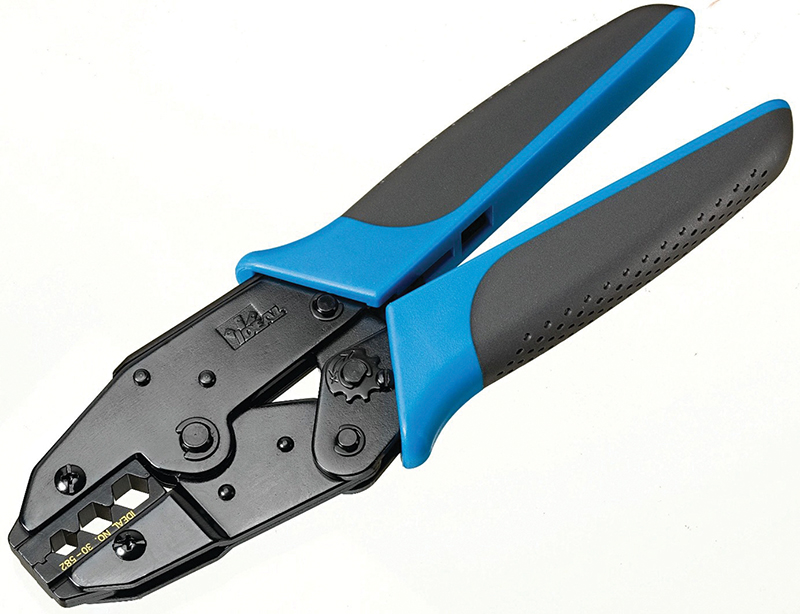 | |
Klein Tools VDV226-110 ratcheting ethernet cable crimper/stripper/cutter | Ideal Electrical 30-503 Crimpmaster ratcheting crimp tool |
Coaxial cables are still used for many installations, and they require unique tooling to terminate. One tool is the Crimpmaster ratcheting crimp tool from Ideal Electrical, Sycamore, Ill. It is designed to terminate F-type connectors (RG6 and RG59) and has three different cavities in the jaws for the connectors. The crimper employs a ratcheting mechanism that prevents under-crimping by ensuring the jaws won’t release until a full crimping cycle has been made.
The tool also features comfortable and contoured handles that give leverage while not digging into the palms of our hands. However, the most notable feature is the replaceable die sets. By removing a couple of screws, the jaws can be replaced with one of 13 interchangeable die sets, including a standard set to terminate powered conductor spade-type connectors.
Get to crimping
At the end of the day, a solid crimp comes down to matching the right tool to the task and understanding the role each connection plays in the overall system. Small-gauge hand crimpers are perfect for everyday control and device work. Step up in wire size, and larger crimping tools (whether ratcheting or hydraulic models) become essential for providing the force required to properly terminate the higher-amperage conductors. In today’s connected world, data and coaxial crimpers are needed to provide clean and reliable signal transmission for those systems.
No matter the application, the goal is the same: to provide a secure and reliable connection that will stand up to the environment and the test of time. By investing in the proper tools and using them as designed, we can ensure that the crimps we make will reflect the professionalism of our work.
Klein Tools | Greenlee | Milwaukee Tool | Ideal Electrical