Game day is as much about the fan experience as what happens on the field or court. College and professional teams want fans to be crowing “Wow!” when the game is over—and come back, with their wallets.
But it takes a lot of power to create an immersive, impressive experience. Ryan Gant, national business development manager for healthcare and low/medium-voltage products with Siemens Smart Infrastructure USA, Peachtree Corners, Ga., has some eye-opening numbers.
“On game day, the 15-minute peak average of an NBA or NHL arena, depending on climate and capacity, would range from 2.5 megawatts (MW) to 9 MW,” he said. “An example is the Los Angeles Clippers’ Intuit Dome, which experiences 6.5 MW peak average demand on game days, as a maximum.”
Justin Carron, director of buildings segment for Eaton, Beachwood, Ohio, has power numbers of his own.
“If you take an NFL stadium that has all the outdoor lighting, the LEDs and HVAC loads, it can go from a couple of megawatts to 5–7 MW,” he said. “What’s interesting from my perspective is they are multipurpose. For the professional sports stadium, you could have a concert one day, a game the next.”
For example, Levi’s Stadium in Santa Clara, Calif., the home of the San Francisco 49ers and Super Bowl LX, is a $1.2 billion venue that has hosted concerts, professional wrestling and college football’s national title game, and will offer matches for this summer’s FIFA World Cup. Cupertino Electric Inc., San Jose, Calif., was the design-build electrical contractor for the stadium, and its work included a 375-kilowatt solar energy system.
Balancing work and tradition
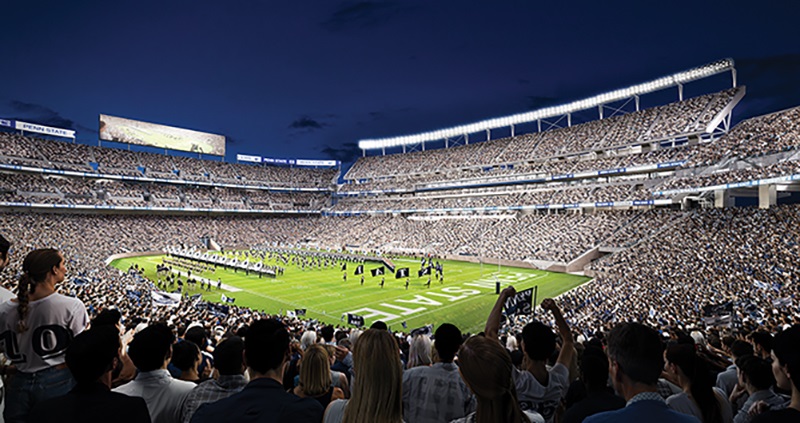
Another notable location is Beaver Stadium, nestled in the fertile plains of middle Pennsylvania and home of the Penn State University football team. John McFadden has been heavily involved in its refurbishment, which included the demolition of its west side at the end of 2024.
McFadden, vice president and business unit leader for electrical contractor Lighthouse Electric Co. Inc., Canonsburg, Pa., said there were two requests for proposals (RFPs) for the project—one for the electrical work, headed up by his firm, and another for low-voltage work, led by systems integrator Dagostino Electronic Services, Pittsburgh.
The west side demolition created many challenges for Lighthouse, especially last fall during the football season.
“On the west side, there were temporary lights fed by generators, which created a lot of coordination efforts,” McFadden said, adding that Penn State is its own utility. “It facilitated the need to have people on-site for games. Any time there was a home game, there were people there.”
But there was more—a lot more, which is what you would expect on a $700 million project. There was plenty of electrical equipment replacement. McFadden said the Eaton gear at Beaver Stadium includes switchgear, pad-mounted transformers, medium-voltage switches, all branch panelboards for power and lighting and dry-type transformers. A new generator by Caterpillar, Irving, Texas, was installed along with ASCO automatic transfer switches, made by Schneider Electric, Boston. And don’t forget lighting controls, which consisted of a lighting package from Acuity, Atlanta, and controls from Crestron, Rockleigh, N.J.
On the other side of the project, Bob Dagostino, president of Dagostino Electronic Services, said his firm’s contribution was the technology elements, such as the broadcast infrastructure.
“It takes into consideration communications, security, wireless access points, cameras, IT infrastructure and the fireworks button,” he said, referring to the button that detonates fireworks from the scoreboard when Penn State scores or wins the game.
It’s all part of the experience, which Dagostino said is for the fans, players and staff. For example, safety is key, so staff must feel confident that the public address system is functional in case there is an evacuation announcement. Secured gates are also crucial, so fans don’t go roaming where they shouldn’t be.
Preventing blackouts
Keep in mind that fans, the team, advertisers and alumni expect a game will come off seamlessly. That’s why a blackout simply cannot happen, which places extra pressure on electrical contractors to make sure everything is in place and operational.
Gant said equipment such as Siemens’ 8DJH 36, NXPLUS C and 8DA10/8DB10 medium-voltage gas-insulated switchgear and Siemens SIEBREAK medium-voltage air-insulated switchgear mitigates the possibility of a blackout. So do unit substations incorporating UL 891 Siemens 3WA switchboards or UL 1558 Siemens 3WA switchgear.
He added that uninterruptible power supplies are often used for loads that the stadium owner insists can’t be lost for even a fraction of a second, including public messaging systems and emergency distributed antenna systems. But there’s more.
“Another option we’re seeing more often is the installation of a microgrid,” Gant said. “Siemens SICAM microgrid controllers can manage the utility connection alongside on-site distributed energy resources of any type: photovoltaics, battery energy storage systems, fuel cells, etc. The microgrid controller can sense when a utility is about to drop off and prep the [distributed energy resources] DERs to restabilize the grid as soon as possible. Designed correctly, this transition can be done in milliseconds to seconds at a maximum.”
Working together at the stadium
Siemens equipment can be found in SoFi Stadium in Los Angeles, Oracle Park in San Francisco, Levi’s Stadium and Beaver Stadium. Eaton equipment is used in a host of stadiums as well, including Madison Square Garden, Lambeau Field and Wrigley Field.
ABB, Cary, N.C., has its equipment at Fenway Park, Lucas Oil Stadium in Indianapolis and Kyle Field in College Station, Texas, which integrates solar power and energy storage.
Ditto for Schneider Electric, which last year was named the official energy management partner of the Tennessee Titans’ new home, Nissan Stadium. That will include uninterruptible backup power, Square D electrical power distribution and control systems, and an integrated building management system. The company predicts a 20% reduction in energy consumption.
Carron said that an electrical equipment manufacturer will work with the stadium owner to hire an architect and a consulting/specifying engineer to do the electrical design.
“We’ll work with the engineer on the design and the electrical contractor may have a seat at the table,” Carron said. “We work with the contractor to get it installed correctly. When the project gets handed off to the owner, there is a strong opportunity for the contractor to be the go-to person to do the required maintenance.”
Adding to that, Gant said, is NFPA 70B, Standard for Electrical Equipment Maintenance, which was codified as a standard in 2023.
“This new, to most people, standard is comprehensive on what must be done to maintain electrical equipment long term, and Siemens electrical services field technicians can be contacted short-term or long-term to perform those procedures manually,” he said.
Keys to contractor success
So what’s the key for an EC working on a stadium project?
“The biggest, from my standpoint, is to be ready for a lot of uncertainty and ambiguity from ownership and/or the design and engineering teams,” McFadden said. “Stay flexible. Be prepared for a long road from RFP to contract. It took us probably a year-plus before we had a finalized contract based on the RFP.”
Dagostino added that weather conditions may not be ideal. January at Beaver Stadium is cold and windy. A contractor has to be innovative, too.
“One of the creative solutions, being that those games are televised, we created a truck dock, where the broadcast trucks come in and connect to the fiber optics and audio cables so they can take their cameras out,” he said.
stock.adobe.com/baphit | ock.adobe.com/nobeastsofierce
About The Author

VOSS is a freelance writer based in the Chicago area and has worked extensively in the low- and high-voltage areas of the electrical industry. Contact him at [email protected].