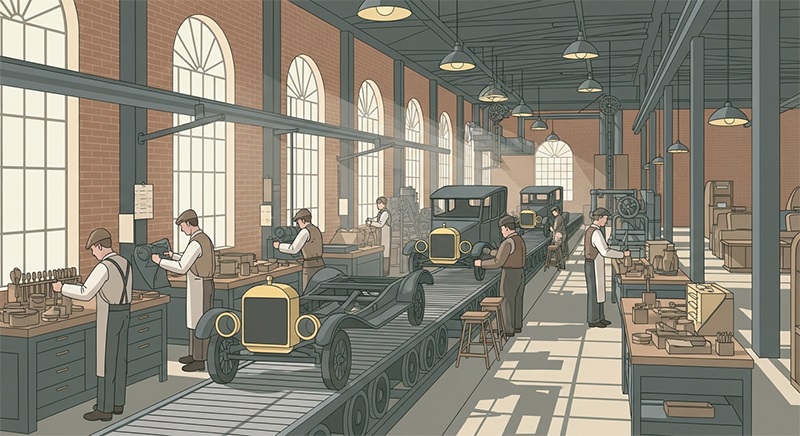
The most fundamental source of success in Henry Ford’s 1913 opening of his first assembly line, and every one thereafter, was something we have all learned to take for granted over the decades since.
It was not his concept of an assembly line, which by no means was a “first.” Twelve years earlier, Ransom Olds, another automotive pioneer and namesake of the Oldsmobile, had premiered his own stationary version of an assembly line in which workers moved from car frame to car frame.
Nor was Ford’s success mostly due to incorporating a powered conveyor system in his assembly line to move semi-finished components from one workstation to the next. Historians tell us that Henry Ford had gotten his inspiration for “bringing the work to the worker” after visiting several “disassembly lines” in contemporary meat-packing plants in Chicago. Meantime, grain mills, commercial bakeries and beer breweries in the early 1900s were already using conveyor systems to move products through the factories.
The real magic in the manufacture of Ford’s famous Model T was in its reliance on interchangeable parts that could be mass-produced economically and fitted together within precise tolerances.
Today, when prefabrication is a big topic of discussion, we can fully appreciate the legacy of Henry Ford and his engineering team. Looking ahead, we foresee a future of greater dependence on modularization.
But one larger-than-life figure stands out for envisioning how society might apply the lessons learned from automobile manufacturing to observable shortcomings in building construction.
He went by the name Le Corbusier, a distinctive pseudonym he had assumed for dramatic effect in his quest to reinvent building design and construction.
Although most Americans would more likely recognize the names of Frank Lloyd Wright or another celebrated architect or two, Le Corbusier is generally regarded as “The Father of Modern Architecture.” He famously observed, “A house is a machine for living in.”
More than 100 years ago, Le Corbusier proposed revolutionary architectural concepts we would look on as completely conventional today. His revolutionary philosophy, for example, called for supporting buildings through thin interior columns versus heavy outer walls. He campaigned for wide-open floor plates without load-bearing interior partitions. Constructed in this manner, high-rise buildings could therefore be clad by exterior “curtain walls” composed of factory-made modular panels. He pioneered ribbon window systems that completely enveloped the exterior of buildings. And a century ago he topped off his list of truly futuristic ideas with a proposal for roof gardens that would symbolically replace the ground area consumed by each new building’s footprint.
Although his name and history may be unfamiliar to most Americans today, many will instantly recognize the exterior profile of the 39-story United Nations Secretariat Headquarters in New York City, completed in 1952, for which he was a leading member of the architectural design team.
But nearly four decades before that, Le Corbusier had become totally absorbed in what he saw on visits to U.S. automobile factories.
Of course, the collective accomplishment of Henry Ford and his engineers (he was not a solitary genius) was markedly deserving of praise. After the opening of Ford’s Highland Park assembly line in 1913, they had been able to reduce the time it took to make a Model T from 12½ hours to about 1½ hours.

Seeing potential today
That legendary example of the latent potential for increasing productivity by using smarter manufacturing techniques echoes in enthusiasm for how it could also be applied to improving productivity in present-day building construction. After all, the building construction industry has been assailed by criticism that has continued for literally decades about its apparently steady decline in productivity.
Perception of this decline in productivity was raised many years ago and repeatedly revisited by a Stanford University professor, now emeritus, Paul Teicholz, in the Department of Civil and Environmental Engineering. Since then, others perceived as authoritative experts have chimed in and reinforced the notion that, while most nonfarm industries have generally shown year-over-year growth in their productivity, the construction industry has continued to trend downward over the past 50–60 years. For a long time, virtually everyone who has weighed in on the subject appeared to be thinking alike.
“If everyone is thinking alike, then somebody isn’t thinking!” That is an adage often attributed to George S. Patton Jr., the famous World War II U.S. Army general. Although he was not referring to anything even close to the subject of productivity in the construction industry, his observation can be easily applied to it.
There is a simple explanation for all this groupthink: everyone who repeats the mantra of declining productivity in construction is directly or indirectly relying on the same original source data.
Electrical contractors do not generally delve into statistical evidence of productivity trends in construction activities. But sometimes some are forced to try to substantiate differences in their workers’ productivity during one time in a project versus another.
When preparing claims for additional compensation to recover unanticipated costs incurred on a project—for which somebody else allegedly was to blame—contractors commonly apply the “measured mile” concept. They select a period during the project when their productivity was normal. Based on whatever kind of documentation they have, they will reveal the labor units their crews were achieving when their progress was unaffected by the outside factors that are antagonists in the storyline of the construction claim.
Then they will show the degradation in the labor units that their crews compiled during the period in which they were affected by outside factors through no fault of their own.
By contrasting the field production data of the normal “measured mile” versus the affected one, they can extrapolate the unanticipated costs they experienced and consequently request an equitable adjustment to the dollar-value of their contract.
At the job-level, that’s how a decline in productivity can be portrayed. In the stratosphere of statistics at a national level, however, the slope of the productivity curve for the entire industry is determined in a far different fashion.
Trend of productivity in construction
Most people in and around the construction industry have seen one graph or another that supposedly portrays the general trend of productivity over several decades of U.S. manufacturing industries versus the construction industry. The trendline of manufacturing climbs upward to the top right corner of the graph like a fighter jet at an air show. Meantime, the trendline of construction starts out on an upward path, but by the early 1970s abruptly heads downward like an atomic-powered submarine in a fast dive for deep water.
At this juncture, we would like to provide two observations: the first on the main source of long-held perception of construction productivity, and the second on how the electrical construction industry ought to be striving to rectify it—at least as far as electrical contracting is concerned.
The trendline representing construction industry productivity over successive decades has been based on data from two main sources: the Bureau of Economic Analysis (BEA) and the Bureau of Labor Statistics (BLS). We can think of the data as forming a “productivity fraction” each year along the way. The numerator stands for the total dollar value of construction put in place each year. The denominator quantifies the labor that went into producing that economic value each year.
Change in the slope of the trendline will rise or fall according to changes in the numerator, the denominator or both. But in any case, it will have no direct connection to the efficiency of the physical installation work performed on job sites throughout the country.
Since this approach to tracking productivity over a successive number of years is based on dollar values and census data, it requires a way to adjust for the effect of inflation. To make that adjustment, economists use “deflators,” that is, factors by which they try to normalize the worth of a dollar at every point along the trendline against a base value in a chosen year.
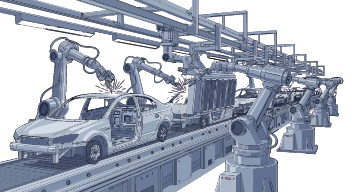
Determining the appropriate value of the deflators for one year versus another is only one of many challenges they must wrestle in attempting to get this analysis right.
The composition of the workforce in construction has changed over the course of the decades since the trendlines of productivity in manufacturing and construction split in the early 1970s into two markedly different directions. From that fork in the road to today, the construction sector has added new classifications of workers included in the denominator of the productivity fraction but are not “hands-on.” Contractors have nonmanual staff on job sites with functions and titles that did not exist 50 years ago. They are included in the calculations that mathematically reduce the perceived rate of construction productivity.
The entire industry’s current obsession with prefabrication is nonetheless a positive development. But the idea that it is a critically needed solution to compensate for a long-term slide in productivity is misguided. There are too many obvious flaws in the way that BLS and BEA data have been assembled to support the notion that construction productivity has been dropping each year.
So, it is incumbent on everyone in the electrical construction industry to inveigh against the prevailing notion that their own sector’s productivity index has provably been slipping from year to year. After all, the supposed decline in productivity is inclusive of every category of construction. It does not specify individual sectors.
Justifiably confident in their own abilities and current experience, electrical contractors must strenuously advertise to their hometown markets the realities of better training, teamwork, tooling, technology and todays than yesterdays, that all add up to better total outcomes in the electrical arena than ever before.
This brings us back to the connection between automobile manufacturing and building construction. The question was, what if buildings were more like cars?
Le Corbusier asked that question a century ago and continued to ask it throughout his career. His answers were all about tangibly improving construction methods.
Today, the most likely responses to that question would run to the subject of technology: Can’t buildings cram in more of the intelligent features that cars have?
Undeniably, buildings themselves are not as “smart” as cars. After all, they are skulls, not brains. As soon as one person enters a building, it has more thinking power than any self-driving automobile. And, incidentally, people spend 90% of their lives inside buildings. Cars spend 95% of their lives parked.
As opposed to automobiles, buildings last longer and are eminently more adaptable to new uses through renovation. Successive advancements in technology in each new model of an automobile brand push its predecessors another step closer to obsolescence.
Buildings have provided shelter and protected humankind for centuries. They do not clutter acres and acres of salvage yards. When deconstructed, they can substantially be recycled.
What if cars were more like buildings?
stock.adobe.com/Jangkrik
About The Author

MCCOY is Beliveau professor in the Dept. of Building Construction, associate director of the Myers-Lawson School of Construction and director of the Virginia Center for Housing Research at Virginia Tech. Contact him at [email protected].

SARGENT heads Great Service Forums℠, which offers networking opportunities, business development and professional education to its membership of service-oriented contractors. Email him at [email protected].