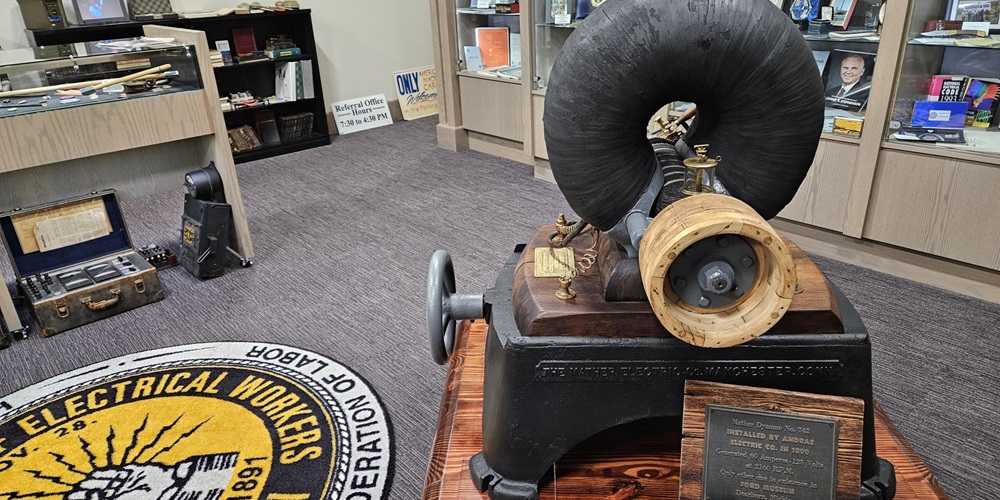
A year ago this October, a rare relic from America’s industrial past came to rest at the IBEW 494 History Museum in Milwaukee. Since then, the fully restored Mather Dynamo—a steam-powered DC generator manufactured in the late 1800s—has attracted lots of attention from visitors.
Their reaction? “Delight and enthusiasm—this is something you don’t get to see every day, especially up close,” said Bob Weber, IBEW 494 business representative, who publicized the acquisition on the local’s Facebook page and its monthly publication, “The Relay.” “People are also impressed that this is one of two Mather Dynamo generators in existence.”
The device operates by Faraday’s law of induction, that a changing magnetic field induces a voltage in a circuit. The process was discovered in 1831 by English scientist Michael Faraday.
Steam power turned the Mather Dynamo’s fly wheel, which turned a rotor. The rotor rotated windings (strands of copper wire tightly wrapped around magnetized iron) through a corresponding magnetic field, rapidly changing it. The process generated DC current. The windings are inside the black donut-shaped structure at the top of the dynamo.
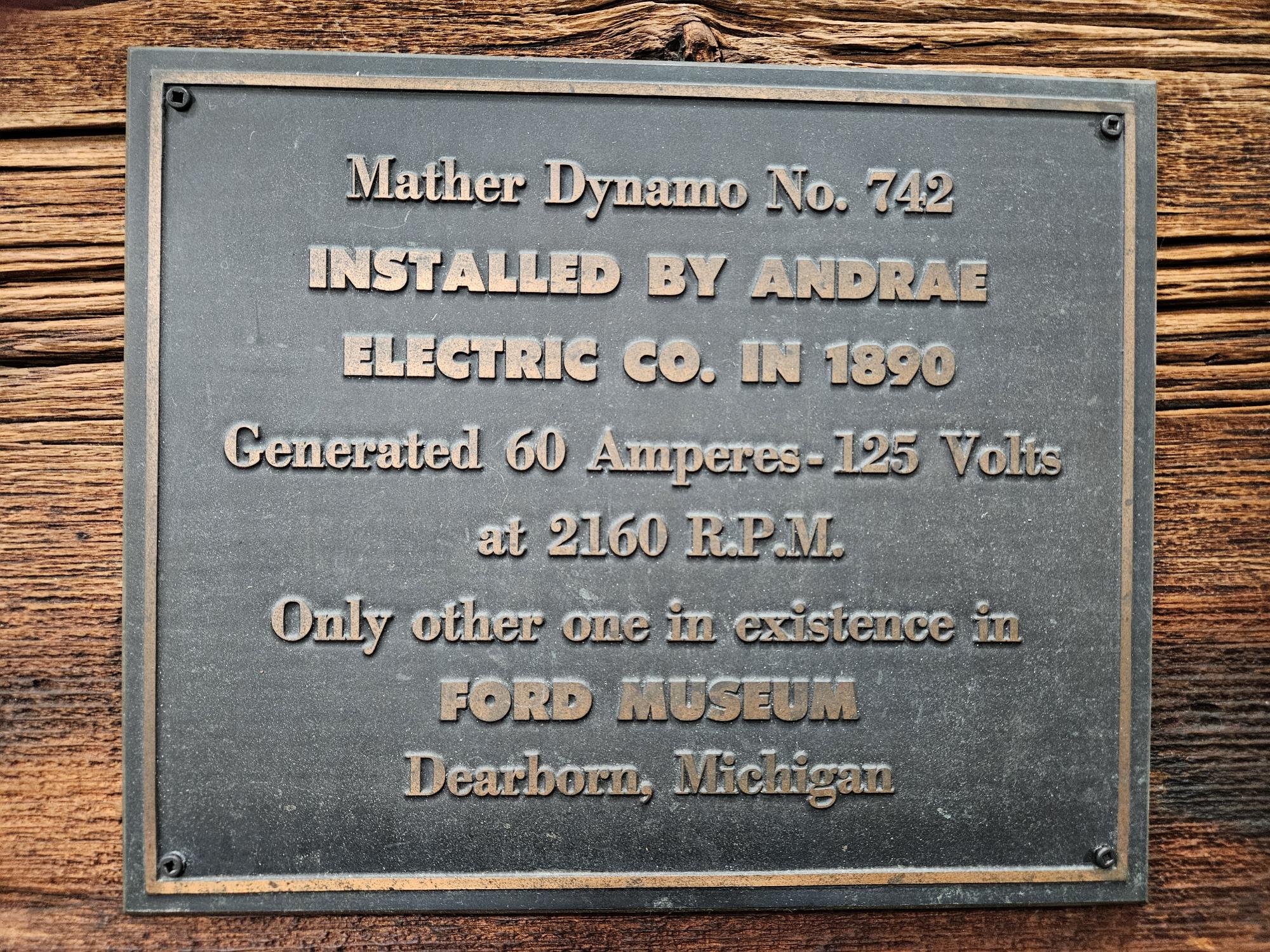
A bronze plaque that sat next to the dynamo for decades reads, “Mather Dynamo No. 742 installed by Andrae Electric Co., in 1890. Generated 60 amperes-125 volts at 2160 R.P.M. Only other one in existence in the Ford Museum, Dearborn, Michigan.” Photo courtesy of Bob Weber.
“This thing was built back in the industrial age when people were still trying to figure things out,” said Don Oldani, IBEW 494 business representative. “Generators like these were used to power streetlights and businesses in Milwaukee, which makes this a piece of local history.”
This Mather Dynamo served the Layton & Plankinton Packing Co., a meat packing plant in South Milwaukee. After being decommissioned in 1920, it was displayed outdoors in a glass case in front of Terminal-Andrae, Pewaukee, Wis., a later iteration of Andrea Electric, the company that first installed it.
The passage of time took its toll, and around 2020, Terminal-Andrae made plans to relocate the dynamo but had no plans for it.
Oldani, a former employee of Terminal-Andrae, launched a preservation effort fueled by donations from IBEW 494 members. Collections covered the restoration by Dietz Electric Co. Inc., a local union motor shop in Milwaukee.
The dynamo weighs around 1,200 pounds, according to a Mather manual referring to a similar dynamo model. The sheer heft of the object made it necessary for the local to consult with an architect to make certain that displaying it would not damage their museum floor.
The dynamo does not currently function due to the museum’s lack of steam power, but it’s still capable of operating, Weber said.
Though museum visitors won’t see power generation, they can adjust manual controls to reposition the dynamo or tighten the slack in a belt used to turn the rotor windings.
Inspired by the IBEW 1 history museum in St. Louis and by the IBEW’s headquarters museum in Washington, D.C., the members of IBEW Local 494 established their history museum in 2016. Since then, as curators, Weber and Oldani have overseen member donations of other relics and photos, with many dating back 100 years.
Other objects housed in the museum include early PPE leather gloves, light fixtures, outlets, wire, tools and photographs of large local projects, previous business managers and the local’s annual meetings and conferences.
Header image: A rare Mather Dynamo from the late 1800s intrigues many who visit IBEW 494’s history museum in Milwaukee. The dynamo once generated DC current. Photo courtesy of Bob Weber.
About The Author
.jpg?sfvrsn=a64b988b_1)
DeGrane is a Chicago-based freelance writer. She has covered electrical contracting, renewable energy, senior living and other industries with articles published in the Chicago Tribune, New York Times and trade publications. Reach her at [email protected].