For being in the wrong place at the wrong time, in October 2000, Cory McCray landed in jail on suspicion of having stolen a firearm. That was after being expelled from City of Baltimore public schools and spending time in juvenile correctional facilities for drug trafficking.
Less than three years later, by age 20, McCray had turned his life around. He started an apprenticeship with IBEW 24 in Baltimore. It wasn’t long until he bought his first home and began helping his family.
McCray credits his dramatic change of fortune to his mother, who encouraged him to consider a career in the trades and to mentoring by local IBEW 24 foremen and leaders. They helped him cultivate a strong work ethic. They also showed him the difference between life with no security and having a solid career with opportunities for growth.
McCray became a journeyman/inside wireman. These days, from January through April, he serves as a state senator for Maryland. The rest of the year, he works as a business agent for IBEW 24 and operates a family business restoring homes.
McCray believes his life experience and legislative work put him in a unique position to challenge an age-old paradigm asserted by American educators—that all students should aim for college. Closer to reality, a recent federal study of higher education by the National Center for Education Statistics indicated that 40% of students who start college never graduate, often due to lack of funds.
“Most educators and policymakers don’t realize they’re trying to fit the majority of people into what works best for a smaller portion of our society,” McCray said.
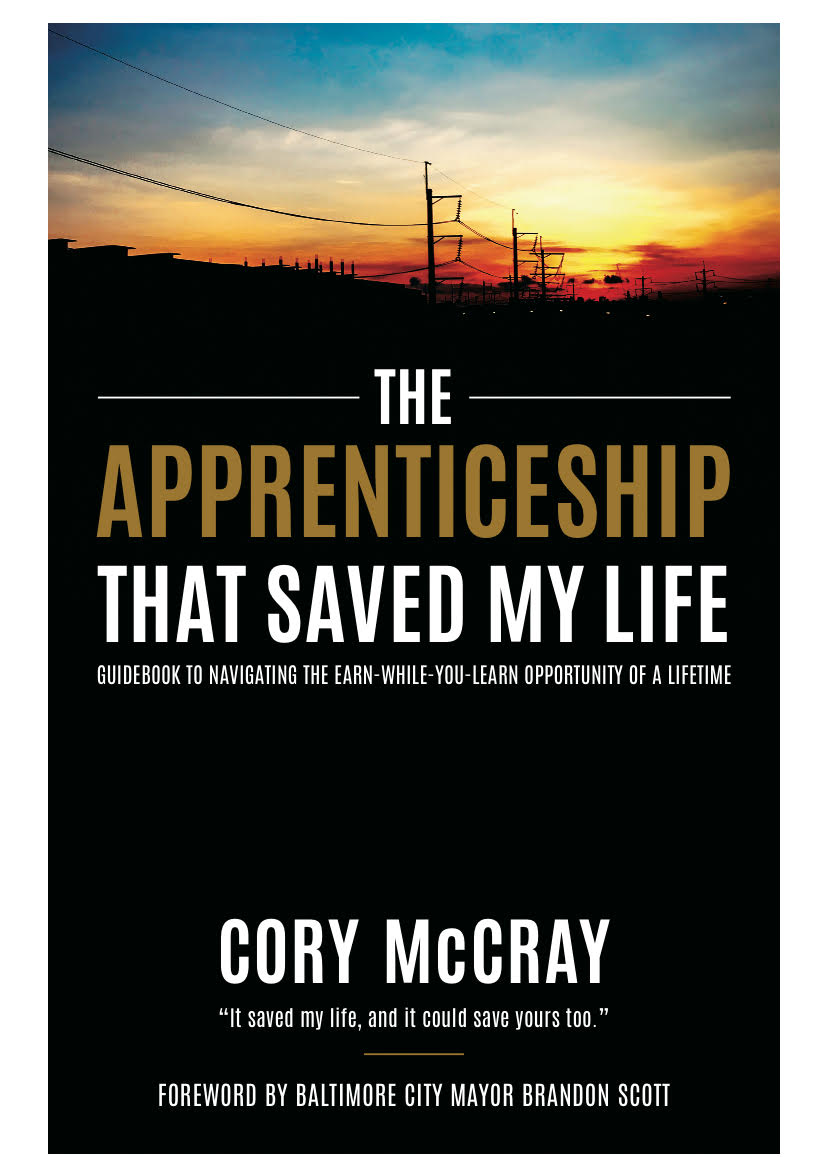
Since last September, McCray has spent many evenings touting his new book, “The Apprenticeship that Saved my Life.” His target audiences are influential policymakers, educators, guidance counselors, high school students and parents.
McCray’s autobiography reveals his journey as an electrical apprentice and doubles as a guidebook for weighing options for careers in the trades. Besides IBEW, it lists other unions for carpentry, cement masonry, elevator construction, iron work, maintenance work, sheet metal work, plumbing and steam fitting, roofing, welding, information technology and videography.
The book also instructs on how to investigate professional certifications offered by state departments of commerce.
The idea to write the book came to McCray in mid-2022. “I’m always asking myself, ‘Am I doing enough?’ I know we only have a limited time on this earth. I thought, ‘How do I give this knowledge to others?’”
As a state senator and recruiter for IBEW 24, McCray has spent years regularly speaking at area high schools, reaching 20–30 students at a time. “I thought, ‘How could I reach 3,000 at a time?’” he said.
As of November, 7,000 copies of McCray’s book had already sold. His goal is to sell 200,000 to high school libraries and guidance counselor offices around the nation.
“I came to value the business model that employers want skilled and trained workers so they can do quality work and get more contracts,” he said.
The book touts the intrinsic value of the IBEW brotherhood—knowing that others are there for you and being there for them, having the opportunity to work with other seasoned journeymen who have cultivated a strong work ethic, skill development, networking opportunities, a secure financial future and the ability to plan finances.
“These strengths are shared by other trades,” McCray said.
“I once spoke with Suzi Levine, former ambassador to Switzerland, who said that at its peak in the 1960s, the United States had 40% of college-age students enrolled in college,” he continued. “The rest were jobs in the trades and other.”
Dismissing the value of careers in the trades to build generational wealth has had detrimental impacts in the United States, McCray said. “Other countries value the trades. They see it as commerce and economic strength. We don’t.”
McCray is convinced his book will serve to “fill the gap” between educators suggesting all students should aim for college and what is more likely to serve the multitudes—that students benefit from also considering careers in the trades.
It’s hard to disagree.
Published by Morgan James Publishing, McCray’s book is available in paperback, hardback, e-book and audiobook formats.
Cory McCray / Morgan James Publishing.
About The Author
.jpg?sfvrsn=a64b988b_1)
DeGrane is a Chicago-based freelance writer. She has covered electrical contracting, renewable energy, senior living and other industries with articles published in the Chicago Tribune, New York Times and trade publications. Reach her at [email protected].