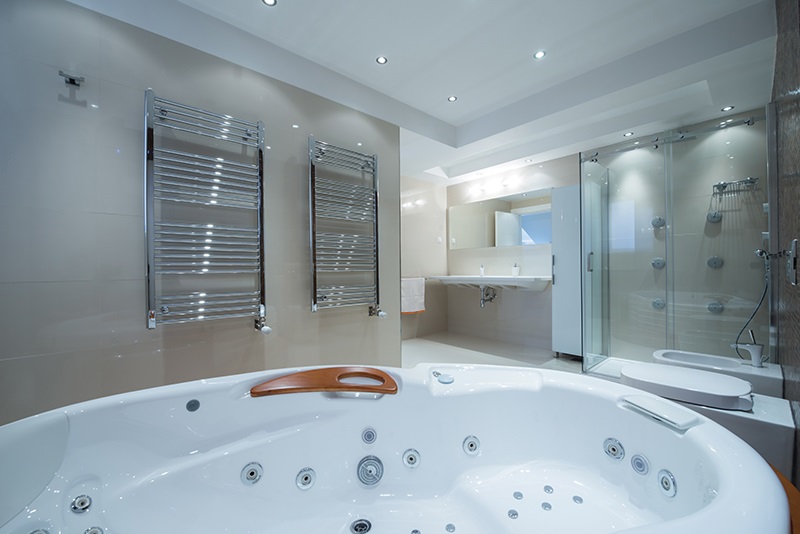
Both hydromassage bathtubs and regular tubs have similar applicable requirements in Part II and Part III of National Electrical Code Article 210 dealing with branch circuits. Regarding the installation of luminaires, switches and other electrical equipment, hydromassage bathtubs are treated the same as ordinary ones. However, more specific requirements exist for hydromassage bathtubs, since electrical power and safety issues are involved.
NEC 210.11 requires branch circuits for lighting and appliances, including motor-operated appliances, to supply the loads calculated in accordance with NEC 220.10. In addition, branch circuits must be provided for specific loads not covered by 220.10 where required elsewhere in the Code and specifically for dwelling unit loads as specified in 210.11(C).
Branch circuit considerations
The number of branch circuits for a bathroom is required in NEC 210.11(C)(3), as well as other sections of Article 210 and any others that might apply based on the type of appliances installed. NEC 210.11(C)(3) states the following: “In addition to the number of branch circuits required by other parts of this section, one or more 120-volt, 20-ampere branch circuits must be provided to supply bathroom(s) receptacle outlet(s) required by NEC 210.52(D) and any countertop and similar work surface receptacle outlets. Such circuits shall have no other outlets.”
An exception to NEC 210.11(C)(3) allows a single 20A circuit to supply a single bathroom with outlets for other equipment within the same space permitted in accordance with 210.23(B)(1) and 210.23(B)(2). This exception and the references to 210.23(B)(1) and (2) may help when installing a hydromassage bathtub in an existing home.
NEC 210.23(B(1) states that the rating of any one cord-and-plug-connected utilization equipment not fastened in place must not exceed 80% of the branch circuit rating. NEC 210.23(B)(2) states that “the total rating of utilization equipment fastened in place, other than luminaires, shall not exceed 50 percent of the branch-circuit ampere rating where lighting units, cord-and-plug-connected utilization equipment not fastened in place, or both, are also supplied.”
Since hydromassage motors are fastened in place and a single 20A branch circuit can supply one bathroom, and the hydromassage motor can’t exceed 10A on the circuit, it may not be necessary to install a new circuit. On average, residential hydromassage motors range from 0.5–1.5 horsepower (HP). The motor’s size must be compatible with the tub’s water capacity and number of jets. Based on NEC Table 430.248, which provides the full load current for single-phase motors, a 0.5-HP motor is rated at 9.8A at 115V, and a 1.5-HP motor is rated at 20A at 115V. Obviously, a 0.5-HP motor would comply with NEC 210.23(B)(2).
However, NEC 680.71 requires hydromassage bathtubs and their associated electrical components to be on an individual branch circuit(s) and protected by a readily accessible GFCI. This requirement supplements and modifies the ones in 210.23(B)(1) and (B)(2). This requires an individual branch circuit to be installed from a panelboard or a service panel to the hydromassage bathtub motor and associated equipment.
NEC 680.71 requires that all 125V, single-phase receptacles not exceeding 30A and located within 6 feet measured horizontally of the inside walls of a hydromassage tub to be GFCI-protected.
This type of bathtub electrical equipment must be accessible without damaging the building structure or finish. This is incredibly important, since some hydromassage motors are actually sealed under the sides and tops of the bathtubs where tile, marble, etc., must be removed to gain access. Where the hydromassage bathtub is cord-and-plug-connected with the supply receptacle accessible only through a service access opening, the receptacle must be installed so its face is within direct view and not more than 1 foot of the opening.
Bonding, bonding, bonding
Finally, NEC 680.74 requires bonding of all metal fittings within or attached to the tub structure in contact with the water; bonding of blower motors, pump motors and electrical equipment associated with water circulation; bonding of metal-sheathed cables, metal raceways and metal piping within 5 feet of the inside walls of the tub and not separated from the tub by a barrier; bonding all exposed metal surfaces that are within 5 feet of the inside walls of the tub and not separated from the tub area by a permanent barrier; and bonding non-current-carrying metal parts of electrical devices and controls that are not associated with the hydromassage tub within 5 feet of it.
There are significant issues that must be dealt with when installing hydromassage bathtubs in new and existing homes.
stock.adobe.com / Evrymmnt
About The Author

ODE is a retired lead engineering instructor at Underwriters Laboratories and is owner of Southwest Electrical Training and Consulting. Contact him at 919.949.2576 and [email protected].