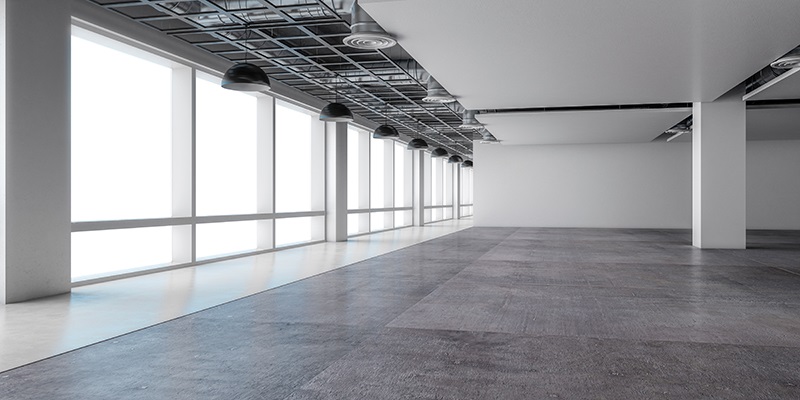
High office vacancy rates wrought by the pandemic and the popularity of remote work have caused concern for many U.S. cities. Meanwhile, the cost of housing exceeds the reach of many Americans.
Office-to-residential conversions are seen as one possible solution to address both of these problems. Yet whether they produce work for contractors may play out differently depending on location.
California and Los Angeles
At the close of 2025, 40% of office space in Los Angeles’ financial district was open and available, according to an April 3, 2026, article in the Los Angeles Times. Around that time, the city noted overall office vacancy rates of 23%, raising concerns over a potential $70 billion loss in property value and erosion of the city’s tax base.
To avoid that circumstance, California and the city of Los Angeles are adopting measures that could spur conversions of office and commercial buildings to residences and mixed-use properties.
California Assembly Bill 507 allows commercial buildings to be approved for conversions at the state level without local government discretionary approval and with California Environmental Quality Act exemptions, reduced fees, reduced parking requirements and strong workforce standards. At the same time, the legislation allows local governments to provide additional incentives.
“We see this as potentially good as an opportunity,” said Joe Sullivan, director of energy and workforce solutions at IBEW 11 and Los Angeles County Chapter NECA. “We’re pretty excited, and we’re looking to engage other Los Angeles County cities to make sure that their planning departments understand what’s in this bill and that projects adhere to these standards.”
Project size matters
For those electrical contractors that do not have a large share of the residential market and tend to focus more on the commercial and industrial segments, which require high-level skills, conversion projects might open up new opportunities.
Thanks to California AB507, conversion projects may offer work that is government-funded and incentivized at the municipal level.
“When these projects include enough units or height, they are subject to workforce standards like prevailing wage, apprenticeship usage and require a skilled and trained workforce,” Sullivan said.
Conversions can also be technically challenging and require experienced contractors and a trained workforce.
Sullivan pointed out another advantage: as long as projects are 50% residential, the state law allows up to 50% mixed-use.
According to Sullivan, electrical contractors in Los Angeles are eager to work on these conversion projects.
Beyond the state law, which goes into effect on July 1, 2026, the Los Angeles city council recently adopted updates to its citywide adaptive reuse ordinance (No 188,7973), which establishes zoning incentives and streamlined procedures for converting commercial buildings and other structures for creating five or more residential units.
The ordinance offers greater flexibility than previous local measures as to how interior spaces may be reconfigured to create light wells, courtyards or other open spaces. New construction portions of unified adaptive reuse projects that provide affordable housing are eligible for “unlimited density.”
Sullivan anticipates that because Los Angeles has many high-rises and a need for housing, conversion work will be plentiful. He said other California cities such as Long Beach, Glendale and Pasadena are likely to also promise work, “as long as there’s compliance with new state regulations,” referring to the part of the new state law requiring that “planning” or comparable departments ensure developers and contractors comply with regulations or face stiff fines.
To gain the most benefit, Sullivan said, electrical contractors should carry out two important actions:
- Meet with city planners to explore whether their cities will build on the state’s adaptive reuse law and implement funding incentives.
- Make sure municipalities understand their role in compliance regarding trade engagement and workforce requirements.
“I think we have the contractors and workforce to do this work,” he said. “We’re trying to make sure we have participation.”
Last January, to build momentum, LA NECA invited its members to a symposium on affordable housing.
“We’re aware that in Los Angeles, between the city and the county, there could be nearly a billion a year for affordable housing,” Sullivan said. “This is a significant opportunity, and adaptive reuse, which has a strong affordable housing component, aligns well with it. We are ready to take advantage of it.”

New York City
Office occupancy rates recovered more quickly in New York City than elsewhere in the United States, yet some less prime properties have remained vacant. At the same time, the city is also grappling with urgent demand for affordable housing.
But unlike places where the conversion movement has been slow to take off, the Big Apple is considered a hotbed of activity with several large projects already underway.
Like California, New York state legislation is now more supportive of urban office conversion efforts.
Starting in 1961, state law capped residential density in New York City at a floor-to-area ratio (FAR) of 12. This meant that a residential building’s total square footage of floor space could not equal more than 12 times the square footage of the lot on which it stood.
The FAR 12 limit prohibited taller office buildings from being used for residential habitation, but Gov. Kathy Hochul removed the cap for 2025 and beyond, thereby enabling high-density office buildings to be converted into housing.
The state also established the 467-m tax incentive for conversions being reconfigured for 25% affordable housing. The incentive has taken conversions beyond permissible to financially viable for property developers and owners, according to business journals and local print media.
Given the complexity and mixed-use aspect of office conversion projects, this effort holds promise of work for electrical contractors in New York.
Conversion trends elsewhere
In other cities, the promise of opportunity seems harder to gauge.
Though Baltimore is seeing bustling conversion activity, William Yull, executive director of the Maryland Chapter NECA in Hanover, Md., said, “I can’t say that our contractors have procured any of the work. We typically do very little, if any, residential work.”
Chicago is starting to see projects. The city council recently approved up to $57 million in tax increment financing to an office-to-residential conversion in the city’s central Loop.
Washington, D.C.’s “Office to Anything” program incentivizes the transformation of vacant office buildings into other uses, including residential. The first project was completed in 2024.
Hartford, Conn., and Albuquerque, N.M., are seeing offices converted to luxury residential properties with fewer units. However, it’s hard to tell how extensive conversion efforts are in these municipalities or the extent to which they will require ECs.
The Oregon-Columbia Chapter NECA in Portland, Ore., hosts a monthly Code Committee Meeting with invitations to local authorities, inspectors and utilities to collaborate on and work toward solutions related to local codes, permitting and the related processes causing project delays.
And yet, permitting—said to be a barrier to office conversions in some cities—is not the leading stumbling block as investors weigh their options on where to fund conversion projects, according to Aaron Watzig, president of West Side Electric Co., Portland, Ore.
Watzig, whose company handles a considerable amount of residential work, said he is concerned about the ongoing sustainability of conversion projects, in light of the city continuing to shed businesses and jobs.
Some areas of Portland with newer buildings note healthier office vacancy rates of around 10%, but areas with older buildings and higher vacancy rates pose concerns. Unfortunately, many older buildings have larger footprints, few windows and limited sewer infrastructure, making them poor candidates for conversion.
Even so, the city’s design and building code requirements, said by many sources to be daunting, have eased up seismic restructuring requirements for older properties, which could be seen as a sign that Portland is attempting to stimulate redevelopment.
Online Extra: A Look at How Labor Relations Affect Office-to-Residential Conversion Work
California Assembly Bill 507 opens office conversion work to union contractors, IBEW members and other building trades, according to Joe Sullivan, director of energy and workforce solutions at IBEW 11 and Los Angeles County Chater NECA. There are several factors in this legislation that affect how labor relations play into office conversion projects in the Los Angeles area.
- If a residential conversion in Los Angeles exceeds four stories and 40 units, electrical contractors must use skilled and trained workers, registered apprentices and document their participation.
- As long as projects in Los Angeles are 50% residential, the state law allows up to 50% mixed use, also suiting them for union contractors.
- As projects increase in size, prevailing wage shifts from the residential rate to the inside wireman’s rate.
- General contractors and developers must provide notification of related conversion work to union subcontractors and IBEW locals and other union construction trade members.
- Contractors must pay prevailing wages and make monthly progress reports.
“We think this workforce language is really good,” Sullivan said. “What could make all the difference for Los Angeles NECA members is the effort put into establishing the labor requirements.”
Los Angeles NECA is eager to work on these conversion projects with IBEW 11, Sullivan said. The local has made a practice of reaching out to state legislators and Los Angeles municipal representatives to ensure that workforce standards are attached to government-funded and subsidized projects.
Representing 12,000 members, IBEW 11 frequently lobbies in tandem with the California State Association of Electrical Workers. To promote trade engagement in conversion work, the local also worked with the Southern California Association of Non-Profit Housing, also known as SCANPH, Sullivan said.
“Over the years, our local has insisted on skilled and trained language so there’s more work for our members, and we realize NECA members made a commitment to use our manpower, so we want them to be able to go after this work,” said Robert Corona, IBEW 11 business manager.
“We’re carrying out efforts started by others here in the 1990s,” Corona said. “As far as approaching participating cities about conversion work, it’s really about educating them and insisting the language (of their local ordinances and RFPs) be strong enough that our (union) contractors can bid on the work.”
New construction portions of unified adaptive reuse projects that provide affordable housing are eligible for “unlimited density,” which may open more projects to union trade labor under state law due to higher numbers of units.
stock.adobe.com/YKvisual | stock.adobe.com/enera | stock.adobe.com/ahmad
About The Author
.jpg?sfvrsn=a64b988b_1)
DeGrane is a Chicago-based freelance writer. She has covered electrical contracting, renewable energy, senior living and other industries with articles published in the Chicago Tribune, New York Times and trade publications. Reach her at [email protected].